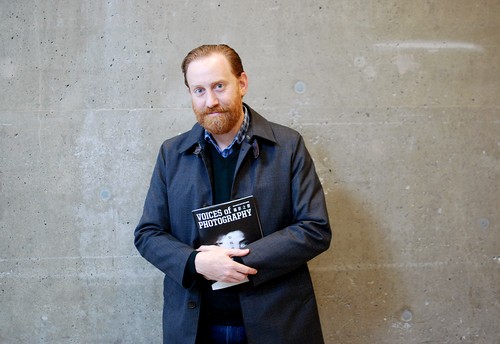
Simon Baker
Personal Information
Description
Actor
Books
Bruno V. Roels
Bringing many years of work together in a single place, here on the page, rather than on the walls of a museum or gallery, we can consider both senses in which Roels thinks images are worth repeating. In the obstinate and dedicated labour of printing and arranging serial, but different, versions of single images together; and then also with regard to the overall effect of bringing these iterations of themselves into the same space. But there is another sense in which we might find Roels?s work echoing not only itself, but that of those that came before him; and that, funnily enough, is in his refusal to take himself, or his work, too seriously. Just seriously enough, it seems, to invest time, effort, and skill into the production of his complex and subtly nuanced work, but never to the point, that, like Ruscha before him, (the artist who made Various Small Fires and Milk), he finds himself unable to resist, and more importantly, to play with, the constraints of his own logic. A little like Dalí too, perhaps, who, captivated as he was by the potential of photography to document and catalogue the world, was also sure that this very capacity would result in us never being able to see anything in the same way, ever again. From ?the subtlety of aquaria? as Dalí himself put it ?to the fastest most fleeting gestures of wild animals, the photograph affords us a thousand fragmentary images culminating in a dramatized cognitive totalization.? That too, is something worth repeating.
Shape of light
The accompanying catalogue to the first major exhibition to consider the relationship between the photographic medium and the history of abstraction in the twentieth century, on display at London's Tate Modern.The exhibition catalogue will be arranged in a broadly chronological way to tell the story of photography and its relationship with abstraction from around 1915 to the present day, and will include historic works in a variety of media from painting and sculpture to montage and kinetic installations. Beginning with the works of cubism and vorticism, the catalogue then highlights the key contributions of Bauhaus, constructivist and surrealist artists of the 1920's and 1930's. It then moves into the 'subjective photography' of the 1940's and 1950's, exploring the global scope of this movement through works by artists from Latin America and Asia, before considering the impacts of photography of abstract expressionism, op art and minimalism in Europe and the US. Bringing together iconic as well as rarely seen works, Photography and Abstract Art explores the development of photography in relation to abstract art, tracing the key moments of innovation in new techniques and practice.
Performing for the camera
Performing for the camera examines how the photograph has both documented and developed our understanding of performance since the invention of the photographic medium. It engages with both the serious business of art and performance and the humour and improvisation of posing for the camera. Featuring many of the most compelling and experimental photographers in history, it explores the works by artists such as Yves Klein, Yayoi Kusama, Nadar, Merce Cunningham, Charles Ray, Boris Mikhailov, Samuel Fosso, Cindy Sherman, Keith Arnatt and Masahisa Fukase. Edited by curator Simon Baker, this book provides fresh insight into the inter-relationship between performance and photography. With over 300 illustrations, this is the definitive publication on two of the most popular and intriguing art forms of our time.
Maya Rochat
SPBH Editions is pleased to present A Rock is a River, a new book by Swiss artist Maya Rochat. Binding the alchemy of photography with the physicality of painting, Rochat creates organic patterns, chromatic alterations and visual ruptures that generate a slow, ongoing process of images mutating, reflecting a world in permanent flux. In the long tradition of artists' books as artworks in their own right, Rochat understands the space of a publication as site-specific, and has conceived a series of works for the form of the publication, taking into account the possibilities of layout and printing experimentation. Drawing from the past two years of her photographic production, she revisits and interweaves images in various scales and rhythms to create an ongoing, unfolding collage in book form.
The radical eye
Elton John's truly remarkable collection of international modernist photography stems from personal passion: since 1991, he has amassed more than two thousand photographs, which include key figures from Europe and America alongside many of the foremost photographers from Japan, Eastern Europe and Latin America. This book draws together the finest works from 1920 to 1950, a period that is widely considered to be photography's 'coming of age', a time of great experimentation and innovation when artists pushed the boundaries of the medium. New Vision refers to the term coined by Laszlo Moholy-Nagy in the mid 1920s to describe the way photography could be used to see the world through a modern lens. As new technology developed, it allowed the freedom both to experiment and to record, leading to new developments such as photograms, typographics and the bird's- and worm's eye views. This period also encompassed key avant-garde movements of the 20th century in which photography played a central role--dada, surrealism, the Bauhaus and Russian constructivism. With over 150 illustrations, an interview with Elton John exploring the motivations behind his collecting, and essays looking at the photographs within the history of modernism and an exploration of the impact of technical innovations on the form, New Vision will introduce a new audience to this unique body of work and provide an indispensable resource to those who are already fans of the period.
Conflict, time, photography
From the seconds after a bomb is detonated to a former scene of battle years after a war has ended, this moving exhibition focuses on the passing of time, tracing a diverse and poignant journey through over 150 years of conflict around the world, since the invention of photography. In an innovative move, the works are ordered according to how long after the event they were created from moments, days and weeks to decades later. Photographs taken seven months after the fire bombing of Dresden are shown alongside those taken seven months after the end of the First Gulf War. Images made in Vietnam 25 years after the fall of Saigon are shown alongside those made in Nakasaki 25 years after the atomic bomb. The result is the chance to make never-before-made connections while viewing the legacy of war as artists and photographers have captured it in retrospect. The immediate trauma of war can be seen in the eyes of Don McCullin's Shell-shocked US Marine 1968, while the destruction of buildings and landscapes are documented by Simon Norfolk's Afghanistan: Chronotopia 2001. Different conflicts will also reappear from multiple points in time throughout the exhibition. The Second World War for example is addressed in Jerzy Lewczynski's 1960 photographs of the Wolf's Lair / Adolf Hitler's War Headquarters, Shomei Tomatsu's images of objects found in Nagasaki, Kikuji Kawada's epic project The Map made in Hiroshima in the 1960s, Michael Schmidt's Berlin streetscapes from 1980 and Nick Waplington's 1993 close-ups of cell walls from a Prisoner of War camp in Wales. The exhibition is staged to coincide with the 2014 centenary and concludes with new and recent projects by British, German, Polish and Syrian photographers which reflect on the First World War a century after it began.--Tate website.
Exposed
Agent Maggie O'Dell believes she's responding to a threat, but instead walks into a trap. The killer's weapon is a deadly virus, virtually invisible and totally unexpected. Maggie knows dangerous minds - from hauntingly perverse child predators to cunningly twisted serial killers. Now she faces a new opponent from inside an isolation ward. Maggie must find clues to catch the killer - while waiting to see if the lethal strain is already multiplying in her body. With every new exposure there's the potential for an epidemic. And Maggie knows she may not live long enough to stop the nightmare scenario becoming a devastating reality.
Another London
In the years between 1930 and 1980, some of the best-known photographers from around the world came to London and made its streets, buildings and communities their subject. For some, the British capital was to become home; for others it remained a foreign city, as enigmatic perhaps as any they had visited. Each brought their own distinctive perspective, subverting or perpetuating national stereotypes, seeking out the typical or the exotic, attempting to penetrate the fabled British reserve with their lens. Together their work creates a portrait of a great world city, changing and mutating, a restless and fascinating muse. This book demonstrates the breadth and variety of the responses London provoked from visiting photographers during the period, from portraits to reportage, from social realism to whimsy and humour, the changes in their technique and attitude demonstrating developments in photography itself. 0Exhibition: Tate Britain, London, UK (31.7.-16.9.2012).