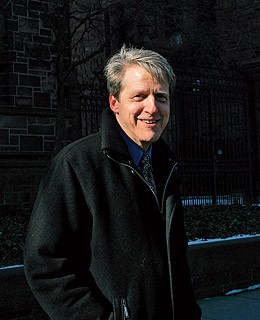
Robert J. Shiller
Personal Information
Description
There is no description yet, we will add it soon.
Books
The life-cycle personal accounts proposal for social security
"The life-cycle accounts proposal for Social Security reform has been justified by its proponents using a number of different arguments, but these arguments generally involve the assumption of a high likelihood of good returns on the accounts. A simulation is undertaken to estimate the probability distribution of returns in the accounts based on long-term historical experience. U.S. stock market, bond market and money market data 1871-2004 are used for the analysis. Assuming that future returns behave like historical data, it is found that a baseline personal account portfolio after offset will be negative 32% of the time on the retirement date. The median internal rate of return in this case is 3.4 percent, just above the amount necessary for holders of the accounts to break even. However, the U.S. stock market has been unusually successful historically by world standards. It would be better if we adjust the historical data to reduce the assumed average stock market return for the simulation. When this is done so that the return matches the median stock market return of 15 countries 1900-2000 as reported by Dimson et al. , the baseline personal account is found to be negative 71% of the time on the date of retirement and the median internal rate of return is 2.6 percent"--National Bureau of Economic Research web site.
The invention of inflation-indexed bonds in early America
"The world's first known inflation-indexed bonds were issued by the Commonwealth of Massachusetts in 1780 during the Revolutionary War. These bonds were invented to deal with severe wartime inflation and with angry discontent among soldiers in the U.S. Army with the decline in purchasing power of their pay. Although the bonds were successful, the concept of indexed bonds was abandoned after the immediate extreme inflationary environment passed, and largely forgotten until the twentieth century. In 1780, the bonds were viewed as at best only an irregular expedient, since there was no formulated economic theory to justify indexation"--National Bureau of Economic Research web site.
Macro markets
In this original book, Professor Shiller has created a unique and authoritative set of proposals for establishing new markets for the management of the biggest economic risks facing society. Our existing financial markets, he argues, are inadequate to deal with such risks and major new markets should be set up. He proposes a class of new international markets, macro markets, markets for claims on aggregate income and service flows. Our stock markets are markets for claims on corporate dividends, and yet the latter are only a few per cent of national incomes: only 3 per cent in the United States. He argues that markets should be set up for claims on the other 97 per cent. He proposes new international markets for perpetual claims on national incomes, and on components and aggregates of national incomes. Other proposals are for new international markets for property and other currently difficult-to-trade assets. Such new markets could dwarf our stock markets in their activity and significance. Establishing such unprecedented new markets presents some important technical problems, which Shiller attempts to solve. He has proposals for implementing index futures markets in perpetual claims on incomes and services. There is also a substantial section on the construction of index numbers for use in settlement in the macro markets. Such new markets could fundamentally alter and diminish macroeconomic fluctuations, and reduce the inequality of incomes around the world.
Phishing for phools
Akerlof and Shiller argue that markets harm as well as help us. As long as there is profit to be made, sellers will systematically exploit our psychological weaknesses and our ignorance through manipulation and deception. Based on the intuitive idea that markets both give and take away, they show how phishing affects everyone, in almost every walk of life. We spend our money up to the limit, and then worry about how to pay the next month's bills. The financial system soars, then crashes. In doing so they explain a paradox: why, at a time when we are better off than ever before in history, all too many of us are leading lives of quiet desperation.
Animal spirits
An argument for recovering Keynes' notion of animal spirits as a contributor to economic phenomena, with examples drawn from the economic crises of the late 20th and early 21st centuries.