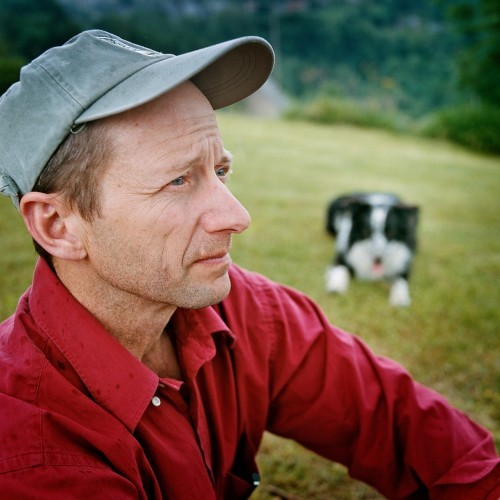
Rick Bass
Personal Information
Description
Rick Bass is an American writer and an environmental activist. - Wikipedia
Books
Why I came West
A poignant look at the thirty-year journey of one of our country's great naturalist writers, Why I Came West explores how Rick Bass fell in love with the mystique of the West (and the Yaak Valley of northwestern Montana in particular) as a dramatic landscape, as an idea, and as a way of life. In a series of moving chapters, Bass describes his own transformation into the writer, hunter, and environmental activist that he is today. He profiles how the rugged, wild landscape smoothed out his own rough edges; attempts to define the appeal of the West that so transfixed him as a boy, a place of mountains and outlaws and continual rebirth, just beyond whatever was near it; and he describes his role as a reluctant environmental activist--sometimes at odds with his own neighbors--unable and unwilling to stand idly by and watch this treasured place disappear.--From publisher description.
The Diezmo
A novel based on the Mier Expedition follows two young men on an expedition to the Mexican border, during which they are captured in a raid on the Mexican village of Mier and end up as pawns in an international chess game that will determine the fate of Texas.
The Hermit's Story
"In the title story, a man and a woman travel across an eerily frozen lake - under the ice. "The Distance" casts a skeptical eye on Thomas Jefferson through the lens of a Montana man's visit to Monticello. "Eating" begins with an owl being sucked into a canoe and ends with a man eating a town out of house and home, and "The Cave" is a story of a man and woman lost in an abandoned mine."--BOOK JACKET.
The New Wolves
The New Wolves is Rick Bass's passionate and eloquent account of the current reintroduction of the Mexican wolf to the American Southwest. Lobos, or Mexican wolves, once roamed freely throughout Arizona, New Mexico, and Texas, until they were hunted to extinction when big cattle interests came to the Southwest, changing the land forever. Now, a Mexican wolf reintroduction--similar to the Yellowstone efforts for its cousin the gray wolf--is fully under way in the Blue Mountains of Arizona. Eleven wolves--all captive-bred, descendants from the last wild Mexican wolves captured over twenty years ago--were released among the mesas. Now they roam in separate packs; they hunt, play, mate, and, it is hoped, will give birth to the first wild-born pups in decades. But it will not be, and has not been, easy; nothing so tenuous and delicate as the existence of a wild wolf in today's world could ever be. With the literary talent and naturalist's sensibility he brought to his highly praised account of a family of wolves in Montana, The Ninemile Wolves, Rick Bass examines the circumstances of the Mexican wolves' arrival: the exhausted, the overgrazed soil of the land, the behavior and requirements of wolves, and the concerns of ranchers, biologists, and environmentalists. He chronicles these new wolves' first few months of freedom: their triumphant desire to survive as well as the unfortunate and sometimes deadly confrontations with the unexpected. The New Wolves brings to life a place--its people and its wildlife, its past and its future. Bass articulates the land's need for wolves to maintain balance, while masterfully depicting the modern conflict between nature and our need to control it. Part mediation, part probing journalism, The New Wolves is an important new chapter in the drama of wolves and the American West -- Book jacket.
Fiber
Fiber is a story about the ravages of activism and the healing properties of art. It is a story about last chances, about crafting solutions from the wreckage of a devastated place, and about the high cost, emotionally and physically, of hope in the presence of despair. Writing from the Yaak Valley of northwestern Montana, the wildest valley in the Lower 48, Rick Bass portrays the plight of the artist deeply embedded in a place he loves. The author asks how a writer survives amidst the destruction of the natural world around him, if, like Bass, the writer must struggle passionately to protect a place like the Yaak from devastation. As a work of fiction, Fiber elegantly follows the life of the narrator as he evolves from the geologist who takes, to the artist who gives, to the activist who fights, and finally to the troubling and magical "log fairy."
Where the sea used to be
The first full-length novel by one of our finest fiction writers, Where the Sea Used to Be tells the story of a struggle between a father and his daughter for the souls of two men - his proteges, her lovers. Old Dudley is a Texan whose religion is oil, and in his fifty years of searching for it he has destroyed a dozen good geologists, "crushing them to dust by manipulating their own desires against them." His most recent victim is Matthew, his daughter Mel's sometime lover. Matthew grew up in Swan Valley in Montana, where Mel has been living and studying wolves for twenty years. The valley is Old Dudley's albatross. He and Matthew have drilled nineteen dry holes there, and sensing that Matthew is burning out, Dudley sends in Wallis, a new geologist. Seduced by the valley and by Mel, Wallis discovers the dark mystery of Dudley's life, yet he cannot escape the old man's grip.
The book of Yaak
The Yaak Valley of northwestern Montana is one of the last great wild places in the United States, a land of black bears and grizzlies, wolves and coyotes, bald and golden eagles, wolverine, lynx, marten, fisher, elk, and even a handful of humans. It is a land of magic, though its magic may not be enough to save it from the forces that now threaten it. The Yaak does have one trick up its sleeve, however: a writer to give it voice. In Winter, Bass portrayed the wonder of living in the valley. In The Book of Yaak he captures the soul of the valley itself, and he explains how, if places like the Yaak are lost, so too will be the human riches of mystery and imagination. Rick Bass has never been a writer to hold back, and The Book of Yaak is his most passionate book yet, a dramatic narrative of a man fighting to defend the place he loves.
In the Loyal Mountains
These tales simultaneously embrace vibrant images of ordinary human life and exuberant descriptions of the natural world. In the title story, a man remembers his youth in the Texas hill country when he joined in his uncle's raucous escapades, which have taken on new shape and meaning in light of what has happened since. While Bass's work is grounded in an uncompromising vision of truth, he magnifies elements until they acquire fantastic proportions. In these stories enormous pigs charge through the streets and root under houses; a narrator meets a woman who runs up and down mountains; a group of children don wolf masks to chase a boy through the woods. Each story is a mythical narrative celebrating the complex and moving relationship between humans and their environment.
Platte river
Rick Bass is one of the foremost writers of his generation. His astonishing work charges headlong past the hard surface of modern life to illuminate man and his relationship to the natural world. Platte River is a collection of three novellas, each a singular exploration of the human heart set against the backdrop of God's creation. Filled with arresting images - chinook winds flying through a valley, couples skating in the dark on thin ice, tools made from animal bones, a delicate shape frozen in a river - "Mahatma Joe" is about an evangelist who settles in Grass Valley, Montana, and the woman who grows obsessed with his vision of the world. In "Field Events," a woman falls in love with a man even more enormous than her discus-tossing brothers. And the title novella, "Platte River," portrays one man's lyric meditation on loneliness, the nature of peace, and his quest for love.
