
UNITED STATES AUTHOR · NATURE · HISTORY
Richard Ellis
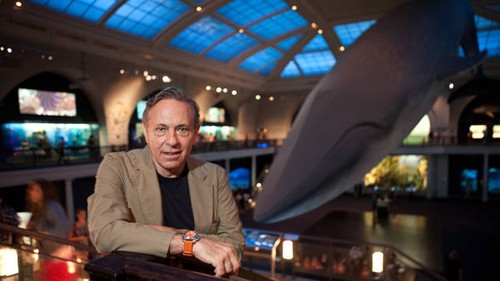
Richard Ellis is an American marine biologist, author, and illustrator. He is a research associate in the American Museum of Natural History's division of paleontology, special adviser to the American Cetacean Society, and a member of the Explorers Club. He was U.S. delegate to International Whaling Commission from 1980 to 1990. His paintings have been exhibited in galleries and museums around the world, and his murals can be seen in the Denver Museum of Natural History, the New Bedford Whaling Museum in Massachusetts, and Whaleworld, a museum in Albany, Western Australia. He is the author of more than 100 magazine articles, which have appeared in leading magazines such as National Geographic, Audubon, and Reader's Digest. He has written over 20 books on animals and marine life. - Wikipedia
Once upon a time, gray whales fed in the cold waters off Iceland and Greenland and migrated south-perhaps to the Bay of Biscay or even to the English Channel-to breed.
— from The empty ocean, 2003
Most acclaimed

Deep Atlantic
1996
Prior to John Ross's successful retrieval in 1818 of six pounds of worm-filled mud from the bottom of Baffin Bay, it was widely believed that no life could possibly flourish in the dark, cold, pressurized waters of the deep Atlantic Ocean. Subsequent expeditions - conducted on ships with trawls, in submersibles such as William Beebe's bathysphere and Jacques Cousteau's Deepstar, and by remote-controlled and robotic diving devices - have unveiled a mind-boggling menagerie, a riot of deep-sea fauna with which we are still only marginally acquainted. Even today, only a handful of people have seen the pillow lava, smoking chimneys, and shimmering water of the hydrothermal vent fields, which are colonized by blind white crabs, clams as big as footballs, and gigantic tube worms with vivid red gills. Only a lucky few explorers of the abyss have encountered Vampyroteuthis infernalis, the "vampire squid from hell," with its complex clusters of photophores that it can turn on and off at will. A mere smattering of marine biologists have witnessed the herds of pulsating sea cucumbers that feed contentedly in the sand and mud of the Atlantic floor. And the same is true for the amazing pelican eel, whose body consists almost entirely of toothless mouth, and for the four-inch-long male anglerfish that permanently attaches himself to the nearly four-foot-long female. . In the strikingly illustrated Deep Atlantic, Richard Ellis brings us face-to-face with these unexpected efflorescences of evolution - fish, mammals, and members of other phyla that have been able to assume incredible shapes and great size thanks to the gravity-canceling buoyancy of water. The animals discussed and pictured herein are adapted for life in the predominant environment on our planet, since 70 percent of its surface is underwater and 90 percent of that water is more than a mile deep. Yet it is an environment as foreign to us as another universe. As we have come to expect from his previous books, Richard Ellis is here again our engrossing guide to the last frontier on earth.
The search for the giant squid
1998
"An authoritative look at the biology and mythology of the world's most elusive sea creature".--Jacket.
The empty ocean
2003
In The Empty Ocean, acclaimed author and artist Richard Ellis tells the story of our continued plunder of life in the sea and weighs the chances for its recovery. Through fascinating portraits of a wide array of creatures, he introduces us to the many forms of sea life that humans have fished, hunted, and collected over the centuries, from charismatic whales and dolphins to the lowly menhaden, from sea turtles to cod, tuna, and coral. Rich in history, anecdote, and surprising fact, Richard Ellis's descriptions bring to life the natural history of the various species, the threats they face, and the losses they have suffered. Killing has occurred on a truly stunning scale, with extinction all too often the result, leaving a once-teeming ocean greatly depleted. But the author also finds instances of hope and resilience, of species that have begun to make remarkable comebacks when given the opportunity. Written with passion and grace, and illustrated with Richard Ellis's own drawings, The Empty Ocean brings to a wide audience a compelling view of the damage we have caused to life in the sea and what we can do about it."--Publisher description.