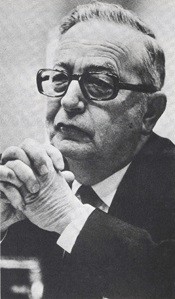
Richard B. Morris
Personal Information
Description
Richard Brandon Morris (July 24, 1904 – March 3, 1989) was an American historian best known for his pioneering work in colonial American legal history and the early history of American labor. In later years, he shifted his research interests to the constitutional, diplomatic, and political history of the American Revolution and the making of the United States Constitution. Source; [Richard B. Morris]( on Wikipedia.
Books
The forging of the Union, 1781-1789
Covering the crucial years from the winning of independence to the creation of the federal government, The Forging of the Union may be considered a sequel to Richard B. Morris's Bancroft Award-winning book, The Peacemakers. Reexamining an enormous fund of original sources and the latest monographs, Morris treats the Confederation interlude as an extraordinary, if brief, period of trial and experimentation. Grave doubts were entertained on a wide variety of issues: the survival of an American union, perpetuation of republican values, the power of a strengthened central government to deal with the great European states, prosperity, sectional tensions, and secessionist murmurings. Would a durable union in fact perpetuate a government by the elite to the detriment of the common people? - Back cover.
The founding of the Republic
Surveys the decisive years, 1789-1801, of the American Republic when the leadership of the Federalists formed a solid base for the government and the future of a nation.
Seven Who Shaped Our Destiny
Character sketches of Franklin, Washington, Adams, Jefferson, Jay, Madison, and Hamilton emphasize their reasons for turning against Britain and their prominence in the American Revolution.
Jacksonian democracy, 1829-1848
Uses excerpts from letters, diaries, novels, poetry, press reports, documents, and other contemporary sources to portray a period of much change and growth in the United States, the administrations of Jackson, Van Buren, Harrison, Tyler, and Polk.
The First World War, 1914-1920
Uses excerpts from letters, diaries, novels, poetry, press reports, documents, and other contemporary sources to portray the events in Europe and the United States before, during, and after World War I.
The westward movement, 1832-1889
Relates the history of the western expansion beyond the Mississippi through eyewitness accounts drawn from such contemporary sources as letters, diaries, reminiscences, novels, poetry, press reports and selections from key public documents.
The shaping of an industrial nation, 1865-1914
Uses excerpts from letters, diaries, novels, poetry, press reports, documents, and other contemporary sources to portray those years of explosive growth following the Civil War during which the United States became the world's most important industrial nation.
Origins of the cold war, 1946-1961
Traces the events of the fifteen year period following World War II through accounts drawn from letters, diaries, reminiscences, novels, poetry, press reports, selections from key public documents, and other contemporary sources.
The United States as a New World power, 1867-1914
Traces the history of the United States from the end of the Civil War to the beginning of World War I through eye-witness accounts, letters, diaries, reminiscences, novels, poetry, press reports, selections from key public documents, and other contemporary sources.
Beginnings of Colonial America, 1607-1770
Relates the history of the colonial period through eyewitness accounts drawn from such contemporary sources as letters, diaries, reminiscences, novels, poetry, press reports, and selections from key public documents.
The times that tried men's souls, 1770-1783
Relates the history of the Revolution through eyewitness accounts drawn from such contemporary sources as letters, diaries, reminiscences, novels, poetry, press reports, and selections from key public documents.
Boom and bust, 1920-1939
Uses excerpts from letters, diaries, novels, poetry, press reports, documents, and other contemporary sources to portray the history of and way of life in the United States between the two world wars.
The Peacemakers
Easygoing Travis and his sister, Paige, an impassioned artist, are swept away by causes of the day—he, unwillingly, to Vietnam; she, ov her own choosing, to demonstrations on college campuses. Both grow cynical as they are exposed to the horrors and hatred of ambitious leaders with deadly agendas. Crushed and to the point of ultimate despair, Paige finds a cause worth living for when she encounters the Jesus Movement and begins a personal journey with God. When Travis returns from the war, broken and disillusioned, Paige embarks on one last crusade, to bring him to the Christ who healed her.
The first book of the founding of the Republic
Surveys the decisive years, 1789-1801, of the American Republic when the leadership of the Federalists formed a solid base for the Government and the future of a nation.