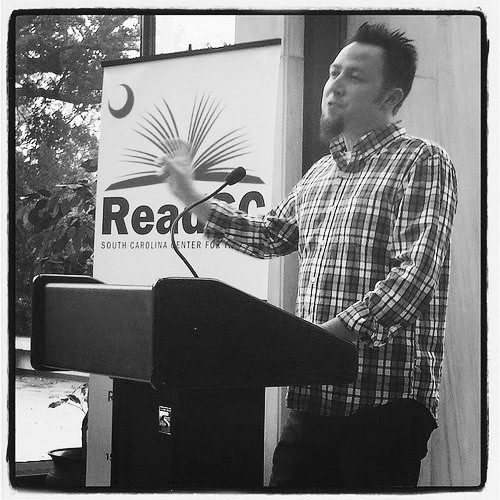
Ray McManus
Personal Information
Description
There is no description yet, we will add it soon.
Books
Found anew
"Found Anew is an anthology of new poetry and prose from writers with strong ties to the Palmetto State that creatively engages with historical photographs found in the digital collections of the University of South Carolina's South Caroliniana Library. In their eclectic approach to ekphrasis--textual response to the visual--editors R. Mac Jones and Ray McManus have recruited an impressive group of poets and fiction writers, including National Book Award-winning poets Terrance Hayes and Nikky Finney (who provides the foreword); their fellow South Carolina Academy of Authors honorees Gilbert Allen, John Lane, Bret Lott, George Singleton, and Marjory Wentworth; Lillian Smith Award-winner Pam Durban, and others. These thirty-one pairings of archival images with original creative responses illustrate the breadth and richness of the diverse talents of South Carolina writers. While the digital collections are a much-valued resource for researchers and educators, Found Anew encourages a wider use as a source of inspiration for writers and artists inventing narratives set in and about South Carolina. In coupling the poems and short stories with the images that inspired them, the anthology shows writers gauging unlikely depths in curious photographs that other eyes might pass over without a second glance, conjuring perfect words for the emotion evoked by a particular image, and rendering and reimagining the visual in seemingly disparate but ultimately linked narratives. An instructive model for active, collaborative engagement between creative writers and culturally significant visual prompts, this collection also serves to demonstrate the accessibility and scope of archival photography available through South Caroliniana's digital collections. Through these creative responses, the images are not recovered or explained--but, rather, found anew. Contributors: Gilbert Allen, Sam Amadon, Laurel Blossom, Darien Cavanaugh, Phebe Davidson, Pam Durban, Julia Eliot, Worthy Evans, Richard Garcia, Will Garland, Linda Lee Harper, Terrance Hayes, Thomas L. Johnson, R. Mac Jones, Julia Koets, John Lane, Brett Lott, Ed Madden, Jonathan Maricle, Terri McCord, Janna McMahan, Ray McManus, Susan Laughter Meyers, Mark Powell, Michele Reese, Mark Sibley-Jones, George Singleton, Charlene Spearen, Daniel Nathan Terry, Jillian Weise, Marjory Wentworth, William Wright"--
Driving Through the Country Before You Are Born (South Carolina Poetry Book Prize)
“Ray McManus’s incantatory rhythms, his catalogs of nouns (and sometimes verbs), carry us into the liminal territory between experience and music, which is to say, the territory of dream. . . . We trust these fine, strong poems, trust their emotional authenticity in response both to the real outer world and to the imaginative inner one.” —Susan Ludvigson, author of Sweet Confluence: New and Selected Poems and Escaping the House of Certainty “The poetry in Ray McManus’s first collection is touched by a light hand that points to and illuminates its sparkling surfaces and deep interior spaces. The work searches out, mourns, and celebrates place, family, love, and death—at all times asserting the continuity between what can be seen and what must be imagined, and recreated from the complex, divided, and parallel pasts of South Carolina and Ireland. . . . This book is full of fervor and grace and is driven by a fierce regard for language and an understated moral vision. A terrific debut.”—Eamonn Wall, author of Refuge at DeSoto Bend and From the Sin-é Cafe to the Black Hills Selected by Kate Daniels as the winner of the South Carolina Poetry Book Prize, Driving through the Country before You Are Born is the first collection of poetry from Ray McManus. The speaker in these poems searches for redemption and solace while navigating from a traumatic loss in the past to a present fraught with violence and self-destruction. The volume chronicles his attempt to glean some measure of forgiveness through acceptance of his own responsibly for his circumstances. The reader is called on to witness family stories without happy endings, landscapes on the verge of collapse, and prophetic visions of horrors yet to come. From these haunting visions, the only viable salvation is rooted in hope that, out of the ruins, there remains the possibility of a fresh beginning.
Punch
McManus's third book, Punch., is a call for the claw-hammer, a hymn to the steel toe, and a series of lonely missives from truck cabs and office cubicles. Punch. is a book about work, about the will that rises and the dust that falls. It is about being lost, hungry, and hopeless, creeping toward the pipelines in a 78 Buick Regal with Big Star on the radio. Sometimes angry, sometimes darkly funny, these lean and muscular poems explore the world of punching in and punching out, the punch-drunk and the sucker-punched. Whether the poems are tightened by the rhythm of a hard hand, or the lines sprawl across the page with swagger, there is real music here. Brute voices, contemplative and haunting, speak to us with unwavering self-conflict and salty confidence. In these poems, life is a struggle and the end is already written, but there's something deeply moving about the resilience and resistance of these voices: Lunch won't be here / for another hour, one says, so when the rain / comes, it is welcome. "Former Poet Laureate, Philip Levine once said we write what we are given. Just as Levine was given industrial Detroit and James Wright was given rural Ohio, Ray McManus was given an American South where 'Every day is the bottom of a bucket. Every day is slide guitar,' where 'blistered hands, hearts, and tongues, give way to callus, the need to alter, to repair.' What Ray McManus has given us in return is Punch.: a tough, tenderhearted, phenomenal work about work. These are poems of lucid witness. Let us give thanks." —Terrance Hayes, National Book Award winner for Lighthead "'Addition is easy,' McManus writes, and he means money in a day-worker's pocket, a lonesome man meeting his lover in an empty parking lot, the handful of bent nails a carpenter can't use, he means the grease and gears and rust and sweat and spit of a working-class life. This is a collection of poems written in the spirit of Levine's What Work Is, whose song is all hard knocks and hard-won knowledge. Its sections are named after blue-collar works shifts, which is fitting--as Punch does the important work of honoring first shifts, swing shifts, graveyard shifts, and hours and days off between them." —Dorianne Laux, author of The Book of Men
Red Dirt Jesus
Red Dirt Jesus is a triptych of harsh landscapes where a man reflects on what he has gained, what he is offering, and what he must lose. It begins with the relationship between father and son that delicately hinges on the tension between hills and ditches, between past and fiction, between throat and gut. Later the speaker is alone, trying on several narrative personas in order to chisel out an understanding of who he is as he moves away from the delicate and airborne. His story is one of dirt, dust, spit, and bone, and he finds solace in grit, knowing that things can only get worse if he lets them. In the end, McManus articulates the understated victory of giving in rather than giving up. As the speaker finds the distant acceptance of stone and rot, he realizes that the body breaks but the spirit doesn’t. “ Here is, in the poetry of Ray McManus, an unabashed sense of place, a fully realized belief in the poetic possibilities in the rural South Carolina landscape which, in his hands, eschews the cliché of country quaintness, for a twenty-first century toughness of existence—declining farms, disillusionment, and spiritual disquiet. Yet, curiously, McManus’ vision is tempered by his complete belief in the healing of poetry, the grace of language and the manner in which this art can achieve a sublime transformation of the human experience. These are, simply put, striking poems of formal accomplishment and affirming musicality. ” — Kwame Dawes, author of most recently Back of Mount Peace and Wheels “ A unique American voice enters poetry here, emerging from monkey grass and moon, from the ditch between father (or Father) and son (or Son). It is crisp, laconic, parodic, mysterious. It blesses the diesel and the mud-flap sinner. Maybe it is Tom Sawyer's dark sexy side. Speaking of the cycles of life and death, it says “Before the end,/ everything is fiction.” It says, “Buzzards gotta eat too,/ same as a worm.” And it also promises that “everything unwilling/ to change will die, everything/ that changes dies only a little.” — Alicia Ostriker, author of The Book of Seventy and No Heaven “ Ray McManus is a son of the red clay country and he gives us that country vividly with all its hard work, pain, loss, and sharp-edged humor. These are truth-telling poems that remind us to pay attention: “to the crow on the fencepost. the fly on the ceiling; to sit on a porch and talk to the dead in private...to lick the sky that falls on your lip...” Like the sons who learn to “hold their scythes steady,” Ray McManus observes the world with a steady eye. ” — Ellen Bass, author of Mules of Love and The Human Line