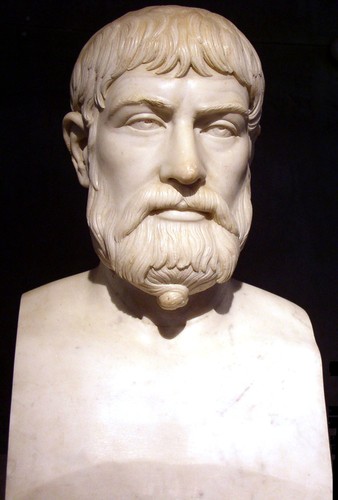
Discover

Pindar

Personal Information

Born March 7, 522
Died March 7, 443 (-79 years old)
Cynocephalus, Boeotian confederation
Also known as: Pindarus, Pindare
34 books
3.9 (16)
37 readers

Description

An Ancient Greek lyric poet from Thebes (Wikipedia).

Books

Newest First

The odes of Pindar

5.0 (1)
16

The odes of Pindar (518-438 B.C.), the most renowned of the ancient Greek poets, were choral songs extolling victories at the Games at Olympia, Delphi, Nemea, and Corinth, that covered the specturm of Greek mythological and moral belief.

Pindari Carmina

0.0 (0)
0

Book digitized by Google from the library of the University of Michigan and uploaded to the Internet Archive by user tpb.

Pindar's Victory songs

0.0 (0)
1

Pindar's victory odes, written in the fifth century B.C. to commemorate the heroes of the athletic games, are some of the most powerful and intricte works of ancient Greek poetry -- and perhaps the most difficult to translate well.

Victory Odes

5.0 (1)
5

The victory odes, or epinikia, are a series of poems composed by the ancient Greek poet Pindar to commemorate the triumphs of athletes who competed in various Panhellenic games like the Olympic, Pythian, Nemean, and Isthmian Games. The poems are known for their intricate complexity, which combines praise for the athletes, mythological references, moral reflections, and philosophical musings. The victory odes are considered to be the most complete works by Pindar that have survived from antiquity, as the rest of his works only exist in papyrus fragments. These odes provide valuable insights into the ancient Greek world, as they reveal how the Greeks celebrated their athletic heroes, and the cultural significance of athletic competition in ancient Greece.

Pindare

0.0 (0)
1

COMPLETE ODES; TRANS. BY ANTHONY VERITY

0.0 (0)
1

"The Greek poet Pindar (c. 518-428 b.c.) composed victory odes for winners in the ancient Games, including the Olympics. He celebrated the victories of athletes competing in foot races, horse races, boxing, wrestling, all-in fighting, and the pentathlon, and his Odes are fascinating not only for their poetic qualities, but for what they tell us about the Games. Pindar praises the victor by comparing him to mythical heroes and the gods, but also reminds the athlete of his human limitations. The Odes contain versions of some of the best known Greek myths, such as Jason and the Argonauts, and Perseus and Medusa, and are a valuable source for Greek religion and ethics. Pindar's startling use of language - striking metaphors, bold syntax, enigmatic expressions - makes reading his poetry a uniquely rewarding experience." "Anthony Verity's translations are complemented by an introduction and notes that provide insight into competition, myth, and meaning."--Jacket.
