Discover

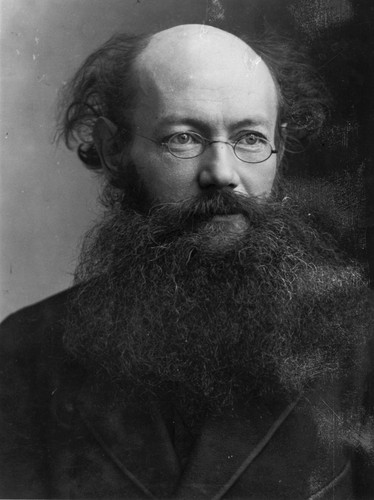
Peter Kropotkin

Personal Information

Born December 9, 1842
Died February 8, 1921 (78 years old)
Moscow, Russian Empire
Also known as: Kniaz Kropotkin Petr Alekseevich, Kniaz Petr Alekseevich Kropotkin
38 books
4.2 (24)
388 readers

Description

Russian anarchist, zoologist, evolutionary theorist, philosopher, scientist, revolutionary, economist, activist, geographer, writer

Books

Newest First

Mutual Aid

4.4 (8)
49

Around the world, people are faced with crisis after crisis, from the COVID-19 pandemic and climate change-induced fires, floods, and storms to the ongoing horrors of mass incarceration, brutal immigration enforcement, endemic gender violence, and severe wealth inequality. As governments fail to respond to—or actively engineer—each crisis, ordinary people are finding bold and innovative ways to share resources and support vulnerable members of their communities. This survival work, when done alongside social movement demands for transformative change, is called mutual aid. This book is about mutual aid: why it is so important, what it looks like, and how to do it. It provides a grassroots theory of mutual aid, describes how mutual aid has been a part of all larger, powerful social movements, and offers concrete tools for organizing, such as how to work in groups, decision-making process, how to prevent and address conflict, and how to deal with burnout. Mutual aid isn’t charity: it’s a form of organizing where people get to create new systems of care and generosity so we can survive.

La conquête du pain

4.1 (14)
153

The Conquest of Bread (French: La Conquête du Pain; Russian: Хлѣбъ и воля, tr. Khleb i volja, "Bread and Freedom"; Хлеб и воля in contemporary spelling), also known colloquially as The Bread Book, is an 1892 book by the Russian anarcho-communist Peter Kropotkin. Originally written in French, it first appeared as a series of articles in the anarchist journal Le Révolté. It was first published in Paris with a preface by Élisée Reclus, who also suggested the title. Between 1892 and 1894, it was serialized in part in the London journal Freedom, of which Kropotkin was a co-founder. In the work, Kropotkin points out what he considers to be the defects of the economic systems of feudalism and capitalism and why he believes they thrive on and maintain poverty and scarcity. He goes on to propose a more decentralized economic system based on mutual aid and voluntary cooperation, asserting that the tendencies for this kind of organization already exist, both in evolution and in human society. The Conquest of Bread has become a classic of political anarchist literature. It was heavily influential on both the Spanish Civil War and the Occupy movement. (Source: [Wikipedia](

Krānti

0.0 (0)
0

Selected articles: on youth, revolution, and socialism; includes an article about the author.

Fields, Factories, and Workshops

0.0 (0)
13

Fields, Factories, and Workshops is an 1899 book by anarchist Peter Kropotkin that discusses the decentralization of industries, possibilities of agriculture, and uses of small industries. Before this book on economics, Kropotkin had been known for his militant activity in behalf of international anarchism and writings on Siberian geography. Through the book, he sought to connect anarchism with science, based on sociological tendencies. The book was compiled from essays he had published in Nineteenth Century and Forum between 1888 and 1890. The book was first published in 1899 by Houghton-Mifflin (Boston) and Hutchinson (London) to favorable reviews among Britons. It has since been republished in multiple editions: Swan Sonnenschein (London) and Putnam (New York) in 1901, 1904, 1907, 1909, and Nelson (London) and Putnam (New York) in 1913 and 1919. Reproductions of the first and second editions appeared in 1968. A later edition, edited by Colin Ward for Harper & Row, released in 1974 with more contemporary illustrations as Fields, Factories and Workshops Tomorrow. (Source: [Wikipedia](

Memoirs of a Revolutionist

5.0 (1)
93

Published in Atlantic monthly Sep. 1898-Sep. 1899 under title The autobiography of a revolutionist. Graphic details of Russian conditions and of an eventful life. — A.L.A. Catalog 1904 “Kropotkin’s story is a singularly rich, diversified, and romantic one, and it is attractively told. Nothing more interesting in its way has ever been written than the chapters relating his prison life and escape. The book abounds in instructive pictures of Russian life and character, done with unconscious art.” – Standard Catalog for Public Libraries : Biography Section (1927)

Syndikalismus und Anarchismus

0.0 (0)
0

Kropotkin gibt hier einen Überblick über den Syndikalismus/die Direkte Aktion als Kampfmittel besonders der Arbeiter, geht auf die Arbeiterbewegung in Frankreich und England ein, auf die Internationale Arbeiterorganisation (Robert Owen), die Gewerkschaftsbewegung und besonders auf die Frage, welche Ausrichtung des Kampfes Erfolg verspricht; ist es nur das Ziel, wirtschaftliche und rechtliche Konzessionen zu erzwingen (z.B. mittels Generalstreik), um danach die Machtpositionen neu zu besetzen und den alten Trott mit neuem Namen weiterzumachen (Regierung könnte jetzt Gewerkschaft heißen) oder sollen die Prinzipien von Hierarchie, Zentralisation, Beamtentum, obrigkeitsdienenden Gesetzen,… sprich: der Staat grundlegend abgelehnt werden, um an seine Stelle die anarchistische Selbstorganisation von Arbeitern und eine freiheitliche Neuorganisation der Gesellschaft zu setzen? Zu welchem Zweck, mit welchem Ziel wähle ich die syndikalistische Kampfform, in welcher politischen Situation kann sie überhaupt sinnvoll sein; in jedem Fall ist sie nicht das Ende (sobald Konzessionen rechtlicher, finanzieller oder personaler Art erzwungen wurden), sondern der Beginn einer grundlegenden Neuorganisation. Nicht Übernahme der Strukturen durch den Kampf (Umsturz), sondern Erstorganisation durch den Kampf als Beginn einer politischen Neuorganisation (Revolution), das ist Kropotkins Weg.

Russian Literature, Ideals and Realities

0.0 (0)
5

Das zaristische Rußland des 19. und Anfang des 20. Jahrhunderts kannte kein öffentliches politisches Leben, und so brachten die bedeutenden Dichter und Denker des Landes ihre Ideale, ihre Vorstellungen des nationalen Lebens und ihre Kritik in der Literatur zum Ausdruck. Als politisch aktiver Mensch sowie als hervorragender Kenner der russischen Literatur gelang es Fürst Petr Kropotkin, diese spezifische Verquickung von literarischer Fiktion und sozialem und politischem Hintergrund aufzuzeigen. Kropotkins Literaturgeschichte umfaßt die Zeit von den Anfängen der russischen Literatur bis zu seinen Zeitgenossen wie Gontscharow, Turgenjew, Tolstoi und Dostojewskij, mit deren Werk er sich besonders ausführlich befaßt. Auch Vergleiche mit der westeuropäischen Literatur fehlen nicht. Eine Literaturgeschichte, die in außergewöhnlicher Weise den Einfluß der großen russischen Literatur auf das geistige Leben dieses Landes aufzeigt. (Quelle: [Diogenes Verlag](