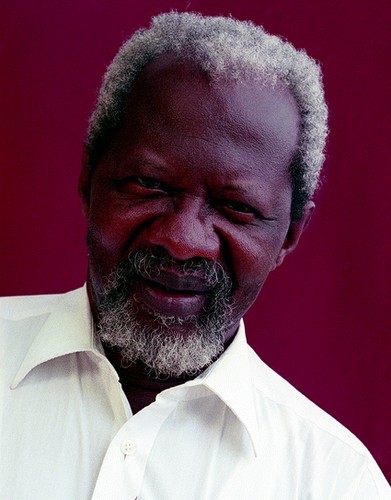
Paulin J. Hountondji
Personal Information
Description
There is no description yet, we will add it soon.
Books
The struggle for meaning
"The Struggle for Meaning is a landmark publication by one of African philosophy's leading figures, Paulin J. Hountondji, best known for his critique of ethnophilosophy in the late 1960s and early 1970s. In this volume, he responds with autobiographical and philosophical reflection to the dialogue and controversy he has provoked. He discusses the ideas routed in the work of such thinkers as Husserl and Hountondji's former teachers Derrida Althusser and Ricoeur, that helped shape his critique and applies them to such issues as the nexus between scientific extraversion and economic dependence, and between the emergence of philosophies of the subject in Africa and political pluralism.". "While the book's immediate concern is with Africa, the theoretical nature of its analyses and its bearing on postmodern theories of the "Other" will make this translation of great interest to many disciplines especially ethnic gender and multicultural studies."--BOOK JACKET.
Combats pour le sens
The Struggle for Meaning is a landmark publication by one of African philosophy's leading figures, Paulin J. Hountondji, best known for his critique of ethno-philosophy in the late 1960s and early 1970s. In this volume, he responds with autobiographical and philosophical reflection to the dialogue and controversy he has provoked. He discusses the ideas, rooted in the work of such thinkers as Husserl and Hountondji's former teachers Derrida, Althusser, and Ricoeur, that helped shape his critique. Applying his philosophical ideas to the critical issues of democracy, culture, and development in Africa today, he addresses three crucial topics: the nexus between scientific extraversion and economic dependence; the nature of endogenous traditions of thought and their relationship with modern science; and the implications' for political pluralism and democracyóof the emergence of 'philosophies of subject' in Africa. While the book's immediate concern is with Africa, the densely theoretical nature of its analyses, and its bearing on current postmodern theories of the 'other,' will make this timely and elegant translation of great interest to many disciplines, especially ethnic, gender, and multicultural studies.
Sur la philosophie africaine
In this seminal exploration of the nature and future of African philosophy, Paulin J. Hountondji attacks a myth popularized by ethnophilosophers such as Placide Tempels and Alexis Kagame that there is an indigenous, collective African philosophy separate and distinct from the Western philosophical tradition. Hountondji contends that ideological manifestations of this view that stress the uniqueness of the African experience are protonationalist reactions against colonialism conducted, paradoxically, in the terms of colonialist discourse. Hountondji argues that a genuine African philosophy must assimilate and transcend the theoretical heritage of Western philosophy and must reflect a rigorous process of independent scientific inquiry. This edition is updated with a new preface in which Hountondji responds to his critics and clarifies misunderstandings about the book's conceptual framework.
Economie et société au Bénin
Au XIXe siècle, le Dahomey avait donné la preuve d'une capacité d'ajustement positif à la mondialisation de l'époque. En détruisant l'autonomie du commerce dahoméen, la colonisation a brisé ce potentiel. Après la décennie perdue des années 1960, qui prolonge la stagnation coloniale, la scène était dressée pour un changement radical, tenté par le régime national et populiste de Kérékou. Le retournement de cette conjoncture a mis un terme à cette seconde tentative du Bénin de s'insérer dans une mondialisation contrôlée.