Discover

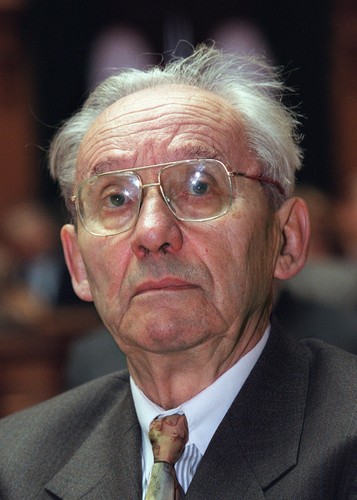
Paul Ricœur

Personal Information

Born February 27, 1913
Died January 1, 2005 (91 years old)
Valence, France
Also known as: Paul Ricoeur, Ricoeur Paul
62 books
3.0 (1)
113 readers

Description

A French philosopher best known for combining phenomenological description with hermeneutic interpretation.

Books

Newest First

Living up to death

0.0 (0)
1

"When French philosopher Paul Ricoeur died in 2005, he bequeathed to the world a highly regarded, widely influential body of work which established him as one of the greatest thinkers of our time. ... [book title] consists of one major essay and nine fragments. Composed in 1996, the essay is the kernal of an unrealized book on the subject of mortality. Likely inspired by his wife's approaching death, it examines not one's own passing but one's experience of others dying. ... [book title] is a moving testimony to Ricoeur's willingness to confront his own mortality with serious questions, a touching insouciance, and hope for the future."--Book jacket.

La Mémoire, l'Histoire, l'Oubli

0.0 (0)
8

"Why do major historical events such as the Holocaust occupy the forefront of the collective consciousness, while profound moments such as the Armenian genocide, the McCarthy era, and France's role in North Africa stand distantly behind? Is it possible that history "overly remembers" some events at the expense of others? A landmark work in philosophy, Paul Ricoeur's Memory, History, Forgetting examines this reciprocal relationship between remembering and forgetting, showing how it affects both the perception of historical experience and the production of historical narrative."--Jacket.

A Ricoeur reader

0.0 (0)
3

Paul Ricoeur is one of the most important modern literary theorists and a philosopher of world renown. This collection brings together his published articles, papers, reviews, and interviews that focus on literary theory and criticism. The first of four sections includes early pieces that explore the philosophical foundations for a post-structural hermeneutics. The second contains reviews and essays in which Ricoeur engages in debate over some of the central themes of literary theory, including figuration/configuration and narrativity. In the third section are later essays on post-structuralist hermeneutics, and in the fourth, interviews in which he discusses text, language, and myths. Mario Valdés provides an introduction to the literary theories of Paul Ricoeur and the works in this collection particularly. He also includes a complete bibliography of Ricoeur's works that have appeared in English.

Hermeneutics and the human sciences

0.0 (0)
3

"This is a collection in translation of essays by Paul Ricoeur which presents a comprehensive view of his philosophical hermeneutics, its relation to the views of his predecessors in the tradition and its consequences for the social sciences. The volume has three parts. The studies in the first part examine the history of hermeneutics, its central themes and the outstanding issues it has to confront. In Part II, Ricoeur's own current, constructive position is developed. A concept of the text is formulated as the implications of the theory are pursued into the domains of sociology, psychoanalysis and history. Many of the essays appear here in English for the first time; the editor's introduction brings out their background in Ricoeur's thought and the continuity of his concerns. The volume will be of great importance for those interested in hermeneutics and Ricoeur's contribution to it, and will demonstrate how much his approach offers to a number of disciplines."--Book cover.
