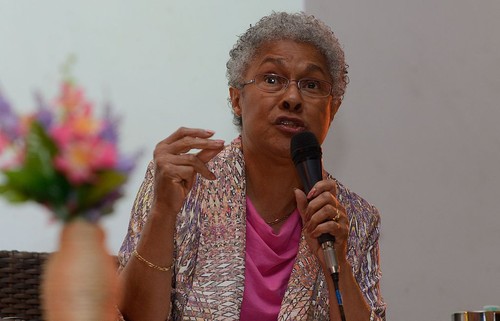
Patricia Hill Collins
Personal Information
Description
Patricia Hill Collins (born May 1, 1948) is a Distinguished University Professor of Sociology at the University of Maryland, College Park. She is also the former head of the Department of African-American Studies at the University of Cincinnati, and a past President of the American Sociological Association Council. Collins was the 100th president of the ASA and the first African-American woman to hold this position. Collins's work primarily concerns issues involving feminism and gender within the African-American community. She first came to national attention for her book Black Feminist Thought: Knowledge, Consciousness and the Politics of Empowerment, originally published in 1990. Source: Wikipedia
Books
Another kind of public education
Sociologist Patricia Hill Collins opens this brilliant new book on race and education by describing how in her senior year at the Philadelphia High School for girls, near the end of a public school education that “had almost silenced me,” she was invited to deliver a graduation address on the meaning of the American flag. She refused to deliver the censored version her teacher demanded, and someone else took her place on stage.Another Kind of Public Education spins the threads of that story—the way education, race, and democracy are intertwined; the way racism and resistance work through a variety of unspoken means; what schools do to limit or to open up possibilities—into a call for “another kind of public education,” one that helps us “envision new democratic possibilities.”Collins begins, in a tour de force of social analysis with practical implications, by demystifying what she calls “racism as a system of power.” She argues that the generation coming of age at the turn of the twenty-first century—in a post-civil-rights society that publicly claims to be “color-blind”—needs a new language for analyzing the new “color-blind racism” of contemporary society that has stymied efforts to live up to the promise of American democracy. She shows us how racism as a system of power works in four distinct yet intertwined domains—structural, disciplinary, cultural, and interpersonal. Drawing examples from schools, politics, pop culture, personal experience, and more, she demonstrates in eye-opening ways how racial inequality is manufactured and reinforced, even as we publicly espouse an ideology of color-blind fairness.And she points, crucially, to what we can do about it. Noting that everyone is situated differently in the complex domains of power, she urges us to “think expansively about resistance,” to figure out in which domain we can have the most effect in resisting racism as a system of power, and how. She also discusses classrooms around the country, teaching as a subversive activity, “cultivating countersurveillance,” and the power of storytelling and media.Blending entertaining storytelling, social theory, and practical suggestions for changing institutions, including schools, Another Kind of Public Education is both a call for change and a reminder that public education—in every sense—is at the heart of American democratic possibilities.
Black Feminist Thought
In spite of the double burden of racial and gender discrimination, African-American women have developed a rich intellectual tradition that is not widely known. In Black Feminist Thought, originally published in 1990, Patricia Hill Collins set out to explore the words and ideas of Black feminist intellectuals and writers, both within the academy and without. Here Collins provides an interpretive framework for the work of such prominent Black feminist thinkers as Angela Davis, bell hooks, Alice Walker, and Audre Lorde. Drawing from fiction, poetry, music and oral history, the result is a book that provided the first synthetic overview of Black feminist thought and its canon.
On lynchings
"Though the end of the Civil War brought legal emancipation to Blacks, their social oppression continued long afterward. The most virulent form of this ongoing persecution was the practice of lynching. During the 1880s and 1890s, more than one hundred African Americans per year were lynched, and in 1892 alone the toll of murdered men and women reached a peak of 161.". "In that awful year, Ida B. Wells (1862-1931), the editor of a small newspaper for Blacks in Memphis, Tennessee, raised one lone voice of protest, charging that White businessmen had instigated three local lynchings against their Black competitors. In retaliation, her editorial office was ransacked and she was forced to flee the South and move to New York City.". "So began a crusade against lynching that became the focus of Wells-Barnett's long, active, and very courageous life. In New York she published Southern Horrors, her first pamphlet on the subject. Later, after moving to Chicago and marrying lawyer Ferdinand Barnett, she brought out the pamphlets. A Red Record and Mob Rule in New Orleans. Anticipating possible accusations of distortion, she was careful to present factually accurate evidence and she deliberately relied on Southern White sources as well as statistics gathered by the Chicago Tribune." "All three of these documents are here collected. Wells-Barnett's work remains important to this day not only as a cry of protest against injustice but also as valuable historical documentation of terrible crimes that must never be forgotten."--BOOK JACKET.
On intellectual activism
Since stepping down as the 100th President of the American Sociological Association, Patricia Hill Collins has been lecturing extensively at universities and at private and public organizations about the role of the intellectual in public culture and how well intellectuals communicate questions about contemporary social issues to the larger public. This book is a collection of those lectures, along with new and (a few) previously-published essays. -- Product details.
Race, Class, and Gender
Examines the interrelationship of race, class, and gender and explores how they have shaped the experiences of all people in the U.S. Drawing from an array of contemporary and historical readings, coupled with personal narratives from a diverse group of writers, this book helps students see the connections between personal experience and social institutions. The introductions to each of the sections provide continuity. By identifying central issues in the field, these introductions help students place the book's articles in context.
Intersectionality
The concept of intersectionality has become a central topic in academic and activist circles alike. But what exactly does it mean, and why has it emerged as such a vital lens through which to explore how social inequalities of race, class, gender, sexuality, age, ability, and ethnicity shape one another? In this fully revised and expanded second edition of their popular text, Patricia Hill Collins and Sirma Bilge provide a much-needed introduction to the field of intersectional knowledge and praxis. Analyzing the emergence, growth, and contours of the concept of intersectionality, the authors also consider its global reach through an array of new topics such as the rise of far-right populism, reproductive justice, climate change, and digital environments and cultures. Accessibly written and drawing on a plethora of lively examples to illustrate its arguments, the book highlights intersectionality’s potential for understanding complex architecture of social and economic inequalities and bringing about social justice-oriented change. Intersectionality will be an invaluable resource for anyone grappling with the main ideas, debates, and new directions in this field.