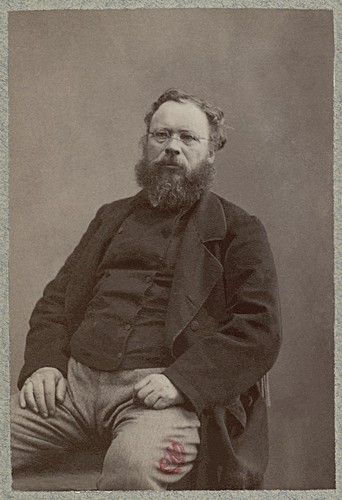
P.-J. Proudhon
Personal Information
Description
French politician, mutualist philosopher, economist, and socialist
Books
De la création de l'ordre dans l'humanité ou Principes d'organisation politique
Rapport du citoyen Thiers
Book digitized by Google from the library of the University of Wisconsin - Madison and uploaded to the Internet Archive by user tpb.
Du principe fédératif et de la nécessité de reconstituer le parti de la révolution
Les Confessions d’un révolutionnaire pour servir à l’histoire de la Révolution de Février
Carnets
Property is Theft! A Pierre-Joseph Proudhon Anthology
More influential than Karl Marx during his lifetime, Pierre-Joseph Proudon's work has long been out of print or unavailable in English. Weighing in at over 700 pages, Iain McKay's comprehensive collection is a much-needed and timely historical corrective, and includes a number of new translations of Proudhon's work for an English-speaking audience, as well as an exhaustive historical introduction to Proudhon's life and works. ([AK Press](
Qu'est-ce que la propriété?
“Property is robbery!” This slogan coined by the French political philosopher Pierre-Joseph Proudhon is one of his answers to the titular question of his 1840 treatise, What Is Property? A fervent attack against the established order of capitalism and private property, the publication of What Is Property? almost immediately led to Proudhon’s official prosecution and the revocation of Proudhon’s scholarship by the Academy of Besançon. (Proudhon, an autodidact of humble origins who began his working life as a printer, relied on the scholarship for financial support.) Proudhon evaded the worst of the consequences thanks to the intervention of the economist Jérôme-Adolphe Blanqui, to whom the second memoir contained in the book is addressed. In this treatise, Proudhon contrasts the legitimate right to possession, in which individuals own the products of their labor and the necessary means of production, and the illegitimate right to property, the absolute right granted to proprietors by civil laws to “use and abuse.” Proudhon examines the implications of the right to property and concludes that, among other things, property is “impossible,” “homicide,” and “the mother of tyranny.” As an alternative to both the proprietary and communist systems of economic organization, Proudhon advances his anarchist economic theory of “mutualism,” in which a socialist society would be organized based on free market exchanges wherein the value of a good or service is determined by the time and expense it has cost the laborer to produce. This edition of What Is Property? was translated in 1876 by Benjamin Tucker, who was a notable advocate of individualist anarchism in his own right in the United States.