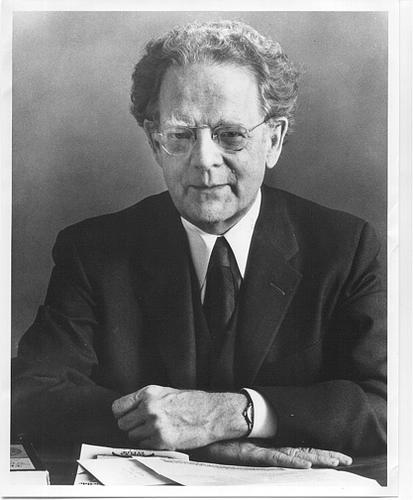
Northrop Frye
Personal Information
Description
There is no description yet, we will add it soon.
Books
1975
"This volume, a collection of Northrop Frye's writings on the theory of literary criticism from the middle period of his career, features one of Frye's own favourites, The Critical Path (1971). An important marker of Frye's development as a critic. The Critical Path openly addresses some of the overarching philosophical topics that he had previously been hesitant to discuss fully: the importance of literature to society, the responsibilities of critics, and the deeper rationale for studying literature." "The texts in this volume chart Frye's transition from an established literary critic to a ground-breaking critical theorist absorbed with essential concepts of language, myth, and human culture, and help to illuminate many of the ideas and arguments that would appear later in The Great Code and Words with Power. Accompanied by the rigorous annotation for which the series is renowned, this scholarly edition is a major contribution to Frye studies and to the field of literary criticism and theory as a whole."--BOOK JACKET.
Northrop Frye's Notebooks for Anatomy of Criticism (Collected Works of Northrop Frye)
"Northrop Frye's Anatomy of Criticism (1957) is widely regarded as a masterpiece of literary theory. The product of years of reading and reflection, the book's value extends far beyond its impact on criticism as a whole; ultimately, it can be viewed as a quintessential defence of liberal learning by one of the twentieth century's most distinguished critics. In this volume, editor Robert D. Denham presents the notebooks to the Anatomy, which can be considered almost as a set of blueprints for Frye's groundbreaking treatise." "Dating from the late 1940s to 1956, the notebooks document the struggle Frye underwent in developing a structure for his work. This process involved incorporating previously published essays and generating new material that would maintain the continuity of his argument. This fully annotated volume contains seventeen holograph notebooks, each illuminating some aspect of the grand structure that eventually emerged. Examined together, the notebooks offer an intimate picture of Frye's creative process and a renewed appreciation of his monumental contribution to literary scholarship."--Jacket.
Northrop Fryes Fiction and Miscellaneous Writings (Collected Works of Northrop Frye)
"The thirteenth and final volume of previously unpublished writings by Northrop Frye gathers together autobiographical reflections, short stories, an unfinished novel, and commentary on a wide range of topics from Canadian culture to religion. Drawn from holdings in the Frye archives - holograph notebooks, typed notes, and typescripts - these writings have been largely inaccessible to Frye scholars until now." "Some of the contents of this volume, Frye's early fiction efforts, for example, will come as a surprise to those primarily acquainted with his published criticism. All of his fables and dialogues are included here, as are a half-dozen sets of notes in which he speculates on fictional forms that he dreams of one day writing. These and the other pieces in this miscellany offer further evidence of Frye's fertile mind, quick wit, expansive imagination, and verbal power. Frye always claimed that the process of writing for him was a search for proper formulas through which to communicate. The material in this volume, which seldom fails to instruct and delight, discloses the process of that search."--Jacket.
The "third book" notebooks of Northrop Frye, 1964-1972
"In the early 1960s, Northrop Frye began keeping notebooks with the aim of creating a critical epic that he referred to as the "Third Book," a project intended as his third major work, following Fearful Symmetry and Anatomy of Criticism. As described by Michael Dolzani, Frye's ambition for the "Third Book" was for it to become no less than a "symbolic guide to the entire universe." The work he envisioned contemplated the ways in which myth and metaphor are the keys to all verbal structures, reaching beyond the hypothetical realm of literature to inform, organize, and control historical, conceptual, political, and perhaps scientific thought." "Although ultimately abandoned, the "Third Book" remains both an essential component of the Collected Works of Northrop Frye and an intriguing text in its own right. Michael Dolzani provides an eloquent introduction that adds an essential unifying frame to the fragmented and complex critical musing which comprise this enormous volume of work. Rather, he has incorporated much useful background material and cross-referencing, enhancing the value of this volume as an important research tool."--Jacket.
The diaries of Northrop Frye, 1942-1955
"With the publication of Fearful Symmetry in 1917, Northrop Frye gained wide renown as a literary theorist, a reputation that continued to build throughout his lifetime. This volume in the Collected Works provides a transcription of the seven books of diaries that Frye kept intermittently from 1912 until 1955. During the period of the final six diaries, 1949-1955, Frye was at work on Anatomy of Criticism, and he refers frequently to many of the essays written during this period that became a part of the book that brought him international acclaim."--BOOK JACKET.
Northrop Frye on religion
"The late Northrop Frye is Canada's best-known literary and cultural critic, and one of the most original thinkers of the twentieth century. During his lifetime, Frye developed a profoundly religious epistemology that informed and infused much of what he wrote. In bringing together his writings on the Bible and religion, this volume offers many keys to the dynamic essence of Frye's thought."--BOOK JACKET.
