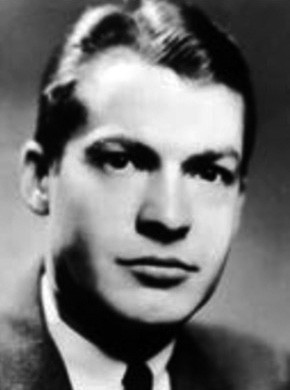
Munro Leaf
Personal Information
Description
Wilbur Monroe Leaf (a.k.a. Munro Leaf) (December 4, 1905 – December 21, 1976) was an American author of children's literature who wrote and illustrated nearly 40 books during his 40-year career. He is best known for The Story of Ferdinand (1936), a children's classic which he wrote on a yellow legal-length pad in less than an hour. Labeled as subversive, it stirred an international controversy.
Books
Fair play
Four-and-twenty watchbirds
Humorous illustrations of the Watchbirds help to introduce the rules of etiquette.
Arithmetic can be fun
Pictures and words present the basic concepts of arithmetic. Introduces the ten numbers, measurements, addition, subtraction, and counting money and time.
History can be fun
A broad survey of world history from the time of the early Egyptians through the ages of Greece and Rome, the Middle Ages and the colonization of America, to the United Nations.
Metric can be fun!
Explains the terms of the metric system and suggests a few exercises for practicing using these measurements.
Who cares? I do
Photographs and text point out the ways in which man's careless disposal of trash is spoiling the environment.
Safety can be fun
All around you, you can find different kinds of Nit-Wits--ones who bounce on beds, climb all over the place, stand on car seats, touch hot stoves, or follow dumb dares, and many others.
The Book of Children's Classics
Corduroy / from Corduroy by Don Freeman -- Ferdinand / from The story of Ferdinand by Munro Leaf, ill. by Robert Lawson -- Pig Pig / from Pig Pig gets a job by David McPhail -- Madeline / from Madeline by Ludwig Bemelmans -- Miss Ruphius / from Miss Rumphius by Barbara Cooney -- Peter Rabbit / from The tale of Peter Rabbit by Beatrix Potter -- Winnie-the-Pooh / from Winnie-the-Pooh and Now we are six by A.A. Milne -- Fudge / from Tales of a fourth grade nothing by Judy Blume -- Homer Price / from Homer Price by Robert McCloskey -- Sam Gribley / from My side of the mountains by Jean Craighead George -- Pippi Longstocking / from Pippi Longstocking by Astrid Lindgren, ill. by Michael Chesworth -- Encyclopedia Brown / from Encyclopedia Brown and the case of the secret pitch by Donald J. Sobol, ill. by Leonard Shortall -- Matilda / from Matilda by Roald Dahl, ill. by Quentin Blake -- Sebastian / from The marvelous misadventures on Sebastian by Lloyd Alexander.
Health can be fun
Relates basic rules for maintaining good health--adequate diet, cleanliness, exercise, rest, and regular checkups.
The story of Simpson and Sampson
The fact that two royal brothers look alike but behave like mirror images nearly pushes them into a confused and pointless joust.
Noodle
The landmark collaboration of two of children's books most beloved talents, Ludwig Bemelmans and Munro Leaf, available again! The story of Noodle, brought to you by the creator of Ferdinand, Munro Leaf, and the creator of Madeline, Ludwig Bemelmans. What could be better than a dog story by these two? Worthy of any child's collection, and a fine learning moral to be found within. Noodle is a little dog who's very long from front to back and very short from top to bottom, which makes it hard for him to dig for bones. One day Noodle finds a wishbone, and the dog fairy arrives with a flip-flap of wings to grant him a wish: "What size and shape do you want to be?" Noodle asks all the animals at the zoo what he should wish for, only to discover he might just be perfect -- exactly the way he is. Originally published in 1937 by children's book greats Ludwig Bemelmans and Munro Leaf, NOODLE is a classic with a quiet wisdom that continues to hold true today.**
Sam and the Superdroop
Ten-year-old Sam Martin was a lucky boy until he met the mysterious Superdroop, a member of the species Comicbookitis, who began taking him on exhausting adventures in Comic Book Land.
Noodle / by Munro Leaf & Ludwig Bemelmans
When Noodle is granted a wish from the good dog fairy to be any size and shape desired, he decides to remain Noodle.
Boo!
Lance goes trick-or-treating with such a scary face that he is able to help himself to all his neighbors' candy.
Manners can be fun
Stick figure drawings and a brief text tell why good manners are important and how to have good manners at home, at play, and on visits.
