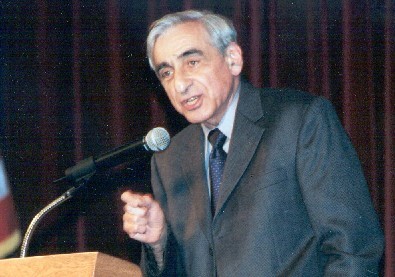
Michael Walzer
Personal Information
Description
Michael Laban Walzer (born on March 3, 1935) is a prominent American political theorist and public intellectual. A professor emeritus at the Institute for Advanced Study (IAS) in Princeton, New Jersey, he is editor emeritus of Dissent, an intellectual magazine that he has been affiliated with since his years as an undergraduate at Brandeis University. He has written books and essays on a wide range of topics—many in political ethics—including just and unjust wars, nationalism, ethnicity, Zionism, economic justice, social criticism, radicalism, tolerance, and political obligation. He is also a contributing editor to The New Republic. To date, he has written 27 books and published over 300 articles, essays, and book reviews in Dissent, The New Republic, The New York Review of Books, The New Yorker, The New York Times, Harpers, and many philosophical and political science journals. Source: [Michael Walzer]( on Wikipedia.
Books
Thinking politically
Thinking Politically brings together a series of remarkable interviews with Raymond Aron that form a political history of our time. Ranging over an entire lifetime, from his youthful experience with the rise of Nazi totalitarianism in Berlin to the denouement of the cold war, Aron meditates on the threats to liberty and reason in the bloody twentieth century. In addition to the interviews published in the original edition, Thinking Politically incorporates three interviews never before published in book form. This supplemental material clarifies Aron's role as a voice of prudential reason in an unreasonable age and allows unparalleled access to the principal influences on Aron's thought. The volume concludes with "Democratic States and Totalitarian States," an address by Aron to the French Philosophical Society as well as the accompanying debate with Jacques Maritain, Victor Basch, and other intellectuals.
Arguing about War
A provocative discussion of recent wars and the issues that surround them, written by a preeminent political theorist. Michael Walzer is one of the world's most eminent philosophers on the subject of war and ethics.
Guerra, política y moral
Walzer entró en 1977 en la historia de la teoría y filosofía política con Guerras justas e injustas, que se convirtio, y sigue siendo, un clásico o mejor, el clásico contemporáneo del tratamiento de la relación entre guerra y moral, insustituible incluso cuando las guerras actuales no suelen ser ya guerras entre estados soberanos. Walzer partió de un ataque frontal al realismo, al negarse a mantener dos tesis interrelacionadas: que «cuando las armas hablan, callan las leyes», y por tanto calla también la reflexión moral y política sobre estas y sobre la conducta práctica de los seres humanos en los conflictos armados; en segundo lugar, que el silencio de las leyes y de la moral es únicamente el correlato de una verdad, descubierta por el realismo político, al despojarnos la guerra de nuestros civilizados aderezos y poner de manifiesto nuestra desnudez, resulta evidente que lo que convencionalmente se ha denominado inhumanidad o conducta inhumana es únicamente la humanidad sometida a presion extrema. El carácter fragmentario y discursivo del razonamiento de Walzer ha dificultado la percepción de la fuerte interconexión de toda su obra, a no ser que se entrelacen textos de, al menos, la primera y última etapa, como se hace en la presente selección. De ahí que pueda afirmarse que Guerra, politica y moral que incluye una entrevista en que habla de la totalidad de su obra, textos de la primera época de Walzer "Contra el realismo", capítulo inicial de Guerras justas e injustas, entre otros y una selección de sus reflexiones recientes mas importantes constituye una introducción general a la visión minimalista de la moral universal que siempre ha defendido Walzer. Los textos que aquí se presentan permiten la continuidad en el razonamiento de Walzer a lo largo de las tres décadas, su peculiar combinación de minimalismo y universalismo, así como su posición singular en el debate entre liberalismo y comunitarismo.
Vernunft, Politik und Leidenschaft. Defizite liberaler Theorie. Max Horkheimer Vorlesungen
On toleration
Michael Walzer examines five "regimes of toleration" - from multinational empires to immigrant societies - and describes the strengths and weaknesses of each regime, as well as the varying forms of toleration and exclusion each fosters. Walzer shows how power, class, and gender interact with religion, race, and ethnicity in the different regimes and discusses how toleration works - and how it should work - in multicultural societies like the United States. Walzer offers an eloquent defense of toleration, group differences, and pluralism, moving quickly from theory to practical issues, concrete examples, and hard questions. His concluding argument is focused on the contemporary United States and represents an effort to join and advance the debates about "culture war," the "politics of difference," and the "disuniting of America." Although he takes a grim view of contemporary politics, he is optimistic about the possibility of coexistence: cultural pluralism and a common citizenship can go together, he suggests, in a strong and egalitarian democracy.
Thick and Thin
"When Michael Walzer's Spheres of Justice was published ten years ago, the front page of The New York Times Book Review hailed the work as "an imaginative alternative to the current debate over distributive justice." Now in Thick and Thin, Walzer revises and extends his arguments in Spheres of Justice, framing his ideas about justice, social criticism, and national identity in light of the new political world that has arisen in the past decade. Walzer focuses on two different but interrelated kinds of moral argument: maximalist and minimalist, thick and thin, local and universal." "According to Walzer the first, thick type of moral argument is culturally connected, referentially entangled, detailed, and specific; the second, or thin type, is abstract, ad hoc, detached, and general. Thick arguments play the larger role in determining our views about domestic justice and in shaping our criticism of local arrangements. Thin arguments shape our views about justice in foreign places and in international society. The book begins with an account of minimalist argument, then examines two uses of maximalist arguments, focusing on distributive justice and social criticism. Walzer then discusses minimalism with a qualified defense of self-determination in international society, and concludes with a discussion of the (divided) self capable of this differentiated moral engagement." "Walzer's highly literate and fascinating blend of philosophy and historical analysis will appeal not only to those interested in the polemics surrounding Spheres of justice but also to intelligent readers who are more concerned with getting the arguments right."--Jacket.
The Revolution of the Saints
The Revolution of the Saints is a study, both historical and sociological, of the radical political response of the Puritans to disorder. It interprets and analyzes Calvinism as the first modern expression of an unremitting determination to transform on the basis of an ideology the existing political and moral order. Michael Walzer examines in detail the circumstances and ideological options of the Puritan intelligentsia and gentry. He sees Puritanism, in sharp contrast to some generally accepted views, as the political theory of intellectuals and gentlemen attempting to create a new government and society.
Exodus and Revolution
Examines the biblical story of the Exdous and shows its part in shaping Western political thought and action.
