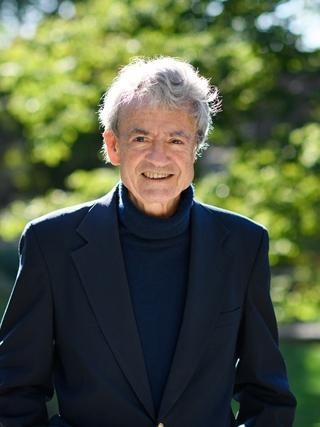
Michael A. Cook
Description
Michael Allan Cook FBA (born 1940) is a British historian and scholar of Islamic history. Cook is the general editor of The New Cambridge History of Islam.
Books
Law and tradition in classical Islamic thought
"Bringing together essays on topics related to Islamic law, this book is composed of articles by prominent legal scholars and historians of Islam. The authors cover a wide swath of issues, ranging from a detailed examination of Shi'i traditions governing legal interpretations about everyday affairs like prayer to the intellectual exchanges between Jewish and Muslim scholars of medieval Islamic tradition on works of logic. Taken together, these articles develop key inquiries concerning Islamic law in unique ways. They also exemplify a critical development in the field of Islamic Studies over the last few years: the proliferation of methodological approaches that employ a broad variety of sources to analyze social and political developments. "-- "This collection brings together the work of some of the most prominent legal scholars and historians of Islam. The assembled articles cover a wide range of issues from debates over the Qur'anic text and issues of law to vibrant intellectual exchanges in philosophy and history. Taken together, these articles develop key inquiries surrounding Islamic law and tradition in unique ways. They also exemplify a critical development in the field of Islamic studies over the last few decades: the proliferation of methodological approaches that employ a broad variety of sources to analyze social and political developments in classical Islam"--
Der Koran. Eine kurze Einführung
Der Koran ist für die Identität des Islam seit fast 1500 Jahren von zentraler Bedeutung. Cooks Einführung geht bewusst nicht chronologisch vor und behandelt zunächst den Koran in der modernen Welt, danach in der traditionell muslimischen Welt. Ein weiterer Abschnitt widmet sich dem Ursprung des Koran, skizziert die Probleme und Rätsel seiner Entstehung.
Ancient religions, modern politics
"Why does Islam play a larger role in contemporary politics than other religions? Is there something about the Islamic heritage that makes Muslims more likely than adherents of other faiths to invoke it in their political life? If so, what is it? Ancient Religions, Modern Politics seeks to answer these questions by examining the roles of Islam, Hinduism, and Christianity in modern political life, placing special emphasis on the relevance--or irrelevance--of their heritages to today's social and political concerns. Michael Cook takes an in-depth, comparative look at political identity, social values, attitudes to warfare, views about the role of religion in various cultural domains, and conceptions of the polity. In all these fields he finds that the Islamic heritage offers richer resources for those engaged in current politics than either the Hindu or the Christian heritages. He uses this finding to explain the fact that, despite the existence of Hindu and Christian counterparts to some aspects of Islamism, the phenomenon as a whole is unique in the world today. The book also shows that fundamentalism--in the sense of a determination to return to the original sources of the religion--is politically more adaptive for Muslims than it is for Hindus or Christians. A sweeping comparative analysis by one of the world's leading scholars of premodern Islam, Ancient Religions, Modern Politics sheds important light on the relationship between the foundational texts of these three great religious traditions and the politics of their followers today"--
Forbidding Wrong in Islam
Michael Cook's magisterial study in Islamic ethics, Commanding Right and Forbidding Wrong in Islamic Thought, was published to much acclaim in 2001. It was described by one reviewer as a masterpiece. In that book, the author reflected on the Islamic injunction, incumbent on every Muslim, to forbid wrongdoing. The present book is a short, accessible survey of the same material. Using anecdotes and stories from Islamic sources to illustrate the argument, Cook unravels the complexities of the subject. Moving backwards and forwards through time, he demonstrates how the past informs the present. By the end, the reader will be familiar with a colourful array of characters from Islamic history ranging from the celebrated thinker Ghazzali, to the caliph Harun al-Rashid, to the Ayatollah Khumayni. The book educates and entertains - at its heart, however, is an important message about the Islamic tradition, its values, and the relevance of those values today.