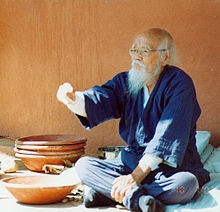
Masanobu Fukuoka
Personal Information
Description
Masanobu Fukuoka was a Japanese farmer known for his commitment to natural farming and sustainable agriculture.
Books
Shizen nōhō wara ippon no kakumei
Six decades ago in postwar Japan, long before Michael Pollan or Alice Waters, Masanobu Fukuoka, a laboratory scientist who had studied plant enzymes and rhizomes in Tokyo laboratories and had worked with poisonous wartime chemicals during the devastations of the Second World War, headed back to the land his father's family farmed for nearly 1,400 years. There he painstakingly recovered and developed a method of farming that aligned itself as closely as possible with natural principles. While Japan set itself on a breakneck course toward modernization, Fukuoka grew rice in the opposite way, refusing to farm with chemicals that would annihilate even something as small as a leaf beetle. Call his book "Zen and the Art of the Wild Cucumber," or see Fukuoka as a Japanese Thoreau tending the whole universe in a beanstalk -- however you approach Fukuoka's rich philosophical side, it's important also to notice that his deep spiritual wisdom was co-terminous with his genius as a farmer. Without fertilizers or even tilling, he nonetheless harvested some of the greatest rice yields per acre in all of Japan. By the late '70s, when The One Straw Revolution was translated into English, Fukuoka had become a guru and disciple in seemingly radical -- but eminently sensible -- ways of approaching food, gardening, farming, and eating. His book is an early cult classic in organic and natural farming circles, but its implications stretch beyond them and continue to resonate as a global food crisis looms. Fukuoka believed that fertilizers and pesticides caused the very problems that they proposed to solve; that rather than annihilating pests, they invited them. He argued that natural foods, grown without these costly additives, should be the cheapest; and that the body living closest to the land and aligning itself with the seasons would be the healthiest. Thirty years later, as this book is re-released, Fukuoka's message -- now more urgent than ever -- remains a deeply nourishing clarion call.
The natural way of farming
Doing nothing, being nothing, becoming nothing is the goal of Fukuoka's farming method, an approach to agriculture which he has pursued for over forty years with resounding success. With no tillage, no fertilizer, no weeding and no pesticides he consistently produces rice, barley, fruit and vegetable crops that equal or exceed the yield per acre of neighboring farmers who embrace modern scientific agriculture. The basis of his philosophy is that nature grows plants just fine without our interference so that the most practical approach is to get out of the way. In the course of explaining his reasoning and methods, this do-nothing farmer delivers a scorching indictment of chemical agriculture and the human assumption that we can improve on nature. He explains the beneficial role of insects and plants usually characterized as pests, the fallacy of artificially boosting fertility with petrochemical concoctions, the logical error implicit in the use of farm machinery or draft animals, and why pollution is an inevitable result of misguided attempts to improve on nature. Calculation of the energy input versus the caloric output of various farms results in the surprising discovery (perhaps it shouldn't be) that (minimal) human labor is the most efficient way to produce food. Draft animals add more work and more energy input, small scale machines compound the problem and large scale mechanized agriculture proves to be a vast waste of energy. He calls modern American farmers "subcontractors of the oil industry," and claims that traditional Japanese farmers on 3-5 acres achieve a real net income higher than American farmers on 500-700 acres. (A skeptical friend of mine wondered if Japanese farm price supports were a factor here. Obviously a complex issue, that, but the declining economic viability of petro-chemical farming is obvious when we note that the onslaught of monster tractors and oil based fertilizers and pesticides has paralleled the collapse of the family farm. The author, to his credit, rejects any artificial manipulation of food prices and believes they should naturally be more or less the same worldwide.) Nor is this text pure philosophy, including as it does specific practical advice on the transition from scientific to natural methods. Crop rotation programs for cold or warm climates, and a ten year rotation system for grain and vegetables make this a practical manual for husbandry. As Fukuoka eloquently suggests, the universe is a circle returning to nothing. Nothing is the most profitable object of our meditations. Doing nothing is simply going with the flow. (See also his "groundbreaking" (literally) ONE STRAW REVOLUTION, Other India Press; 1992)