Discover

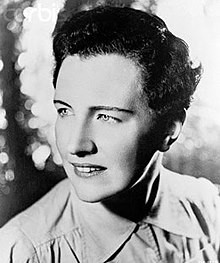
Mary Renault

Personal Information

Born September 4, 1905
Died December 13, 1983 (78 years old)
London, South Africa
Also known as: M. Renault (pseud.), Mary Renault (pseud.)
17 books
3.9 (12)
385 readers

Description

Eileen Mary Challans (4 September 1905 – 13 December 1983), known by her pen name Mary Renault (/ˈrɛnoʊlt/), was an English writer best known for her historical novels set in ancient Greece. Born in Forest Gate in 1905, she attended St Hugh's College, Oxford, from 1924 until 1928. After graduating from St Hugh's with a Third Class in English, she worked as a nurse and began writing her first novels, which were contemporary romances. In 1948, she moved to South Africa with her partner Julie Mullard, where she spent the rest of her life. Living in South Africa allowed her to write about openly gay characters without fearing the censorship and homophobia of England. She devoted herself to writing historical fiction in the 1950s, which were also her most successful books. She is best known for her historical fiction today. Renault's works are often rooted in themes related to love, sexuality and relationships. Her books attracted a large gay following at the time of their publication, when few mainstream works depicted homosexuality in a positive light. Her work has had a generally positive reception by critics. She has received numerous awards and honours, both during her lifetime and posthumously. [source](

Books

Newest First

Fire from Heaven

5.0 (1)
72

Fire from Heaven is a 1969 historical novel by Mary Renault about the childhood and youth of Alexander the Great. It reportedly was a major inspiration for the Oliver Stone film Alexander.

Return to night

0.0 (0)
2

English woman physician falls in love with patient in hospital.

The Last of the Wine

4.0 (1)
1

"The path to true love is not always straight. Edmund Bingley is trying to divorce at a time when it takes no less than an Act of Parliament and even a king can't acquire one. His brother Charlie is hopelessly in love with someone he can never marry. And the last Darcy daughter is giving her living legend of a protective father a run for his money. Can Edmund find a way out of his loveless marriage? Can the family find the missing Cassandra Darcy before it's too late? With the help of old friends, former enemies, priests, monks, Romani, American diplomats, and Tibetan lamas, they'll have to find a way. In Altman's tenth and final installment of The Darcys and the Bingleys, life has come full circle for the original clan, who has watched its children grow, make mistakes, and take responsibility for themselves."--Page 4 of cover.

The King Must Die

3.0 (2)
69

Historical fiction. Theseus, a prince of ancient Athens, is taken as a slave to the island of Crete, where he's condemned to certain death as a bull dancer. But he abducts the Princess Ariadne & makes a daring escape.

The Bull from the Sea

4.5 (2)
21

The Bull from the Sea reconstructs the legend of Theseus, the valiant youth who slew the Minotaur, became king, and brought prosperity to Attica. Chief among his heroic exploits is the seduction of Hippolyta, the Queen of the Amazons, who irrevocably brought about both his greatest joy and his tragic destiny.

The Praise Singer

0.0 (0)
6

'Mary Renault's portraits of the ancient world are fierce, complex and eloquent, infused at every turn with her life-long passion for the Classics. Her characters live vividly both in their own time, and in ours' MADELINE MILLER Mary Renault is a shining light to both historical novelists and their readers. She does not pretend the past is like the present, or that the people of ancient Greece were just like us. She shows us their strangeness; discerning, sure-footed, challenging our values, piquing our curiosity, she leads us through an alien landscape that moves and delights us' HILARY MANTEL In the story of the great lyric poet Simonides, Mary Renault brings alive a time in Greece when tyrants kept an unsteady rule and poetry, music, and royal patronage combined to produce a flowering of the arts. Born into a stern farming family on the island of Keos, Simonides escapes his harsh childhood through a lucky apprenticeship with a renowned Ionian singer. As they travel through 5th century B.C. Greece, Simonides learns not only how to play the kithara and compose poetry, but also how to navigate the shifting alliances surrounding his rich patrons. He is witness to the Persian invasion of Ionia, to the decadent reign of the Samian pirate king Polykrates, and to the fall of the Pisistratids in the Athenian court. Along the way, he encounters artists, statesmen, athletes, thinkers, and lovers, including the likes of Pythagoras and Aischylos. Using the singer's unique perspective, Renault combines her vibrant imagination and her formidable knowledge of history to establish a sweeping, resilient vision of a golden century.

The Charioteer

0.0 (0)
47

After enduring an injury at Dunkirk during World War II, Laurie Odell is sent to a rural veterans' hospital in England to convalesce. There he befriends the young, bright Andrew, a conscientious objector serving as an orderly. As they find solace and companionship together in the idyllic surroundings of the hospital, their friendship blooms into a discreet, chaste romance. Then one day, Ralph Lanyon, a mentor from Laurie's schoolboy days, suddenly reappears in Laurie's life, and draws him into a tight-knit social circle of world-weary gay men. Laurie is forced to choose between the sweet ideals of innocence and the distinct pleasures of experience. Originally published in the United States in 1959, The Charioteer is a bold, unapologetic portrayal of male homosexuality during World War II that stands with Gore Vidal's The City and the Pillar and Christopher Isherwood's Berlin Stories as a monumental work in gay literature.

The Persian Boy

3.7 (3)
78

Historical novel set in the time of Alexander the Great. This novel tells the story of the climactic last seven years of Alexander the Great's life through the eyes of his lover, Bagoas, a eunoch who was sold to King Darius of Persia, but found freedom with the great general, sustaining Alexander through mutiny, assassination attempts and two wives.

The Nature of Alexander

4.0 (1)
15

The book is a biography of King Alexander the Great, (356-323 BCE/BC), ruler of Macedon, Egypt and Persia. Renault wrote several historical novels in which Alexander appears: The Mask of Apollo (1966), Fire from Heaven (1969), The Persian Boy (1972) and Funeral Games (1981). She felt these were not enough to tell the whole story of Alexander, and so she completed her nonfiction biography. Nonfiction. Source: Wikipedia.

The Mask of Apollo

0.0 (0)
20

The Mask of Apollo is a historical novel written by Mary Renault. Set in the ancient Greek world during the 4th century BC, the novel is written as the first-person narrative of a fictional character, Nikeratos (or 'Niko'), an actor. Throughout his professional life and his work in Syracuse and Athens, Nikeratos meets several historical characters and becomes a witness (and sometimes a marginal participant) in the political conflicts of Syracuse.

Funeral Games

4.0 (1)
14

As Funeral Games opens, Alexander the Great lies dying. Around his body gather the generals, the provincial satraps and the royal wives, already competing for the prizes of power and land. Only Bagoas, the Persian boy mourning in the shadows, wants nothing. Tracing the events of the fifteen years following Alexander's death, Funeral Games sees his mighty empire disintegrate, and brings Mary Renault's Alexander trilogy to a dramatic close.