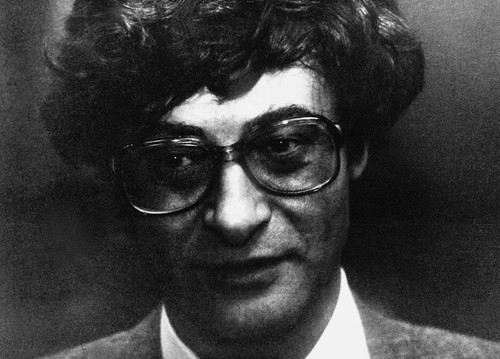
Mahmoud Darwish
Personal Information
Description
There is no description yet, we will add it soon.
Books
The Butterfly's Burden
Newest work from Mahmoud Darwish--the most acclaimed poet in the Arab world.
Why Did You Leave the Horse Alone?
Since Mahmoud Darwish's death in 2008 his poetic writings continue to be read by an audience in awe. Why Did You Leave the Horse Alone? is a collection of autobiographical poetry designed to give an insight into the wider human condition. Darwish's writing explores the meaning of life, identity and the impact of exile. Hailed as the most important Arab poet of the modern day, Darwish's voice has come to represent a generation and the Palestinian people in the midst of the tense political situation in the Middle East. While Darwish explored themes of lost Eden, exile and life after death.
Yawmīyāt al-ḥuzn al-ʻādī
"First published in Beirut in 1973, these probing essays ask vital questions about the existentially complex realities the Palestinians in Israel face and the ambiguity of Darwish's own identity as an Israeli Palestian."--Title page verso.
In the presence of absence
"Darwish composed this remarkable elegy at the apex of his creativity, but with the full knowledge that his death was imminent. Thinking it might be his final work, he summoned all his poetic genius to create a luminous work that defies categorization. In stunning language, Darwish's self-eelgy inhabits a rare space where opposites bleed and blend into each other. Prose and poetry, life and death, home and exile are all sung by the poet and his other... Through these lyrical meditations on love, longing, Palestine, history, friendship, family, and the ongoing conversation between life and death, the poet bids himself his readers a poignant farewell"--Inside cover.
If I were another
Darwish was that rare literary phenomenon: a poet both acclaimed by critics as one of the most important poets in the Arab world and beloved by his readers.
Memory for Forgetfulness: August, Beirut, 1982 (Literature of the Middle East)
State of siege
"A traveler looks out his hotel window on a war-torn Sarajevo. A mortar explodes in his room and, when the authorities arrive, the corpse has disappeared and only a notebook of apocryphal stories and poems is found. These engimas lead into a labyrinth, where blind and barbarous forces lay siege to individual lives and diverse cultures."--BOOK JACKET.
Palestine as Metaphor
"First English publication of interviews with the late Mahmoud Darwish. Palestine as Metaphor consists of a series of interviews with Mahmoud Darwish, which have never been translated and published in English before. The interviews are a wealth of information on the poet's personal life, his relationships, his numerous works, and his tragedy. They illuminate Darwish's conception of poetry as a supreme art that transcends time and place. Several writers and journalists conducted the interviews, including a Lebanese poet, a Syrian literary critic, three Palestinian writers, and an Israeli journalist. Each encounter took place in a different city from Nicosia to London, Paris, and Amman. These vivid dialogues unravel the threads of a rich life haunted by the loss of Palestine and illuminate the genius and the distress of a major world poet"--
Memory for forgetfulness
"One of the Arab world's greatest poets uses the 1982 Israeli invasion of Lebanon and the shelling of Beirut as the setting for this sequence of prose poems. Mahmoud Darwish vividly recreates the sights and sounds of a city under terrible siege. As fighter jets scream overhead, he explores the war-ravaged streets of Beirut on August 6th (Hiroshima Day). Memory for Forgetfulness is an extended reflection on the invasion and its political and historical dimensions. It is also a journey into personal and collective memory. What is the meaning of exile? What is the role of the writer in time of war? What is the relationship of writing (memory) to history (forgetfulness)? In raising these questions, Darwish implicitly connects writing, homeland, meaning, and resistance in an ironic, condensed work that combines wit with rage. Ibrahim Muhawi's translation beautifully renders Darwish's testament to the heroism of a people under siege, and to Palestinian creativity and continuity. Sinan Antoon's foreword, written expressly for this edition, sets Darwish's work in the context of changes in the Middle East in the past thirty years."--Cover.