Discover

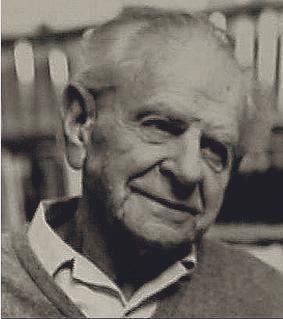
Karl Popper

Personal Information

Born July 28, 1902
Died September 17, 1994 (92 years old)
Vienna, Cisleithania
Also known as: Karl R. Popper, Karl Raimund Popper
29 books
3.9 (13)
441 readers

Description

Sir Karl Raimund Popper (28 July 1902 – 17 September 1994) was an Austrian-British philosopher, academic and social commentator.

Books

Newest First

The Lesson of this Century

0.0 (0)
0

Ben shu nei rong shou ji le ka mi, bo pu mi de guan yu min zhu li lun de yan jiang gao, guang fan she ji dao le dang jin de zheng zhi yu she hui wen ti.

Popper selections

4.5 (2)
28

Previously published as: A pocket Popper. Guilford, Surrey : Fontana Paperbacks, 1983.Includes index. Bibliography: p. 467-468.

Objective Knowledge

0.0 (0)
13

The essays in this volume represent an approach to human knowledge that has had a profound influence on many recent thinkers. Popper breaks with a traditional commonsense theory of knowledge that can be traced back to Aristotle. A realist and fallibilist, he argues closely and in simple language that scientific knowledge, once stated in human language, is no longer part of ourselves but a separate entity that grows through critical selection.

Unended quest

0.0 (0)
10

At the age of eight, Karl Popper was puzzling over the idea of infinity and by fifteen was beginning to take a keen interest in his father's well-stocked library of books. Unended Quest recounts these moments and many others in the life of one of the most influential thinkers of the twentieth century, providing an indispensable account of the ideas that influenced him most. As an introduction to Popper's philosophy, Unended Quest also shines. Popper lucidly explains the central ideas in his work, making this book ideal for anyone coming to Popper's life and work for the first time.

The Poverty of Historicism

3.5 (2)
25

On its publication in 1957, The Poverty of Historicism was hailed by Arthur Koestler as 'probably the only book published this year which will outlive the century.' A devastating criticism of fixed and predictable laws in history, Popper dedicated the book to all those 'who fell victim to the fascist and communist belief in Inexorable Laws of Historical Destiny.' Short and beautifully written, it has inspired generations of readers, intellectuals and policy makers. One of the most important books on the social sciences since the Second World War, it is a searing insight into the ideas of this great thinker.

The Open Society and Its Enemies (1+2)

4.4 (5)
152

An open society provides its citizens with a mechanism for changing government; a closed society doesn't, forcing its citizens to rely on extra-legal revolution. Popper analyzes the open-closed society debate using three exemplars of closed-society advocacy: Plato, Hegel (and wow, does Popper hate on Hegel), and Marx. The main analytical viewpoints are historicist (backward-looking, utopian) motivations for closed societies and rational (forward-looking, empirical) motivations for open societies.

The Logic of Scientific Discovery

1.0 (1)
90

When first published in 1959, this book revolutionized contemporary thinking about science and knowledge. It remains the one of the most widely read books about science to come out of the twentieth century.
