Joy Hakim
Personal Information
Description
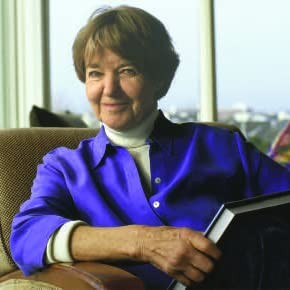
I'm a teacher turned newspaper reporter who decided to write a storyteller's U.S. history. It turned into: A History of US, ten small books published by Oxford University Press. The books begin with the first explorers crossing the Bering Strait, the series ends with Donald Trump. In testimony before the Senate Education Committee American historian David McCullough called the books "superb." People Magazine described me as "the J.K. Rowling of the history world." The books have sold more than 5 million copies. They are intended to cross disciplines and teach reading skills as well as American history. Why should language arts be the sole reading discipline? A Dallas school used the books to teach middle school reading and scores went up 10%. Educator teams at Oxford and Johns Hopkins have done terrific coordinated teaching materials. Freedom: A History of US, is a one-volume US history, companion to a 16-part PBS series of the same name narrated by Katie Couric, with voices by a host of Hollywood figures. This one volume history is available from Social Studies School Services. The Story of Science is a three-book series published by Smithsonian Books with encouragement from the NSTA (National Science Teachers Association). The first volume is Aristotle Leads the Way; the second, Newton at the Cente. They tell of classic science. The third book, Einstein Adds A New Dimension, attempts to explain quantum theory and relativity through stories, so everyone can understand those amazing and very current sciences. Science writer Timothy Ferris said he wished he had them when he was a boy. Educators at Johns Hopkins and Juliana Texley at NSTA developed teaching materials for classroom use (available from NSTA or Amazon). Reading guru Lucy Calkins, of Teachers College, Columbia, has called the books the "gold standard" in the field. They have been translated into Korean and Chinese. The Chinese books recently won an education award in Shanghai. "Free To Believe (Or Not)," tells the tale of religious freedom in America through a series of stories and through original documents. The book was written to help teachers and students handle those often hard to read documents. I'm finishing four small books that put biology into a narrative framework tracking this timely science from Vesalius (Renaissance) to Jennifer Doudna and Emanuelle Carpentier (today's genetics). Right now, I'm writing freebie lessons to read and do at home. They can be found on my website:joyhakim.com. You can also connect with me on Twitter: @joyhakim_joy or at joyhakim@gmail.com.
Books
The Story of Science, Newton at the Center
The Story of Science follows the human quest to learn, an approach to history intended to inspire and inform.. Will the 20th century be remembered for its succession of wars. or for relativity, quantum theory and technological marvels? What is quantum theory? What is relativity? How do we teach those big ideas? In this book, readers watch as Copernicus's systematic observations place the sun at the center of our universe-to the dismay of establishment thinkers. After readers follow the achievements and frustrations of Galileo, Kepler, and Descartes, they appreciate the amazing Isaac Newton, whose discoveries about gravity, motion, colors, calculus, and Earth's place in the universe set the stage for modern physics, astronomy, mathematics, chemistry and modern political theory. Yes, Thomas Jefferson and John Adams both read Newton's Principia. That amazing book makes it clear that the great world follows understandable rules. So why can't nations do the same thing?
Aristotle leads the way
The Story of Science follows the human quest to learn, an approach to history intended to inspire and inform.. Will the 20th century be remembered for its succession of wars. or for relativity, quantum theory and technological marvels? What is quantum theory? What is relativity? How do we teach those big ideas? In this book, readers travel back in time to ancient Babylon, Egypt, Greece, India, and the Arab world. They explore the lives and ideas of people like Pythagoras, Archimedes, Brahmagupta, Al Khwarizmi, Fibonacci, Ptolemy, St. Augustine, and St. Thomas Aquinas. Those ancients asked questions that would eventually lead to modern science. They often got the wrong answers, but that question-asking was essential. Read this book and you'll understand why. Combine ancient history, hands on science activities, and some research and writing using this book.
A History of US- War, Peace, and All That Jazz (1918-1945) #9
From woman's suffrage to Babe Ruth's home runs, from Louis Armstrong's jazz to Franklin Delano Roosevelt's four presidential terms, from the finale of one world war to the dramatic close of the second, War, Peace, And All That Jazz presents the story of some of the most exciting years in U.S. history. With the end of World War I, many Americans decide to live it up, go to silent flicks, drive cars, and cheer their favorite baseball teams. When Depression strikes the good times dampen--jobs are hard to find, farmers are in trouble, and racism won't seem to go away. Along comes President F.D.R., who promises a New Deal, gives Americans hope, and then sees the nation through the horrors and victories of World War II. Full Series: 1.The First Americans (Prehistory-1600) 2.Making Thirteen Colonies (1600-1740) 3.From Colonies to Country (1735-1791) 4.The New Nation (1789-1850) 5.Liberty for All? (1820-1860) 6.War, Terrible War (1855-1865) 7.Reconstructing America (1865-1890) 8.An Age of Extremes (1880-1917) 9.War, Peace, and All That Jazz (1918-1945) 10.All the People: (Since 1945) NOTE: Years may differ Depending on Edition
All the People #10
Covers the period of American history from 1945 to 1998, from the end of World War II to the Clinton administration. Full Series: 1.The First Americans (Prehistory-1600) 2.Making Thirteen Colonies (1600-1740) 3.From Colonies to Country (1735-1791) 4.The New Nation (1789-1850) 5.Liberty for All? (1820-1860) 6.War, Terrible War (1855-1865) 7.Reconstructing America (1865-1890) 8.An Age of Extremes (1880-1917) 9.War, Peace, and All That Jazz (1918-1945) 10.All the People: (Since 1945) NOTE: Years may differ Depending on Edition
Reconstruction and Reform (Reconstructing America- 1865-1890)
A history of the Reconstruction period and the movements of reform, immigration, industrialization, and urbanization. Full Series: 1.The First Americans (Prehistory-1600) 2.Making Thirteen Colonies (1600-1740) 3.From Colonies to Country (1735-1791) 4.The New Nation (1789-1850) 5.Liberty for All? (1820-1860) 6.War, Terrible War (1855-1865) 7.Reconstructing America (1865-1890) 8.An Age of Extremes (1880-1917) 9.War, Peace, and All That Jazz (1918-1945) 10.All the People: (Since 1945) NOTE: Years may differ Depending on Edition
An Age of Extremes
For the captains of industry (sometimes called Robber Barons)--men like Andrew Carnegie, John D. Rockefeller, J.P. Morgan, and Henry Ford--the Gilded Age is a time of big money. Technology booms with the new trains, telephones, electric lights, harvesters, vacuum cleaners, and more. But for millions of immigrant workers, it is a time of hardship––workers , including children, often toil 12 to 14 hours a day sometimes under dangerous conditions. In An Age of Extremes, you'll meet Mother Jones, Ida Tarbell, Big Bill Haywood, Sam Gompers, Theodore Roosevelt and others. You'll watch the United States step onto the world stage as it enters the bloody battlefields of Europe in World War I. Full Series: 1.The First Americans (Prehistory-1600) 2.Making Thirteen Colonies (1600-1740) 3.From Colonies to Country (1735-1791) 4.The New Nation (1789-1850) 5.Liberty for All? (1820-1860) 6.War, Terrible War (1855-1865) 7.Reconstructing America (1865-1890) 8.An Age of Extremes (1880-1917) 9.War, Peace, and All That Jazz (1918-1945) 10.All the People: (Since 1945) NOTE: Years may differ Depending on Edition
A History of US- Liberty for all?(1820-1860) #5
Henry David Thoreau said, "Eastward I go only by force, but westward I go free." Lots of Americans agreed. The 19th century was an exuberant time in the United States and many were on the move. Liberty For All tells of mountain men, railroad builders, whalers, gold rush hopefuls, and farmers, as well as of poets and painters. Read of westward migration, the California Gold Rush, war with Mexico, the Oregon boundary conflict, and Texas and the Alamo. Meet two black women who when thrown off a street car, go to court, win their case, and Intergrated streetcars -all this BEFORE the Civil War and 100 years before Rosa Parks. Full Series: 1.The First Americans (Prehistory-1600) 2.Making Thirteen Colonies (1600-1740) 3.From Colonies to Country (1735-1791) 4.The New Nation (1789-1850) 5.Liberty for All? (1820-1860) 6.War, Terrible War (1855-1865) 7.Reconstructing America (1865-1890) 8.An Age of Extremes (1880-1917) 9.War, Peace, and All That Jazz (1918-1945) 10.All the People: (Since 1945) NOTE: Years may differ Depending on Edition
A History of US- War, Terrible War (1855-1865)#6
War, Terrible War takes us into the Civil War, from the battle of Manassas to the battle of Gettysburg and on to the South's surrender at Appomattox Court House. Follow soldiers in blue and gray as they endure long marches, freezing winter camps, and awful battles fought on American soil. Abolitionists, slave owners, and ordinary Americans listen to the debates over slavery and states rights. Meet Abraham Lincoln, Robert E. Lee, Ulysses S. Grant, John Brown, Harriet Tubman, Jefferson Davis, soldiers on both sides, slave owners, abolitionists, average citizens, and others. This is the story of a people affected by the horrors of a war where brother sometimes fought brother. Full Series: 1.The First Americans (Prehistory-1600) 2.Making Thirteen Colonies (1600-1740) 3.From Colonies to Country (1735-1791) 4.The New Nation (1789-1850) 5.Liberty for All? (1820-1860) 6.War, Terrible War (1855-1865) 7.Reconstructing America (1865-1890) 8.An Age of Extremes (1880-1917) 9.War, Peace, and All That Jazz (1918-1945) 10.All the People: (Since 1945) NOTE: Years may differ Depending on Edition
A History of US-Making Thirteen Colonies (1600-1740)#2
The American continent, long isolated from the rest of the world, has been rediscovered. This time by Europeans. Some come in search of freedom, some come with the hope of riches. They sometimes bring Africans, in chains. As to the Native Americans, they face disease and competition from these newcomers. Read Making Thirteen Colonies to learn more. Meet Pocahontas and John Smith in Jamestown. Join William Penn and the Quakers of Pennsylvania. Sit with the judges at the Salem witch trials. Hike over the mountains with Daniel Boone. And read what Ben Franklin has to say in Poor Richard's Almanack. The dynamic interaction of all these diverse peoples will create a new kind of nation, one based on the idea that all people deserve equal treatment. Getting that fairness doctrine to work won't be easy. Full Series: 1.The First Americans (Prehistory-1600) 2.Making Thirteen Colonies (1600-1740) 3.From Colonies to Country (1735-1791) 4.The New Nation (1789-1850) 5.Liberty for All? (1820-1860) 6.War, Terrible War (1855-1865) 7.Reconstructing America (1865-1890) 8.An Age of Extremes (1880-1917) 9.War, Peace, and All That Jazz (1918-1945) 10.All the People: (Since 1945) NOTE: Years may differ Depending on Edition
A History of US-From Colonies to Country (1735-1791) #3
It really didn't make sense for a nation far across the ocean to control the fate of people living on the American continent. Many realized that, but Tom Paine put it into words. This book, perhaps the key book in the whole series, tells the story of the American Revolution. Lots of nations have had revolutions, but few have handled the rebuilding process as well. A group of "founders" realized that it wouldn't be easy for people to run their own government, so they designed a remarkable constitution. Nothing like it had ever been written before. Its ideas would change the whole world. In From Colonies To Country you will find other stories that may surprise you. Read about two Spanish explorers who set out on July 4, 1776 on a journey that covered an enormous expanse of western land. Or read about a rich landowner and fur merchant whose wife was Native American. They fair, decent and heroic, and won some important battles. Full Series: 1.The First Americans (Prehistory-1600) 2.Making Thirteen Colonies (1600-1740) 3.From Colonies to Country (1735-1791) 4.The New Nation (1789-1850) 5.Liberty for All? (1820-1860) 6.War, Terrible War (1855-1865) 7.Reconstructing America (1865-1890) 8.An Age of Extremes (1880-1917) 9.War, Peace, and All That Jazz (1918-1945) 10.All the People: (Since 1945) NOTE: Years may differ Depending on Edition
