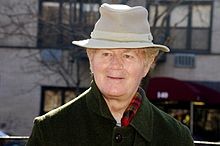
Jonathan Schell
Personal Information
Description
Jonathan Edward Schell (August 21, 1943 – March 25, 2014) was an American author and visiting fellow at Yale University, whose work primarily dealt with campaigning against nuclear weapons. Source: [Jonathan Schell]( on Wikipedia.
Books
The Seventh Decade
Explores the growing danger of nuclear conflict since the end of the Cold War, citing issues such as the invasion of Iraq, nuclear programs of Iran and North Korea, and the rise of terrorism
The Gift of Time
A collection of letters in which Jorge Ramos shares the lessons he wants his two young children to learn about the world around them.
The Unconquerable World
This book is a visionary work that explores the limits of violence and charts an unexpectedly hopeful course toward a nonviolent future. At times of global crisis, Jonathan Schell's writings have presented influential alternatives to conventional, dead-end thinking. His classic bestseller, The Fate of the Earth, was hailed by the New York Times as "an event of profound historical moment." Now, as the world stands once more on the brink of upheaval, Schell reenters the fray with a lucid, impassioned, provocative book that points the way out of the unparalleled devastation that marked the 20th century toward another, more peaceful path. Tracing the unlimited expansion of violence to its culmination in nuclear stalemate, Schell uncovers a simultaneous but little-noted history of nonviolent action at every level of political life. His historical journey turns up seeds of nonviolence even in the bloody revolutions of America, France, and Russia, as well as in the people's wars of China and Vietnam. And his investigations into familiar history -- from Gandhi's independence movement in India to the explosion of civic activity that brought about the unpredicted collapse of the Soviet Union -- suggest foundations of an entirely new kind on which to construct an enduring peace. At a time when all-out war, with its risk of human extinction, must cease to play the role of final arbiter, The Unconquerable World, a bold book of global significance, offers the only realistic hope of safety. - front/back jacket flap
Jonathan Schell
"From the Vietnam era to the war on terror, Jonathan Schell (1943-2014) produced a body of work as brave, humane, and consequential as any in the history of American journalism. His legacy rests especially on three books about the threat of nuclear weapons--'the gravest danger of our age'--and the changing nature of modern warfare. On the 75th anniversary of the bombings of Hiroshima and Nagasaki, Library of America brings together these essential works in one volume for the first time."--From jacket. Fate of the Earth: When Jonathan Schell heard all that loose talk about attainment of objectives in a limited nuclear war, it was too much for him. He did what all of us would like to do: he wrote a book. It's very pessimistic. The mere presence of all those weapons is enough to ensure that sometime, somewhere, someone is going to set one off. Schell makes sure all of us know the horrendous possibilities of a nuclear exchange & all the reasons for bringing such possibilities to a halt. Everyone agrees. The question is, how do we get these monsters under control? Abolition: Provides a lucid analysis of the issues that need to be resolved and the steps that need to be taken to eliminate the possibility of nuclear war. Unconquerable world: At times of global crisis, Jonathan Schell's writings have offered important alternatives to conventional thinking. Now, as conflict escalates around the world, Schell gives us an impassioned, provocative book that points the way out of the unparalleled devastation of the twentieth century toward another, more peaceful path. Tracing the expansion of violence to its culmination in nuclear stalemate, Schell uncovers a simultaneous but little-noted history of nonviolent action at every level of political life. His investigation ranges from the revolutions of America, France, and Russia, to the people's wars of China and Vietnam, to the great nonviolent events of modern times-including Gandhi's independence movement in India and the explosion of civic activity that brought about the surprising collapse of the Soviet Union. Suggesting foundations of an entirely new kind on which to construct an enduring peace, The Unconquerable World is a bold book of sweeping significance.
Writing in time
"In the fall of 1990... the Cold War was on its last legs. Within the year, it would formally end, with the wholly unexpected dissolution not just of the conflict between the Soviet Union and the United States but of the Soviet Union itself. The abruptness of the Union's disintegration left the world dumbfounded." Such is the state of affairs, described in Jonathan Schell's introduction, that form one of the themes of Writing in Time. Schell wrote weekly columns in Newsday (and its sister newspaper, New York Newsday) from 1990 through 1996. This book examines the world-shaking events he covered during those years.
The time of illusion
"In this book, which originated as a series of articles for 'The New Yorker', Jonathan Schell has written a reflective account of our nation's political life between the time President Richard Nixon took office, in January 1969, and the time he left office, in August 1974. The author has examined what seemed to be, as they occurred, a chaotic succession of random events, of arbitrary, contradictory, aberrant Presidential acts, and found a logical coherence that we thought were not there--an explanation for much that was unexplained and appeared inexplicable." --Jacket.
The fate of the earth
Examines the biological, political, social, and moral consequences of nuclear warfare and asks how such a holocaust might be prevented.
The Village of Ben Suc
A reportage about the forced evacuation of the village of Ben suc in the province of Binh Duong, Vietnam approximately 50 miles north west of Saigon. The jungle surrounding the village was also destroyed so that it would be impossible for the "ewnemy" to ever reoocupy the area. (1967)
The Unfinished Twentieth Century
Discusses how the nuclear build-up of the twentieth-century poses a new threat for the twenty-first century.
A hole in the world
Rhodes, author of Making of the Atomic Bomb, begins the story of his boyhood with his mother's suicide, when he was 13 months old. After several itinerant years, his father finally landed Rhodes and his brother Stanley in the house of a ghastly woman who was to become Rhodes's stepmother. Living a tortured existence, Rhodes and his brother were systematically starved, sent out of the house for 12-hour stretches, and deprived of any kind of emotional warmth. Eventually they were rescued and sent to live on a farm, where they began to heal.
