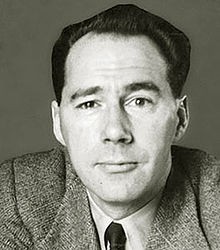

UNITED KINGDOM AUTHOR · SCIENCE FICTION · FICTION
John Wyndham
Also known as: John Wyndham Parkes Lucas Beynon Harris, J. Wyndham
John Wyndham Parkes Lucas Beynon Harris (10 July 1903 – 11 March 1969) was an English science fiction writer best known for his works written using the pen name John Wyndham, although he also used other combinations of his names, such as John Beynon and Lucas Parkes. Some of his works were set in post-apocalyptic landscapes. His best known works include The Day of the Triffids (1951) and The Midwich Cuckoos (1957), the latter filmed twice as Village of the Damned. Source: [John Wyndham]( on Wikipedia.
When a day that you happen to know is Wednesday starts off by sounding like Sunday, there is something seriously wrong somewhere.
— from The Day of the Triffids, 1951
Most acclaimed

The Day of the Triffids
1951
When Bill Masen wakes up blindfolded in hospital there is a bitter irony in his situation. Carefully removing his bandages, he realizes that he is the only person who can see: everyone else, doctors and patients alike, have been blinded by a meteor shower. Now, with civilization in chaos, the triffids - huge, venomous, large-rooted plants able to 'walk', feeding on human flesh - can have their day.The Day of the Triffids, published in 1951, expresses many of the political concerns of its time: the Cold War, the fear of biological experimentation and the man-made apocalypse. However, with its terrifyingly believable insights into the genetic modification of plants, the book is more relevant today than ever before. [Comment by Liz Jensen on The Guardian]: > As a teenager, one of my favourite haunts was Oxford's Botanical Gardens. I'd head straight for the vast heated greenhouses, where I'd pity my adolescent plight, chain-smoke, and glory in the insane vegetation that burgeoned there. The more rampant, brutally spiked, poisonous, or cruel to insects a plant was, the more it appealed to me. I'd shove my butts into their root systems. They could take it. My librarian mother disapproved mightily of the fags but when under interrogation I confessed where I'd been hanging out – hardly Sodom and Gomorrah – she spotted a literary opportunity, and slid John Wyndham's The Day of the Triffids my way. I read it in one sitting, fizzing with the excitement of recognition. I knew the triffids already: I'd spent long hours in the jungle with them, exchanging gases. Wyndham loved to address the question that triggers every invented world: the great "What if . . ." What if a carnivorous, travelling, communicating, poison-spitting oil-rich plant, harvested in Britain as biofuel, broke loose after a mysterious "comet-shower" blinded most of the population? That's the scenario faced by triffid-expert Bill Masen, who finds himself a sighted man in a sightless nation. Cataclysmic change established, cue a magnificent chain reaction of experimental science, physical and political crisis, moral dilemmas, new hierarchies, and hints of a new world order. Although the repercussions of an unprecedented crisis and Masen's personal journey through the new wilderness form the backbone of the story, it's the triffids that root themselves most firmly in the reader's memory. Wyndham described them botanically, but he left enough room for the reader's imagination to take over. The result being that everyone who reads The Day of the Triffids creates, in their mind's eye, their own version of fiction's most iconic plant. Mine germinated in an Oxford greenhouse, in a cloud of cigarette smoke.
The Chrysalids
1955
This book is about a post apocalyptic world returned back to the times of the horse and carriage seen through the eyes of a young boy. Deviations are punished or destroyed and what few books remained govern the way people think about change and the differences from the norm. The twists and turns in this rather short book as bought me back to it many times over the years, which is very unusual for me. It would make a great Spielberg movie with the authors descriptions of the scarred landscape and the characters being fantastic. you could really picture the trials and tribulations of these people. When the young boy David finds his closest friend has a sixth toe on each foot and is asked to keep it a secret from his god fearing tyrant of a father, he comes to question his own secrets and what would happen to him if anyone found out. I wont tell you the twist, but definitely recommend this read to anyone, young or old.
The Seeds of Time
2001
Long considered the foremost American Marxist theorist, Fredric Jameson continues his investigation of postmodernism under late capitalism in The Seeds of Time. In three parts Jameson presents the problem of Utopia, attempting to diagnose the cultural present and to open a perspective on the future of a world that is all but impossible to predict with any certainty - "a telling of the future," as Jameson calls it, "with an imperfect deck.". "The Antinomies of Postmodernity" highlights the seemingly unresolvable paradoxes of intellectual debate in the age of postmodernity. Jameson suggests that these paradoxes revolve around the idea of "nature," the terms of antifoundationalism and antiessentialism, and contemporary society's inability or refusal to consider the idea of Utopia. The chapter attempts to sketch the "unrepresentable exterior" of these debates - which is the locus of the future according to Jameson. In "Utopia, Modernism, and Death," Jameson meditates on the fascinating and terrifying Utopian fiction Chevengur, written in the 1920s by the Soviet author Andrei Platonov. He discusses the unique character of Utopian visions in the Second World of communism, where commodity fetishism has not had as profound an effect on social relations as we have seen in the First World under late capitalism. The Seeds of Time continues in "The Constraints of Postmodernism" with an examination of contemporary architectural trends, in an attempt to suggest the limits of the postmodern. By delineating these limits, Jameson stakes out a prediction of the boundaries of postmodernity - the "unrepresentable exterior" approached in Part One - which we need to recognize and surpass.