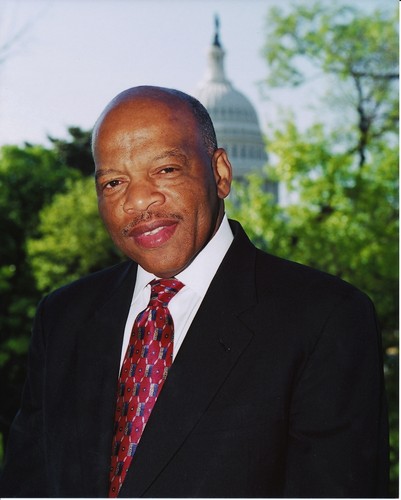
John Lewis
Personal Information
Description
Often called "one of the most courageous persons the Civil Rights Movement ever produced," John Lewis has dedicated his life to protecting human rights, securing civil liberties, and building what he calls "The Beloved Community” in America. His dedication to the highest ethical standards and moral principles has won him the admiration of many of his colleagues on both sides of the aisle in the United States Congress. He has been called "the conscience of the U.S. Congress,” and Roll Call magazine has said, "John Lewis…is a genuine American hero and moral leader who commands widespread respect in the chamber.” He was born the son of sharecroppers on February 21, 1940, outside of Troy, Alabama. He grew up on his family's farm and attended segregated public schools in Pike County, Alabama. As a young boy, he was inspired by the activism surrounding the Montgomery Bus Boycott and the words of the Rev. Martin Luther King Jr., which he heard on radio broadcasts. In those pivotal moments, he made a decision to become a part of the Civil Rights Movement. Ever since then, he has remained at the vanguard of progressive social movements and the human rights struggle in the United States. As a student at Fisk University, John Lewis organized sit-in demonstrations at segregated lunch counters in Nashville, Tennessee. In 1961, he volunteered to participate in the Freedom Rides, which challenged segregation at interstate bus terminals across the South. Lewis risked his life on those Rides many times by simply sitting in seats reserved for white patrons. He was also beaten severely by angry mobs and arrested by police for challenging the injustice of Jim Crow segregation in the South. During the height of the Movement, from 1963 to 1966, Lewis was named Chairman of the Student Nonviolent Coordinating Committee (SNCC), which he helped form. SNCC was largely responsible for organizing student activism in the Movement, including sit-ins and other activities. While still a young man, John Lewis became a nationally recognized leader. By 1963, he was dubbed one of the Big Six leaders of the Civil Rights Movement. At the age of 23, he was an architect of and a keynote speaker at the historic March on Washington in August 1963. In 1964, John Lewis coordinated SNCC efforts to organize voter registration drives and community action programs during the Mississippi Freedom Summer. The following year, Lewis helped spearhead one of the most seminal moments of the Civil Rights Movement. Hosea Williams, another notable Civil Rights leader, and John Lewis led over 600 peaceful, orderly protestors across the Edmund Pettus Bridge in Selma, Alabama on March 7, 1965. They intended to march from Selma to Montgomery to demonstrate the need for voting rights in the state. The marchers were attacked by Alabama state troopers in a brutal confrontation that became known as "Bloody Sunday." News broadcasts and photographs revealing the senseless cruelty of the segregated South helped hasten the passage of the Voting Rights Act of 1965. Despite more than 40 arrests, physical attacks and serious injuries, John Lewis remained a devoted advocate of the philosophy of nonviolence. After leaving SNCC in 1966, he continued his commitment to the Civil Rights Movement as Associate Director of the Field Foundation and his participation in the Southern Regional Council's voter registration programs. Lewis went on to become the Director of the Voter Education Project (VEP). Under his leadership, the VEP transformed the nation's political climate by adding nearly four million minorities to the voter rolls. In 1977, John Lewis was appointed by President Jimmy Carter to direct more than 250,000 volunteers of ACTION, the federal volunteer agency. In 1981, he was elected to the Atlanta City Council. While serving on the Council, he was an advocate for ethics in government and neighborhood preservation. He was elected to Congress in November 1986 and has served as U.S. Representative of Georgia's Fifth Congressional District since then. He is Senior Chief Deputy Whip for the Democratic Party in leadership in the House, a member of the House Ways & Means Committee, and Chairman of its Subcommittee on Oversight. John Lewis holds a B.A. in Religion and Philosophy from Fisk University, and he is a graduate of the American Baptist Theological Seminary, both in Nashville, Tennessee. He has been awarded over 50 honorary degrees from prestigious colleges and universities throughout the United States, including Harvard University, Brown University, the University of Pennsylvania, Princeton University, Duke University, Morehouse College, Clark-Atlanta University, Howard University, Brandeis University, Columbia University, Fisk University, and Troy State University. John Lewis is the recipient of numerous awards from eminent national and international institutions, including the highest civilian honor granted by President Barack Obama, the Medal of Freedom, the Lincoln Medal from the historic Ford’s Theatre, the Golden Plate Award given by the Academy of Excellence, the Preservation Hero award given by the National Trust for Historic Preservation, the Capital Award of the National Council of La Raza, the Martin Luther King, Jr. Non-Violent Peace Prize, the President’s Medal of Georgetown University, the NAACP Spingarn Medal, the National Education Association Martin Luther King Jr. Memorial Award, and the only John F. Kennedy "Profile in Courage Award" for Lifetime Achievement ever granted by the John F. Kennedy Library Foundation. John Lewis is the co-author of the National Book Award winning and #1 New York Times bestselling graphic novel memoir trilogy MARCH, written with Andrew Aydin and illustrated by Nate Powell. The first volume, MARCH: Book One, received a 2014 American Library Association (ALA) Coretta Scott King Book Award Author Honor, an ALA Notable Children's Book designation, was named one of YALSA's 2014 Top Ten Great Graphic Novels for Teens, and became the first graphic novel ever to receive a Robert F. Kennedy Book Award. MARCH: Book Two was released in 2015 and immediately became both a New York Times and Washington Post bestseller. MARCH: Book Two was awarded the comic industry's highest honor, the Will Eisner Award, as well as two Harvey awards among other honors. MARCH: Book Three was released in 2016, debuted at #1 on the New York Times Bestseller list, and became the first comics work to ever win the National Book Award. In January 2017, MARCH: Book Three made history again by winning four ALA Youth Media Awards, including the Printz Award, the Sibert Medal, the Coretta Scott King Author Book Award, and the YALSA Excellence in Nonfiction Award, becoming the first book to ever win four Youth Media Awards in a single year and cementing the MARCH Trilogy's place at the pinnacle of comics and young adult literature. The MARCH trilogy has been adopted into the core curriculm of school systems across the country to teach the Civil Rights Movement to the next generation, and has been selected as a First-Year common reading text at colleges and universities such as Michigan State University, Georgia State University, Marquette University, University of Utah, Henderson State University, University of Illinois Springfield, Washburn University, and many others. He is also the author of Across That Bridge: Life Lessons and a Vision for Change, written with Brenda Jones, and winner of the 2012 NAACP Image Award for Best Literary Work-Biography. His biography, published in 1998, is entitled Walking With The Wind: A Memoir of the Movement. Written with Michael D'Orso, Walking With The Wind is a receipient of the Anisfield-Wolf Book Award as well as the Robert F. Kennedy Book Award. He is also the subject of two other books written about his life: Freedom Riders: John Lewis and Jim Zwerg on the Front Lines of the Civil Rights Movement, by Ann Bausum and John Lewis in the Lead, by Jim Haskins and Kathleen Benson, with illustrations by famous Georgia artist, Bennie Andrews. He has been interviewed for numerous documentaries, news broadcasts, and journals, including the The Late Show with Stephen Colbert, Morning Joe, the Rachel Maddow Show, the Today show, CNN Headline News, CNN’s American Morning, CSPAN’s Washington Journal, Time Magazine, Newsweek Magazine, The New Yorker, The New York Times, The Washington Post, USA Today, the Atlanta Journal Constitution, the Boston Globe, the Dallas Morning News, the Miami Herald, the Philadelphia Tribune, Roll Call magazine, and many more. John Lewis lives in Atlanta, Georgia. He has one son, John Miles.
Books
Walking with the wind
"This bilingual edition of recent verse by the celebrated Iranian filmmaker Abbas Kiarostami (award-winning director of such films as Close-Up and Taste of Cherry) includes English translations of more than two hundred crystalline, haiku-like poems, together with their Persian originals. The translators, noted Persian literature scholars Ahmad Karimi-Hakkak and Michael Beard, contribute an illuminating introduction to Kiarostami's poetic enterprise, examining its relationship to his unique cinematic corpus and to the traditions of classic and contemporary Persian poetry. Of interest to enthusiasts of cinema and literature alike, Walking with the Wind - the second volume in Harvard Film Archives series "Voices and Visions in Film" - sheds light on a contemporary master who transforms simple fragments of reality into evocative narrative landscapes."--BOOK JACKET.
Run
Ben Forsberg is an ordinary guy, leading an ordinary life - or so he thinks. Everything changes the day two government agents appear unexpectedly at his door. Ben's business card has been found in the wallet of one of America's most dangerous assassins, who has just been shot dead. Whoever killed him has now set their sights on Ben. With no idea why he has been targeted, Ben has to act quickly. And in a world where suddenly nothing is as it seems, and no one can be trusted, Ben's only option is to run for his life.
Better Life for Their Children
"Born to Jewish immigrants, Julius Rosenwald rose to lead Sears, Roebuck & Company and turn it into the world's largest retailer. Born into slavery, Booker T. Washington became the founding principal of Tuskegee Institute. In 1912 the two men launched an ambitious program to partner with black communities across the segregated South to build public schools for African American children. This watershed moment in the history of philanthropy-one of the earliest collaborations between Jews and African Americans-drove dramatic improvement in African American educational attainment and fostered the generation who became the leaders and foot soldiers of the civil rights movement. Of the original 4,978 Rosenwald schools built between 1917 and 1937 across fifteen southern and border states, only about 500 survive. While some have been repurposed and a handful remain active schools, many remain unrestored and at risk of collapse. To tell this story visually, Andrew Feiler drove more than twenty-five thousand miles, photographed 105 schools, and interviewed dozens of former students, teachers, preservationists, and community leaders in all fifteen of the program states. A Better Life for their Children includes eighty-five duotone images that capture interiors and exteriors, schools restored and yet-to-be restored, and portraits of people with unique, compelling connections to these schools. Brief narratives written by Feiler accompany each photograph, telling the stories of Rosenwald schools' connections to the Trail of Tears, the Great Migration, the Tuskegee Airmen, Brown v. Board of Education, embezzlement, murder, and more. Beyond the photographic documentation, A Better Life for Their Children includes essays from three prominent voices. Congressman John Lewis, who attended a Rosenwald school in Alabama, provides an introduction; preservationist Jeanne Cyriaque has penned a history of the Rosenwald program; and Brent Leggs, director of African American Cultural Heritage at the National Trust for Historic Preservation, has written a plea for preservation that serves as an afterword"--
March. Book Two
187 pages : chiefly illustrations ; 25 cmGN850L Lexile
Carry on
Simon Snow is the worst Chosen One who's ever been chosen. That's what his roommate, Baz, says. And Baz might be evil and a vampire and a complete git, but he's probably right. Half the time, Simon can't even make his wand work, and the other half, he starts something on fire. His mentor's avoiding him, his girlfriend broke up with him, and there's a magic-eating monster running around, wearing Simon's face. Baz would be having a field day with all this, if he were here. It's their last year at the Watford School of Magicks, and Simon's infuriating nemesis didn't even bother to show up.
March. Book One
March is a vivid first-hand account of John Lewis’ lifelong struggle for civil and human rights, meditating in the modern age on the distance traveled since the days of Jim Crow and segregation. Rooted in Lewis’ personal story, it also reflects on the highs and lows of the broader civil rights movement. Book One spans John Lewis’ youth in rural Alabama, his life-changing meeting with Martin Luther King, Jr., the birth of the Nashville Student Movement, and their battle to tear down segregation through nonviolent lunch counter sit-ins, building to a stunning climax on the steps of City Hall. Many years ago, John Lewis and other student activists drew inspiration from the 1950s comic book "Martin Luther King and the Montgomery Story." Now, his own comics bring those days to life for a new audience, testifying to a movement whose echoes will be heard for generations. --back flap
March. Book Three
Welcome to the stunning conclusion of the award-winning and best-selling March trilogy. Congressman John Lewis, an American icon and one of the key figures of the civil rights movement, joins co-writer Andrew Aydin and artist Nate Powell to bring the lessons of history to vivid life for a new generation, urgently relevant for today's world.
Oral history interview with John Lewis, November 20, 1973
As the chairman of the Student Nonviolent Coordinating Committee (SNCC) from 1963 to 1966, future Georgia congressional representative John Lewis was a prominent leader of the civil rights movement. Lewis begins the story of his involvement in the civil rights movement in 1957, when he left his family of tenant farmers in rural Pike County, Alabama, to attend the American Baptist Theological Seminary in Nashville, Tennessee. While a seminary student in Nashville, Lewis began to participate in workshops on nonviolence and became an active and leading participant in the sit-in movement of 1960 in Nashville. For Lewis, the sit-in movement was substantial both for changing his personal views on the civil rights movement and for its ability to generate solidarity within the movement. Shortly after his introduction to civil rights activism, Lewis graduated and was ordained. Seeing the civil rights movement as "an extension of the Church, " Lewis devoted his energy to the movement full-time thereafter. In 1961, Lewis participated in the Freedom Rides through Mississippi and Alabama, and he offers an extensive overview of their purpose, the violent opposition the Riders faced, and the support they received from civil rights leaders and the White House. After the Freedom Rides, Lewis returned to Nashville, where he headed the Nashville student movement as a graduate student at Fisk University until 1963. That year, Lewis became the chairman of SNCC, a position he held for three years. In vivid detail, Lewis describes the major activities of SNCC during those years, focusing particularly on the Mississippi Freedom Summer of 1964 and the voter registration drives in Selma and the subsequent march to Montgomery in 1965. Throughout the interview, Lewis situates the role of SNCC more broadly within the civil rights movement as a whole, speaking at length about the transition from religious to political leadership within the movement, the growing importance of voter registration and political participation, and the need for solidarity within the African American community (particularly at the local level). Additionally, Lewis offers his thoughts on the role of Martin Luther King, Jr., as a leader of the movement, focusing on both King's influence on him personally and on the movement nationally. Lewis concludes the interview with an overview of the tensions that began to develop within SNCC during his chairmanship, leading to his decision to leave the organization following Stokely Carmichael's rise to power and the shift towards the politics of black power in 1966.