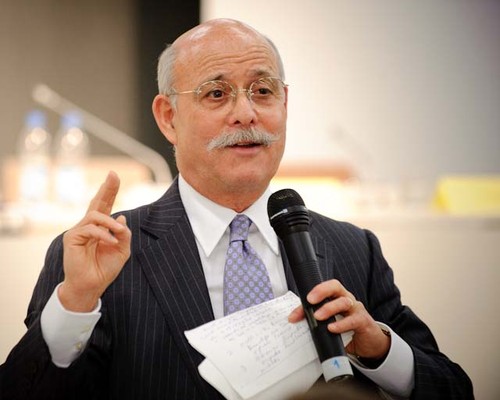
Jeremy Rifkin
Personal Information
Description
There is no description yet, we will add it soon.
Books
The European Dream
"The American Dream is in decline. Americans are increasingly overworked, underpaid, and squeezed for time. But there is an alternative: the European Dream-a more leisurely, healthy, prosperous, and sustainable way of life. Europe's lifestyle is not only desirable, argues Jeremy Rifkin, but may be crucial to sustaining prosperity in the new era. With the dawn of the European Union, Europe has become an economic superpower in its own right-its GDP now surpasses that of the United States. Europe has achieved newfound dominance not by single-mindedly driving up stock prices, expanding working hours, and pressing every household into a double- wage-earner conundrum. Instead, the New Europe relies on market networks that place cooperation above competition; promotes a new sense of citizenship that extols the well-being of the whole person and the community rather than the dominant individual; and recognizes the necessity of deep play and leisure to create a better, more productive, and healthier workforce. From the medieval era to modernity, Rifkin delves deeply into the history of Europe, and eventually America, to show how the continent has succeeded in slowly and steadily developing a more adaptive, sensible way of working and living. In The European Dream, Rifkin posits a dawning truth that only the most jingoistic can ignore: Europe's flexible, communitarian model of society, business, and citizenship is better suited to the challenges of the twenty-first century. Indeed, the European Dream may come to define the new century as the American Dream defined the century now past."
The biotech century
Jeremy Rifkin notes that after more than forty years of running on parallel tracks, the information and life sciences are fusing into a single powerful technological and economic force that is laying the foundation for the Biotech Century. Our way of life, says Rifkin, is likely to be transformed more fundamentally in the next few decades than in the previous thousand years. Food and fiber may be grown indoors in giant bacteria baths, partially eliminating the farmer and the soil for the first time in history. Animal and human cloning could be commonplace, with "replication" increasingly replacing "reproduction." Millions of people could obtain a detailed genetic readout of themselves, allowing them to gaze into their own biological futures and predict and plan their lives in ways never before possible. Parents may choose to have their children gestated in artificial wombs outside the human body. Genetic changes could be made in human fetuses to correct deadly diseases and disorders and enhance mood, behavior, intelligence, and physical traits. The new genetic commerce raises more troubling questions than any other economic revolution in history. Rifkin explores these and many other critical issues in this book about the coming era.
Voting green
A voting guide to making the most informed and meaningful environmental decision; includes a comprehensive congressional report card on Green issues.
La troisième révolution industrielle : Comment le pouvoir latéral va transformer l'énergie, l'économie et le monde
Ce livre développe la thèse d'une troisième révolution industrielle - que l'auteur appelle de ses vœux -, un nouveau paradigme économique qui va ouvrir l'ère post-carbone, basée notamment sur l'observation que les grandes révolutions économiques ont lieu lorsque de nouvelles technologies de communication apparaissent en même temps que des nouveaux systèmes énergétiques (hier imprimerie, charbon ou ordinateur ; aujourd'hui Internet & les énergies renouvelables). La Seconde Révolution Industrielle se meurt donc. Dans un futur proche, les humains génèreront leur propre énergie verte, et la partageront, comme ils créent et partagent déjà leurs propres informations sur Internet. Cela va fondamentalement modifier tous les aspects de la façon dont nous travaillons, vivons et sommes gouvernés. Comme les première et deuxième révolutions industrielles ont donné naissance au capitalisme et au développement des marchés intérieurs ou aux Etats-nations, la troisième révolution industrielle verra des marchés continentaux, la création d'unions politiques continentales et des modèles économiques différents. Le défi est triple : La crise énergétique, le changement climatique, le développement durable. Ces défis seront relevés par un changement de la mondialisation à la "continentalisation". C'est-à-dire la fin d'une énergie divisée, pour une énergie distribuée.
The Zero Marginal Cost Society
The capitalist era is passing -- not quickly, but inevitably. Rising in its wake is a new global collaborative Commons that will fundamentally transform our way of life. Ironically, capitalism's demise is not coming at the hands of hostile external forces. Rather, The Zero Marginal Cost Society argues, capitalism is a victim of its own success. Intense competition across sectors of the economy is forcing the introduction of ever newer technologies. Bestselling author Jeremy Rifkin explains that this competition is boosting productivity to its optimal point where the marginal cost of producing additional units is nearly zero, which makes the product essentially free. In turn, profits are drying up, property ownership is becoming meaningless, and an economy based on scarcity is giving way to an economy of abundance, changing the very nature of society. Rifkin describes how hundreds of millions of people are already transferring parts of their economic lives from capitalist markets to global networked Commons. "Prosumers" are producing their own information, entertainment, green energy, and 3-D printed products at nearly zero marginal cost, and sharing them via social media sites, rentals, redistribution clubs, bartering networks, and cooperatives. Meanwhile, students are enrolling in massive open online courses (MOOCs) that also operate at near-zero marginal cost. And young social entrepreneurs are establishing ecologically sensitive businesses, crowdsourcing capital, and even creating alternative currencies in the new sharable economy. As a result, "exchange value" in the marketplace -- long the bedrock of our economy -- is increasingly being replaced by "use value" on the collaborative Commons. In this new era, identity is less bound to what one owns and more to what one shares. Cooperation replaces self-interest, access trumps ownership, and networking drubs autonomy. Rifkin concludes that while capitalism will be with us for at least the next half century, albeit in an increasingly diminished role, it will no longer be the dominant paradigm. We are, Rifkin says, entering a world beyond markets where we are learning how to live together collaboratively and sustainably in an increasingly interdependent global Commons. - Publisher.