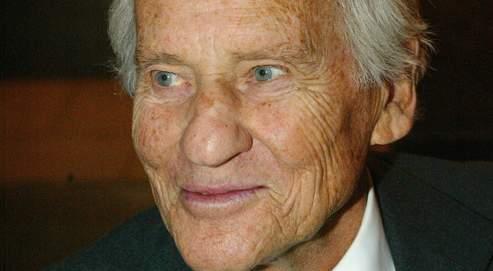
Jean d' Ormesson
Personal Information
Description
There is no description yet, we will add it soon.
Books
At God's pleasure
In this evocative, hanting novel a lost world is recovered, a world both privileged and doomed, the world of an aristocratic family as it confronts, head on, the twentieth century. The narrator, an orphaned only son of a younger son, is our guide and through him we witness the dissolution of "my old and beloved family" as it comes face to face with modern life. Through the elegant, witty voice of his narrator, Jean d'Ormesson takes readers into the shimmering, ephemeral seemingly timeless world of the aristocrat. We are swept up in the lives of grandparents, aunts, uncles, cousins, nieces, nephews, grandchildren, great and great-great grandchildren. We have visited the family's townhouses and estates, been privy to their scandals, been honored guests at their tea parties and soires. And lovingly, tenderly, nostalgically, d'Ormesson has shown us not only the weaknesses that brought this world to its end, but also the strengths and virtues that kept it viable so long.
The glory of the Empire
"The Glory of the Empire is the rich and absorbing history of an extraordinary empire, at one point a rival to Rome. Rulers such as Prince Basil of Onessa, who founded the Empire but whose treacherous ways made him a byword for infamy, and the romantic Alexis the Bastard, who dallied in the fleshpots of Egypt, studied Taoism and Buddhism, returned to save the Empire from civil war, and then retired "to learn how to die," come alive in The Glory of the Empire, along with generals, politicians, prophets, scoundrels, and others. D'Ormesson also goes into the daily life of the Empire, its popular customs, and its contribution to the arts and the sciences, which, as he demonstrates, exercised an influence on the world as a whole, from East to West, and whose repercussions are still felt today. But it is all fiction, a thought experiment worthy of Jorge Luis Borges, and in the end The Glory of the Empire emerges as a great shimmering mirage, filling us with wonder even as it makes us wonder at the fugitive nature of power and the meaning of history itself"--
Comme un chant d'espérance
Novel in which the author questions the world and its origins, and his thoughts about God and men.
Dieu, les affaires et nous
Il est démocrate, il est libéral : cet écrivain n'a jamais cessé d'affirmer ses convictions. Si l'idée de faire de la politique ne lui a pas traversé l'esprit, le spectacle de la politique, du combat des idées, de la marche du monde l'a fasciné. Il s'est toujours engagé. Nous sommes liés au monde et il nous faut participer au grand jeu des événements qui nous entourent parce que nous dépendons de l'histoire et que l'histoire dépend de nous. Ces textes surprennent par leur fraïcheur et leur allant. Dix ou trente ans après, ils continuent d'exciter l'esprit et de donner les causes des événements actuels. On y trouvera des portraits de grands hommes, des reportages à l'étranger, bien sûr des commentaires et des prises de position sur la politique intérieure française. Il faut relire les écrits passés (et toujours actuels). Sinon comment juger ceux qui jugent et voir s'ils ont eu tort ou raison? Comment savoir si un commentateur de l'actualité porte un regard juste sinon en vérifiant après coup ses analyses et ses prévisions? Pour dire s'il est équitable, il faut attendre que la passion tombe et que l'histoire ait au moins commencé à faire son œuvre. C'est donc un bel exercice de vérification auquel se livre l'auteur. Il s'est parfois trompé. Sur plusieurs points, les faits lui ont donné raison. Pendant toutes ces années, Jean d'Ormesson a observé le monde et les hommes et les femmes qui nous gouvernent. Prenez parti, dit-il, et trompez-vous sans trop de bassesses. Ceux qui ne défendent pas leurs amis sont ignobles. Ceux qui ne défendent que leurs amis sont aveugles. Il faut se débrouiller dans ce labyrinthe. C'est ce qu'on appelle l'honneur des hommes. Covers the social and political history of France from 1981 to the present day.
Guide des égarés
We do not know why we were born or what we become after death. We are all astray. That's the question, "What am I doing here" that this pocket manual strives to meet.