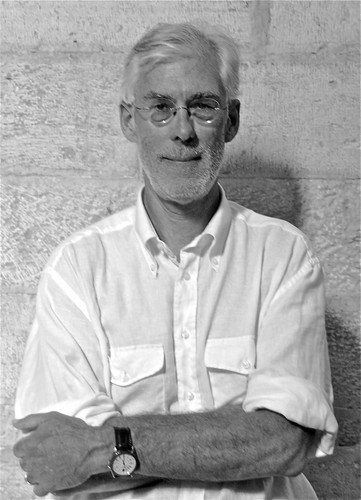
James Williamson
Personal Information
Description
James Williamson, author of The Ravine and The Architect, is a professor of architecture at the University of Memphis. After some 30 years of professional practice in his own firm, he now teaches full-time at both the graduate and undergraduate levels. Prof. Williamson has received over 30 architectural design awards at the local, regional, and national levels, and his work has been published internationally. In 2005 he was elected to the College of Fellows of the American Institute of Architects in recognition of his notable contributions in architectural design and education. He was born in Memphis, and is a graduate of Rhodes College. As a student he participated in the Civil Rights movement, marching with Dr. Martin Luther King during the 1968 Memphis sanitation workers' strike. During the Vietnam War he served as a naval officer. Following his military service Prof. Williamson obtained two Master of Architecture degrees from the University of Pennsylvania, where he was a student of renowned architect Louis Kahn. In Philadelphia he also worked as an associate of Robert Venturi. Major commissions by his own firm in Memphis included a number of new churches, the restoration of two historic cathedrals and a theater, the headquarters of the city’s ballet company, a law office, and collaboration on a plan for downtown Memphis. His first novel, The Architect, was praised by a reviewer as “a thoughtful, moving novel about the realities of building, particularly when style collides with money, politics, and the demands of the less than enlightened… a lively treatise on architecture itself.” A previous book, The Central Gardens Handbook, is a guide to historic preservation for a local historic district, now in its second edition. In addition, he has had a number of articles published in national and international architectural journals, as well as a cover article for “Tennessee Historical Quarterly” magazine. The Ravine (2012) is his latest novel. Prof. Williamson is currently at work on a non-fiction book about Louis Kahn.
Books
The Ravine
A compelling story, "The Ravine" evokes the South during the early years of the Civil Rights movement where a complex mixture of love and hate, ignorance and enlightenment, and guilt and innocence coexist. It promises to keep the reader on edge until its dramatic and unexpected conclusion. In 1958, thirteen year-old Harry Polk is looking forward to an idyllic summer spent visiting his Aunt Cordelia and Uncle Horace in Tuckalofa, Mississippi. Harry soon learns that beneath its placid surface, the town is not what it seems. Before the summer is over he will encounter the violence and injustice of segregated society, intolerance of religious and social class differences, and closely guarded family secrets. When a popular young black man is brutally murdered by the county sheriff, Harry, Cordelia, and Horace will be caught up in a series of events culminating in an act of revenge that leaves Harry emotionally scarred. Years later, when Harry is summoned to Tuckalofa to arrange the funeral of his formidable Aunt Cordelia, he is forced to confront the past that has lain dormant for years—a past in which he found himself embroiled in the vicious crime that had tragic consequences for the entire town. James Williamson, a professor of architecture at the University of Memphis, was raised in the South in the days of segregation. His first novel, "The Architect," was praised as “a thoughtful, moving novel about the realities of building, particularly when style collides with money, politics, and the demands of the less than enlightened…a lively treatise on architecture itself.”
Kahn at Penn
Louis I. Kahn is widely known as an architect of powerful buildings. But although much has been said about his buildings, almost nothing has been written about Kahn as an unconventional teacher and philosopher whose influence on his students was far-reaching. Teaching was vitally important for Kahn, and through his Master's Class at the University of Pennsylvania, he exerted a significant effect on the future course of architectural practice and education. This book is a critical, in-depth study of Kahn's philosophy of education and his unique pedagogy. It is the first extensive and comprehensive investigation of the Kahn Master's Class as seen through the eyes of his graduate students at Penn.
Central Gardens handbook
A guide to preservation by architects for homeowners in a distinguished Memphis historic district.