Discover

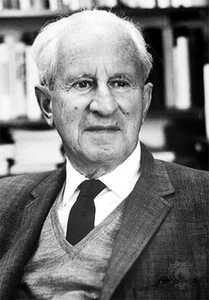
Herbert Marcuse

Personal Information

Born July 19, 1898
Died July 29, 1979 (81 years old)
Berlin, West Germany
Also known as: Marcuse, Herbert, HERBERT MARCUSE
26 books
3.6 (10)
183 readers

Description

Herbert Marcuse (July 19, 1898 – July 29, 1979) was a German-American philosopher, sociologist, and political theorist, associated with the Frankfurt School of Critical Theory. Born in Berlin, Marcuse studied at the universities of Berlin and then at Freiburg, where he received his PhD. He was a prominent figure in the Frankfurt-based Institute for Social Research – what later became known as the Frankfurt School. He was married to Sophie Wertheim (1924–1951), Inge Neumann (1955–1973), and Erica Sherover (1976–1979). In his written works, he criticized capitalism, modern technology, historical materialism and entertainment culture, arguing that they represent new forms of social control. Source: [Herbert Marcuse](

Books

Newest First

Counterrevolution and Revolt

0.0 (0)
2

Counterrevolution and Revolt is a 1972 book by the philosopher Herbert Marcuse. Summary

The New Left and the 1960s

0.0 (0)
0

This volume contains articles, letters, talks an interviews including: "On the New Left," a transcription of the 1968 talk at The Guardian newpaper's 20th anniversary; "Reflections on the French Revolution" which contains comments on the 1968 French student and worker uprising; "Liberation from the Affluent Society" which presents Marcuse's contribution to the 1967 "Dialectics of Liberations" conference; and "USA: Questions of Organization and the Revolutionary Subject", a conversation between Marcuse and the German writer Hans Magnus Enzenburger, published here in English for the first time. -- Back cover.

Secret Reports on Nazi Germany

0.0 (0)
3

"During the Second World War, three prominent members of the Frankfurt School--Franz Neumann, Herbert Marcuse, and Otto Kirchheimer--worked as intelligence analysts for the Office of Strategic Services, the wartime forerunner of the CIA. This book brings together their most important intelligence reports on Nazi Germany, most of them published here for the first time. These reports provide a fresh perspective on Hitler's regime and the Second World War, and a fascinating window on Frankfurt School critical theory. They develop a detailed analysis of Nazism as a social and economic system and the role of anti-Semitism in Nazism, as well as a coherent plan for the reconstruction of postwar Germany as a democratic political system with a socialist economy. These reports played a significant role in the development of postwar Allied policy, including denazification and the preparation of the Nuremberg Trials. They also reveal how wartime intelligence analysis shaped the intellectual agendas of these three important German-Jewish scholars who fled Nazi persecution prior to the war."--Amazon.com.
Eros and Civilization

3.0 (1)
33

This is Herbert Marcuse's masterpiece which transfixed youth in the 1960s, convincing the New Left there was hope in revolutionary activity. It's also Marcuse encounter with Signmund Freud, well worth the time to decipher it. Narcuse is optimistic, in that if we tame or transform capitalism, we can fix ourselves. It's a far cry from Freud's pessimistic outlook.

The critical spirit

0.0 (0)
2

Bibliographical footnotes. Introduction: What is the critical spirit?--Utopianism, ancient and modern, by M.I. Finley.--Primitive society in its many dimensions, by S. Diamond.--Manicheanism in the Enlightenment, by R.H. Popkin.--Schopenhauer today, by M. Horkheimer.--Beginning in Hegel and today, by K.H. Wolff.--The social history of ideas: Ernst Cassirer and after, by P. Gay.--Policies of violence, from Montesquieu to the Terrorist, by E.V. Walter.--Thirty-nine articles: toward a theory of social theory, by J.R. Seeley.--History as private enterprise, by H. Zinn.--From Socrates to Plato, by H. Meyerhoff.--Rational society and irrational art, by H. Read.--The quest for the Grail; Wagner and Morris, by C.E. Schorske.--ValeÌ#x81;ry; Monsieur Teste, by L. Goldmann.--History and existentialism in Sartre, by L. Krieger.--German popular biographies; culture's bargain counter, by L. Lowenthal.--The Rechtsstaat as magic wall, by O. Kirchheimer.Revolution from above: some notes on the decision to collectivize Soviet agriculture, by E.H. Carr.--Winston Churchill, power politician and counter revolutionary, by A.J. Mayer.--Brahmins and business, 1870-1914; a hypothesis on the social basis of success in American history, by G. Kolko.--On the limits of professional thought, by M.R. Stein.--The limits of integration, by P. Mattick.--The society nobody wants; a look beyond Marxism and liberalism.--Marcuse as teacher, by W. Leiss, J.D. Ober and E. Sherover.--Marcuse bibliography, by W. Leiss, J.D. Ober and E. Sherover (p. 427-433).

The essential Marcuse

0.0 (0)
1

"An overview of Herbert Marcuse's four decades of political and philosophical criticism"--P. of cover.

Reason and Revolution

4.0 (2)
12

Reason and Revolution: Hegel and the Rise of Social Theory (1941; second edition 1954) is a book by the philosopher Herbert Marcuse, in which the author discusses the social theories of the philosophers Georg Wilhelm Friedrich Hegel and Karl Marx. Marcuse reinterprets Hegel, with the aim of demonstrating that Hegel's basic concepts are hostile to the tendencies that led to fascism. The book has received praise as an important discussion of Hegel and Marx. (Source: [Wikipedia](

An Essay on Liberation

0.0 (0)
9

An Essay on Liberation is a 1969 book by the Frankfurt School philosopher Herbert Marcuse. (Source: [Wikipedia](
