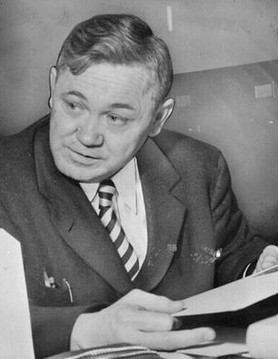
Henry Steele Commager
Personal Information
Description
Henry Steele Commager (October 25, 1902 – March 2, 1998) was an American historian.
Books
The Story of the Second World War
Historian Donald L. Miller offers The Story of World War II, an expanded and updated rewrite of Henry Steele Commager's 1945 The Story of the Second World War. Commager was a historian who taught at NYU, Columbia and Amherst; he died in 1998. Miller (Lewis Mumford: A Life) is a professor at Lafayette College and the host of PBS's A Biography of America. With new material from oral accounts, letters and memoirs to which Commager didn't have access and with the inclusion of nearly 200 b & w photographs, Miller alters the footprint but respects the integrity of his predecessor's work. Old-school, just-the-facts-Ma'am historiography is the name of this game, but the extensive, moving testimonies by veterans of their brushes with death and terror humanize and vivify the described events. Maps.
Commager on Tocqueville
With an insight that approached genius, Alexis de Tocqueville saw that America held the key to the future. He predicted that the American democratic experiment he witnessed in the early nineteenth century would spread to the rest of the Western world. With the recent collapse of communism and the emergence of democracy everywhere, Tocqueville's writings are more relevant today than ever before. In Commager on Tocqueuille, one of America's most distinguished historians, Henry Steele Commager, applies Tocqueville's predictions and questions to our present time. He asserts that now - with the validity of the whole democratic experiment at stake in Europe, America, Asia, and Africa - Tocqueville's writings offer both warning and guidance. Commager introduces the study with an analysis of Tocqueville's classic Democracy in America. Explaining the book's history and assessing its strengths and weaknesses, Commager places Tocqueville in an appropriate context before launching into the heart of his study - Tocqueville's concern for the reconciliation of liberty and order. With that larger subject as a base, Commager explores five major questions raised by Tocqueville: democracy and the tyranny of the majority; the price of a just society; centralization and democracy; the military in a democracy; and contradictions between political equality and economic inequality. Commager uses Tocqueville as a vehicle to discuss these timeless questions, incorporating contemporary concerns such as the environment, civil rights, and the military-industrial complex. Commager on Tocqueville intertwines the analysis of a truly remarkable contemporary thinker with the visionary genius of an early nineteenth-century statesman. Students of history, political science, philosophy, and anyone interested in recent international political events will find this book invaluable.
The Civil War Almanac
Provides a day-to-day chronology of events of the American Civil War.
