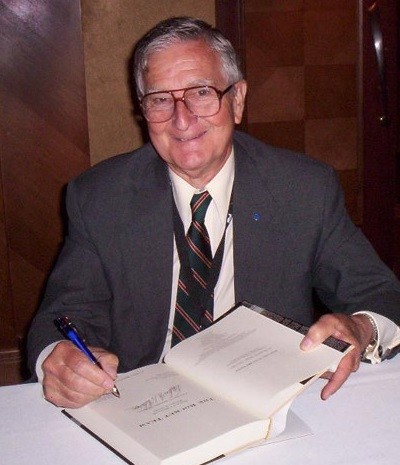
Frederick I. Ordway III
Personal Information
Description
Frederick Ira Ordway III was born in New York City and raised in Maine. He studied geosciences at Harvard University. He spent several years in graduate study at the University of Paris and other universities in Europe. He worked at a mining company and later for the rocket fuel company Reaction Motors. He spent three years as a technical adviser on the film 2001: A Space Odyssey. From 1970-1973 he was a faculty member at The University of Alabama in Huntsville. He then became a special assistant to Robert Seamans, the first Director of the Energy Research and Development Agency (now the DOE), where he stayed for the remainder of his career. He was the author, co-author, or editor of more than thirty books and over three hundred articles. He was the longest-serving member of the American Rocket Society, having joined in 1939 and maintained his membership until his death in 2014.
Books
History of rocketry & space travel
From Book Cover: This comprehensive, authoritative, and highly acclaimed history now has been updated and enlarged to cover all the latest developments and discoveries in space science and exploration. These include the Apollo manned landings on the moon, the probing by Russia and the United States of Venus and Mars, the voyages of Pioneers 10 and 11 past Jupiter to the outer reaches of the Solar System, the American Mariner 10 flight to Mercury, the Skylab missions, as well as the exciting applications of Earth Resources Technology Satellites in monitoring and managing this planet's resources. International in scope and illustrated with more than 350 photographs and drawings, this volume ranges from ancient Babylonian and Greek concepts of the universe through the developments of primitive rockets by Chinese, Arabian, and Medieval European experimenters to the breathtakingly complex interplanetary missions of today. It reviews the work of three great pioneers of the early part of the twentieth century - America's Goddard, Germany's Oberth, and Russia's Tsiolkovsky - as well as the accomplishments of Esnault-Pelterie in France, Isaac Lubbock's work on liquid propellants in Great Britain, and the development of the Russian "Katyusha". It details the experiments of von Braun and Walter R Dornberger in German before World War II, and gives a full account of the work of their development team on the V-2 rocket at the Peenemunde Center. The dramatic story of the German scientists' surrender to American forces in 1945, as well as their eventual accomplishments at the Army's Redstone Arsenal and subsequently NASA's Marshal Space Flight Center in Huntsville, Alabama, is also told at first hand. Here are interesting insights into the United States' rocket experiments during World War II and the reasons behind the near-disastrous delay in America's long-range missile research and satellite programs - which went into high gear only after Russia, had begun flight-testing her own long-range rockets that a few years later enabled her to open the space age with the famous Sputnik. Less-familiar but highly significant aspects of our many-faceted space effort, from its beginning with FDR's National Defense Research Committee, are disclosed and documented. The authors trace the development of many specific rockets and missiles, ranging from the Bazooka to huge intercontinental ballistic missiles and anti-ballistic missiles. From an unequaled base of direct knowledge reinforced by exhaustive research, Dr. von Braun and Professor Ordway assess the meaning for the future of man's epochal leap into space. They survey the current status of space programs in the United States and Russia, as well as in all the other major nations, and forecast their probable direction. Tables, providing valuable rocketry and spacecraft data, and an extensive bibliography are included.
Visions of spaceflight
"Frederick I. Ordway III's fascination with rockets and spaceflight began in the days long before NASA. He pursued his obsession, became one of the first to work in the fledgling industry, and along the way amassed an impressive, world-class collection of images of space art. His pictures depict scenes from works from the second century to the eve of the Space Age, in the late 1950s. Now, for the first time, in one full-color volume, the stars from his collection are brought together.". "Many of the pictures here have not been seen outside the collection in modern times; others appeared only in magazines during the early decades of the twentieth century: the original works are presented in this book in pristine glory. Images of early astronauts maneuvering their craft in Mars orbit; fantastic vehicles - with propulsion ranging from dewdrops (seventeenth century) to anti-gravity (nineteenth century) - abound. These realms are populated by heroes and scientists, dreamers and pioneers: a mix of the intentionally fantastic with the rigorously scientific."--BOOK JACKET.