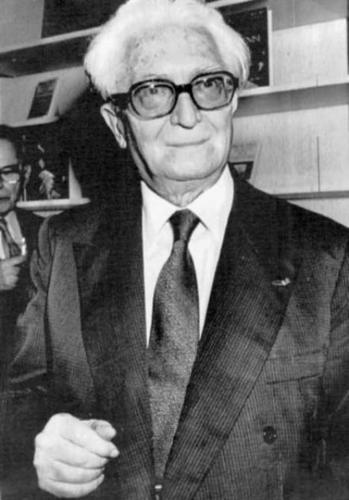
Fernand Braudel
Personal Information
Description
Fernand Braudel was the foremost French historian of the postwar era and a leader of the Annales School. His scholarship focused on three great projects, each representing several decades of intense study: "The Mediterranean" (1923–49, then 1949–66), "Civilization and Capitalism" (1955–79), and the unfinished "Identity of France" (1970–85). His reputation stems in part from his writings, but even more from his success in making the Annales School the most important engine of historical research in France and much of the world after 1950. As the dominant leader of the Annales School of historiography in the 1950s and 1960s, he exerted enormous influence on historical writing in France and other countries. Braudel has been considered one of the greatest of those modern historians who have emphasised the role of large-scale socioeconomic factors in the making and telling of history. He can also be considered as one of the precursors of World Systems Theory.
Books
The Mediterranean
The focus of Fernand Braudel's great work is the Mediterranean world in the second half of the sixteenth century, but Braudel ranges back in history to the world of Odysseus and forward to our time, moving out from the Mediterranean area to the New World and the other destinations of Mediterranean traders. Braudel's scope embraces the natural world and material life, economics, demography, politics, diplomacy.
The Mediterranean and the Mediterranean World in the Age of Philip II, Vol. 1
Out of Italy, 1450-1650
"By 1450, all of Europe and the Mediterranean were influenced by the teachings, the economies and the intellect of Italy. Its predominance had been achieved through a long history of effort, patience and strategic victories. How did Italy, or rather a handful of Italian cities, a few men all told, succeed in acquiring and maintaining a position of dominance vis-à-vis Byzantium, Islam, and western Europe? In this fascinating and insightful study, Fernand Braudel, one of the most distinguished historians of our time, examines the many-sided phenomenon of greatness that characterized Italy during the two centuries spanning the Renaissance, Mannerism, and the Baroque -- dazzling, multicoloured Italy, whose radiance shone all over Europe. Braudel perceptively describes the extent, nature and force of Italian influence abroad, analyses the complex interaction between art, science, politics and commerce, and proposes a paradigm of Italy's extraordinary cultural flowering. This is the first English translation of Braudel's now-classic text. The volume is beautifully designed and illustrated with works by Michelangelo, Raphael, Titian, Ghirlandai, van Eyck, Rubens, Caron, and Poussin. It is an invaluable work for students of Italian history who will find that their understanding of Italian culture has been immeasurably enriched." -- Book jacket.
The wheels of commerce
TABLE OF CONTENTS: The instruments of exchange. Europe: the wheels of trade at the lowest level -- Europe: the wheels of trade at the highest level -- The world outside Europe -- Concluding hypotheses -- Markets and the economy. Merchants and trade circuits -- Trading profits, supply and demand -- Markets and their geography -- National economies and the balance of trade -- Locating the market -- Production : or capitalism away from home. Capital, capitalist, capitalism -- Land and money -- Capitalism and pre-industry -- Transport and capitalist enterprise -- A rather negative balance sheet -- Capitalism on home ground. Capitalist choices and strategies -- Individual firms and merchant companies -- Back to a threefold division -- Society : `A set of sets' -- Social hierarchies -- The all-pervasive state -- Civilizations do not always put up a fight -- Capitalism outside Europe -- By way of conclusion.
Méditerranée et le monde méditerranéen à l'époque de Philippe II
Geographical, environmental, and economic study of the Mediterranean lands with emphasis on period 1550-1600 A. D.
Grammaire des civilisations
Fernand Braudel was one of the greatest historians of the twentieth century. A leading member of the Annales school, he rejected a narrow focus on Western warfare, diplomacy, and power politics, and opened up economic and social history to influences from anthropology, sociology, geography, psychology, and linguistics. In the late 1950s, when the Annales approach was widely accepted in French universities, a major reform introduced the study of "the main contemporary civilizations" into the final year of secondary schools. Traditionalists attacked the new stress on the social sciences and eventually triumphed, but Braudel was firmly committed to such changes. This marvelous survey of world history, the last of his books to be translated into English, was originally intended for French "sixth-formers." Yet its real value is far more permanent. Even an "educational story," Braudel once suggested in a lecture, can become a "tale of adventure," provided the historian manages to "find the key to a civilization" and is not afraid of simplicity - "not simplicity that distorts the truth, produces a void, and is another name for mediocrity, but simplicity that is clarity, the light of intelligence." Such a light shines throughout A History of Civilizations. After an introductory section examining the nature of cultures and civilizations, their continuities and transformations, Braudel surveys broad historical developments in almost every corner of the globe: the Muslim world - from the rise of Islam to post-colonial revival; Black Africa - from the slave trade to the dilemmas of development; the Far East: China, India, the maritime states and Japan; Europe - from the collapse of the Roman Empire to political union; the European civilizations of the New World: Latin America and the United States; the English-speaking universe: Canada, Southern Africa, Australia, and New Zealand; and the other Europe: Russia, the USSR, and the CIS. For this excellent translation, Richard Mayne has gently updated the text. And yet, as he explains in his Introduction, very little was necessary. Braudel always had an astonishingly firm grasp on the broad sweep of history - a grasp which, "in the hands of a master, can help explain the most dramatic convulsions in the past, the present, and the future."
The structures of everyday life
This social and economic history of Europe from the Middle Ages to the Industrial Revolution organizes a multitude of details to paint a rich picture of everyday life.
Capitalism & Material Life, 1400-1800
This work is concerned with the quest for progress in daily life throughout the world between the fifteenth and eighteenth centuries. Professor Braudel studies the demographic expansion that outstripped the production of goods, and the many other factors that brought about the low subsistence level of the majority of people in contrast with the luxurious living standards of the wealthy and privileged few; the effects of famine and plague; the gradual expansion of the towns in a basically agricultural economy. In this first of a two-volume work deals with population; staple diets throughout the world; housing and clothes; the spread of technology in particular, sources of power; communications; early economies and kinds of money; towns in East and West. The second volume will deal with the rise and expansion of capitalism.
Civilization and Capitalism, 15th-18th Century (Civilisation & Capitalism: 15th-18th Century)
Civilisation matérielle, économie et capitalisme
The concluding volume of the trilogy charts the growth of the world economy from the 15th to the 18th century concentrating on the human activity that underlies the business of life.