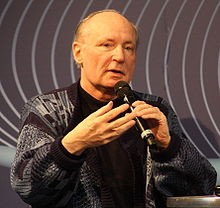
Eugen Drewermann
Personal Information
Description
Eugen Drewermann is a German church critic, theologian, peace activist and former Roman Catholic priest. His work has been translated into more than a dozen languages. Trained in philosophy, theology, psychoanalysis, and comparative religious studies, he criticized the Roman Catholic Church's literal and biologistic interpretations of miracles, the virgin birth, Ascension, and Resurrection as superstitious and medieval. Archbishop Degenhardt of Paderborn and the Catholic Bishops Conference of Germany engaged in a long drawn-out and heated debate with Drewermann which was closely followed by media and public. As a consequence, on 7 October 1991, the Archbishop disallowed him to teach at the Catholic Seminary of Paderborn and, shortly afterwards, revoked his license to preach 1992. Drewermann left the Catholic Church on his 65th birthday on 20 June 2005. Source: Wikipedia
Books
Strukturen des Bösen, Tl.2, Die jahwistische Urgeschichte in psychoanalytischer Sicht
Der Wolf und die sieben jungen Geißlein / Der Wolf und der Fuchs. Grimms Märchen tiefenpsychologisch gedeutet
Goethes Märchen tiefenpsychologisch gedeutet, oder, Die Liebe herrscht nicht
Glauben in Freiheit 3/2. und es geschah so. Die moderne Biologie und die Frage nach Gott
Glauben in Freiheit 3/1. Der sechste Tag. Die Herkunft des Menschen und die Frage nach Gott
Daß auch der Allerniedrigste mein Bruder sei. Dostojewski - Dichter der Menschlichkeit
Und gäbe dir eine Seele ..
The story of an unrequited love, of someone more willing to give up her lover and her own life than to give up loving. A love that is greater than the desire for fulfillment, larger than life and death. Hans Christian Andersen's Little Mermaid is a thought-provoking tale, for it tells us about those unhappy lovers who want to give themselves to someone who can not accept the gift of their life. The theologian and psychoanalyst gradually decrypts Andersen's language and symbolism with the methods of depth psychology. He comes to a new interpretation of this famous fairy tale, which also contains autobiographical elements of the author Hans Christian Andersen. Nowhere else but in his diaries Andersen himself speaks so directly, not anywhere else he sets out to describe - even if symbolically veiled - his most intimate feelings, his yearning for love and his loneliness.