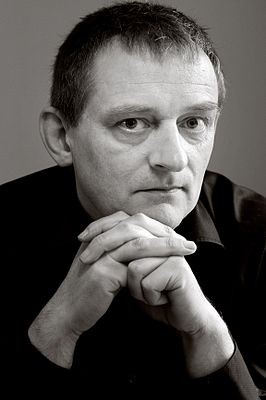
Erwin Mortier
Personal Information
Description
There is no description yet, we will add it soon.
Books
Berlinde De Bruyckere
Berlinde De Bruyckere (Ghent, 1964) has been a leading light in the international contemporary art world for many years already. Her raw, intriguing sculptures, installations and drawings draw strength from vulnerability and tenderness in the face of relentlessness. This exhibition catalogue shows her taking new steps on her artistic path, in search of the meaning of humanity, physicality, suffering and vitality. The themes in De Bruyckere's work have a universal and timeless value. But they gain extra urgency in times when, prompted by an unknown pandemic, the need for human connection is greater than ever, while at the same time the body has become a danger to mankind.00De Bruyckere's compelling sculptures have a long and complex creative history. Much of her work is constructed of wax, resin, rope, skins and canvas, which she sometimes exposes to the elements for years before incorporating them into her art. Despite their confronting character the sculptures cry out to be touched and stroked, and exude warmth and the tangibility of existence. It is this powerful resonance that has made De Bruyckere one of the most important West European artists, ever since the early days of her career. Her oeuvre has been honoured by solo exhibitions all over the world. She has received several awards and has participated twice in the Venetian Biennale: in 2003 in the main pavilion, and in 2013 when she represented Belgium, in collaboration with Nobel Prize winner J.M. Coetzee. The Bonnefanten is the stage for her first Dutch solo exhibition since 2015.00Exhibition: Bonnefantenmuseum, Maastricht, The Netherlands (09.02.-27.06.2021).
While the gods were sleeping
While the Gods Were Sleeping is a novel about the magnitude and impact of the First World War, the recollections of which are recorded in the notebooks of the elderly Helena. The young Helena is sent to her uncle's country house before the war, and from here she witnesses scenes of indescribable horror. But it is also where she meets Matthew again, a British Army photographer who she goes on to marry. This is a story not about spectacular events; rather, Mortier is concerned with writing about war, history and the past with great empathy and engagement, and with a mixture of melancholy, qualification and resignation.
My fellow skin
My Fellow Skin is a beautiful, affectionate novel told from the point of view of an impressionable young boy. The novel opens before the boy can talk, and we follow Anton's first, tentative steps on the path to adulthood. He gradually begins to grasp an understanding of time and death, and when he goes to school he falls in love for the first time -- not with the schoolgirls his peers are interested in, but with his classmate, Willem. A gentle, protective relationship develops between them, and this gives Anton his own, new identity, his 'fellow skin'. But their love ends tragically, and Anton ultimately loses not only his love, but also his youth, the protection of his parents, and the old house in the village. He is left desolate. --