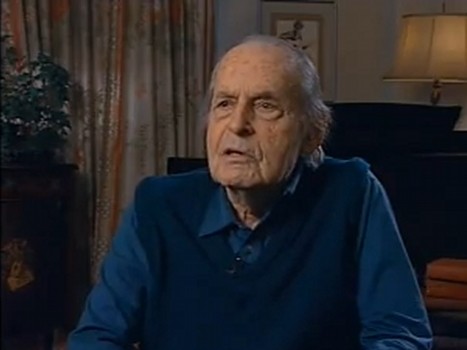
Discover

Erik Barnouw

Personal Information

Born January 1, 1908
Died January 1, 2001 (93 years old)
The Hague, United States
Also known as: Barnouw, Eril Barnouw
18 books
0.0 (0)
62 readers

Description

American media historian

Books

Newest First

The golden web

0.0 (0)
1

Detailed and scholarly review of American radio broadcasting from 1933 to 1953. Addresses the key innovators like Paley and Murrow, and many important figures whose names are unknown. This is a dense, well-reaearched book. Volume 2 of a 3 volume set. You don not need to have read volume 1 to enjoy this one. Not light reading.

Media marathon

0.0 (0)
1

Media history is his subject, and, as this memoir makes so delightfully clear, it has also been Erik Barnouw's life. Barnouw's story, told with wit and charm in Media Marathon, is the story of American culture adjusting to the twentieth century, of new media repeatedly displacing the old in a century-long competitive upheaval. Born in Holland in 1908 and an immigrant to the United States at the age of eleven, Barnouw spent his early working years in an astounding array of occupations - actor and stage manager, lyricist, translator, director, producer, teacher, and union official. This varied background, described here in rich detail, informs his writings about the world in which he moved, specifically regarding the shifting channels of twentieth-century mass communication. Telling his story through a series of personal profiles of the famous, the infamous, and the little known but powerfully influential, Barnouw recounts the events that took him from the vaudeville stage to the Library of Congress, where he became the first chief of its newly formed Motion Picture, Broadcasting, and Recording Sound Division. Thornton Wilder, Pearl S. Buck, Joshua Logan, Dwight Eisenhower, Lynn Fontanne, Tallulah Bankhead, and Akira Iwasaki - these are among the featured characters in the drama of American media, rendered here in striking close-ups. From The Hague to retirement in Vermont, with stops in India, Japan, and Russia, Barnouw's remarkable story gives readers the chance to relive crucial chapters of modern media history - and to relive them with one of that history's masters as an incomparable guide.

House with a past

0.0 (0)
0

The author's purchase of a stone house in Vermont, a former Mormon place of worship, leads him to investigate its history and that of the Mormon Church.

The sponsor

0.0 (0)
1

"The Sponsor is divided into three parts. In "Rise," Barnouw sketches the rise of the sponsor, in both radio and television, to his present state of eminence. In "Domain," the sponsor's pervasive impact on television programming is examined, with an emphasis on network television, the primary arena of the industry. And in "Prospect," Barnouw assesses what such dominance has meant for American society, mores, and institutions - and what it may mean for our future. This is a gripping volume about power, how it not only influences programming itself, but how it defines for the average person what is good, great, and desirable."--Jacket.

Tube of plenty

0.0 (0)
11

Based on the classic History of Broadcasting in the United States, Tube of Plenty represents the fruit of several decades' labor. When Erik Barnouw--premier chronicler of American broadcasting and a participant in the industry for fifty years--first undertook the project of recording its history, many viewed it as a light-weight literary task concerned mainly with "entertainment" trivia. Indeed, trivia such as that found in quiz programs do appear in the book, but Barnouw views them as part of a complex social tapestry that increasingly defines our era. To understand our century, we must fully comprehend the evolution of television and its newest extraordinary offshoots. With this fact in mind, Barnouw's new edition of Tube of Plenty explores the development and impact of the latest dramatic phases of the communications revolution. Since the first publication of this invaluable history of television and how it has shaped, and been shaped by, American culture and society, many significant changes have occurred. Assessing the importance of these developments in a new chapter, Barnouw specifically covers the decline of the three major networks, the expansion of cable and satellite television and film channels such as HBO (Home Box Office), the success of channels catering to special audiences such as ESPN (Entertainment and Sports Programming Network) and MTV (Music Television), and the arrival of VCRs in America's living rooms. He also includes an appendix entitled "questions for a new millennium," which will challenge readers not only to examine the shape of television today, but also to envision its future. --Publisher.

Radio Pioneers Project

0.0 (0)
0

Radio reporter. Topics include: early days of radio; experiences as radio reporter.
