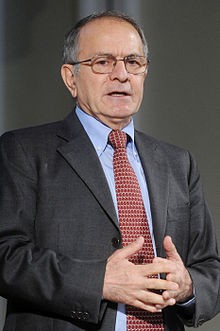
Emilio Gentile
Personal Information
Description
Emilio Gentile (born 31 August 1946, in Bojano) is an Italian historian specializing in the ideology and culture of fascism. Gentile is considered one of Italy's foremost cultural historians of fascist ideology. He studied under Renzo De Felice and wrote a book about him. Gentile is a professor at the Sapienza University of Rome. He considers fascism a form of political religion. He also applied the theory of political religion to the United States after the September 11 attacks. In 2003, Professor Gentile was awarded the Hans Sigrist Prize. Source: [Emilio Gentile]( on Wikipedia.
Books
The Italian Road to Totalitarianism (Totalitarianism Movements and Political Religions)
God's democracy
"In God's Democracy, Emilio Gentile argues that the: presidency of George W. Bush sought to alter the way religion: functions in American political life. Prior to the events of 9/11, the national government operated under a civil religious regime that placed a sacred umbrella over the entire country and its leading political figures. American civil religion was not only an inclusive faith, but one that provided ample room for citizens with different politics and different world views." "In the wake of 9/11, President Bush used religion to differentiate Americans along partisan lines. Relying heavily on his evangelical Christian base, he attempted to substitute for the inclusivism of the traditional American civil religion an exclusivist political religion in which Democrats were portrayed as hostile to religious values and incapable of dealing With the country's foreign enemies." "This book provides the historical context for this attempted transformation and shows in a detailed way how the Bush administration pursued it. Unlike other works that strive to show how religion has generally come to be treated in American politics, this book looks more squarely at the Bush Administration and its attempt to shut out Democrats from the political process by invoking religious language and ideals. Gentile concludes by posing the question, of whether this radical shift in the way Americans understand themselves religiously will prove permanent."--Jacket.
The sacralization of politics in fascist Italy
Fascism was the first and prime instance of a modern political religion. Rereading signs, symbols, cults, and myths, Italy's leading scholar of Fascism offers a new history of Italian nationalism as a civic religion, albeit in its extreme form, and of Italian Fascism as a vital catalyst for contemporary mass politics. Emilio Gentile decodes Italy culturally, going beyond political and social dimensions that explain Italy's Fascist past in terms of class, or the cynicism of its leaders, or modernizing and expansionist ambitions. By looking back at the Risorgimento's civic and moral renewal of the Italians as a free people educated in the faith and worship of a "national religion," at the jarring countereffects of the secularized nation-state not trusting mass political mobilization, and at Fascism's retrieval of history from Rome, the French Revolution, and Romanticism, Gentile reconstructs the cultural configurations of a sacred politics. He shows how Mussolini used the concept of propaganda as a project in civic pedagogy, and how the Fascists thus cultivated a new consciousness that filled the void left by the decline of traditional religion. Fascism mobilized the masses through spectacle and public ceremony in an effort to conquer and shape the mentality and customs of a still emerging nation.
Il culto del littorio
Un viaggio all'interno dell'universo simbolico del fascismo, fra i miti, i riti, e i monumenti di un movimento politico che ebbe l'ambizione di imprimere nelle coscienze di milioni di italiani e italiane la fede nei dogmi di una nuova religione laica, istituzionalizzata, praticata e predicata fra le masse.
Fascismo
Juan J. Linz Storch de Gracia, intelectual español de rango universal, está considerado como uno de los sociólogos políticos que mejor conoce la política europea del siglo XX. Los siete volúmenes de estas 'Obras escogidas' recogen sus principales escritos sobre cuestiones tan relevantes como el fascismo, el nacionalismo, los regímenes totalitarios y autoritarios, los sistemas democráticos, las elites y los partidos políticos, los empresarios y la economía y la historia española.--