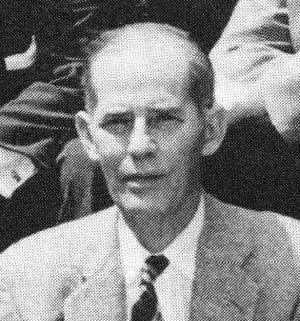
Donald Grady Davidson
Personal Information
Description
Donald Grady Davidson (August 8, 1893 – April 25, 1968) was a U.S. poet, essayist, social and literary critic, and author. An English professor at Vanderbilt University from 1920 to 1965, he was a founding member of the Fugitives and the overlapping group Southern Agrarians, two literary groups based in Nashville, Tennessee. Early life Davidson was born on August 8, 1893 in Campbellsville, Tennessee.His father, William Bluford Davidson, was "a teacher and school administrator," and his mother, Elma Wells, was "a music and elocution teacher."He had two brothers, John and William. Davidson received a classical education at Branham and Hughes Military Academy, a preparatory school in Spring Hill, Tennessee. He earned both his bachelor's (1917) and master's (1922) degrees at Vanderbilt University.He served as a lieutenant in the United States Army during World War I.Career Davidson was an English professor at Vanderbilt University from 1920 to 1965.While at Vanderbilt, Davidson became associated with the Fugitives, who met to read and criticize each other's verse.Later, they founded a review of the same name, which launched the literary careers of the poets and critics John Crowe Ransom, Allen Tate and Robert Penn Warren,the poet Laura Riding, and the poet and psychiatrist Merrill Moore. He enjoyed a national reputation as a poet, in part due to the inclusion of his dramatic monologue, "Lee in the Mountains",in early editions of the influential college literature textbook Understanding Poetry. Its editors were his former students Warren and Cleanth Brooks. From 1923 to 1930, Davidson reviewed books and edited the Nashville Tennessean book page, where he assessed more than 370 books. Around 1930, Davidson began his association with the Southern Agrarians.He was chiefly responsible for the decision of the group to write essays, published as the Agrarian manifesto I'll Take My Stand. Davidson shared the Agrarians' distaste for industrial capitalism and its destructive effect on American culture. Davidson's romantic outlook, however, led him to interpret Agrarianism as a straightforward politics of identity. "American" identity had become "characterless and synthetic," he argued in 1933. He encouraged Americans to embrace their identities as "Rebels, Yankees, Westerners, New Englanders or what you will, bound by ties more generous than abstract institutions can express, rather than citizens of an Americanized nowhere, without family, kin, or home." He was in favor of segregation.: xxxii In 1931, Davidson began a long association with Middlebury College's Breadloaf School of English. He bought a house in Vermont where he did much of his later writing. He taught at the Breadloaf School every summer until his death. In 1939 his textbook, American Composition and Rhetoric, was published and widely adopted for English courses in American universities.: 227 Perhaps most widely read today is Davidson's two-volume history: The Tennessee (1946 and 1948), in the Rivers of America series. The second volume is notable for its critique of the Tennessee Valley Authority (TVA) and the impact of its dam-building and eminent domain land seizure on local society. Although originally a supporter of the New Deal, he was suspicious that the TVA was a plot of northern business interests to exploit and dominate the South. He denounced the TVA as an instrument of political collectivism, run by outsiders, designed to destroy the South's traditions.In 1952 his ballad opera, Singin' Billy, with music by Charles F. Bryan, was performed at the Vanderbilt Theater. His work as book page editor for the Nashville Tennessean was commemorated in 1963 with the publication of The Spyglass: Views and Reviews, 1924–1930. A comprehensive collection of his poetry, Poems: 1922–61, was published in 1966.

Books
The big ballad jamboree
The Big Ballad Jamboree is Donald Davidson's only novel. He set his story - the romance of country singer Danny MacGregor and ballad scholar Cissy Timberlake - in the fictional Appalachian town of Carolina City. It is the summer of 1949, midway between World War II and the full-scale birth of television. A state teachers college is preparing for its major folk music festival. Seen through the eyes of a young man with a musical gift descended from moutain people, this is definitive fiction about a community struggling to embrace a modern commercial economy without losing its folk heritage. As they are feeling the seismic cultural shift, Danny MacGregor's band is offered its big break to appear regularly on the Grand Ole Opry.
Regionalism and nationalism in the United States
A quarter of a century before Lyndon B. Johnson popularized the slogan "The Great Society," Donald Davidson wrote his critique of Leviathan, the omnipotent nation-state, in terms that only recently have come to be appreciated. "Leviathan is the idea of the Great Society, organized under a single, complex, but strong and highly centralized national government, motivated ultimately by men's desire for economic welfare of a specific kind rather than their desire for personal liberty. " Originally published as The Attack on Leviathan, this eloquent volume is an attack on state centralism and an affirmation of regional identity. Davidson's work is a special sort of intellectual as well as social history. It reveals an extraordinary mastery of the literature on regionalism in the United States, with special emphasis on the work on Rupert Vance and Howard Odum in the social sciences. Davidson looks at regionalism in arts, literature, and education. He favors agriculture over industrialization, and "the hinterland" over cities, examining along the way varying historical memories, the dilemma of Southern liberals, and the choice of expedience or principles. His book is a forceful and commanding challenge to those who would push for central authority at the sacrifice of individual and regional identity. Davidson concludes with a devastating critique of nationalism leading to a supra-nationalism. Ultimately, the heterogeneity of human desires comes up against the uniformity of world systems and world states. Davidson offers instead a broad world of intellectual history and commentary in which individualism allies itself with communities as a means for stemming the tide of collectivism and its base in a world state. For Davidson, Leviathan, the monstrous state, is a devourer, not a savior. As several peoples rise to strike down their own Leviathans, this courageous book may be better understood now than it was in 1938. Donald Davidson was part of that movement in American letters known as the Southern Agrarians. He was a poet, critic, historian, and political analyst. He spent most of his life at Vanderbilt University, and was himself born in central Tennessee. He is best known as the author of The Tall Men (1927) and a collection of essays, Still Rebels, Still Yankees (1957).
The Spyglass
"Donald Davidson is well known as a poet and essayist, but few know or remember that during the 1920's he was also a book reviewer. The Nashville Tennessean asked Davidson to conduct its book page in 1924, and he saw in this assignment an opportunity to create a forum of Southern literary opinion, to some extent compensating for the lack of a good Southern literary journal. From his own column, at first called THE SPYGLASS and later THE CRITIC'S ALMANAC, a selection is presented here. The essays are grouped under six headings: Southern Fiction, Other American Fiction, Poetry, Critics and Commentators, Society and the Arts, and Backgrounds of Agrarianism. Included are reviews of books by such writers as Earnest Hemingway, Thomas Wolfe, and Elinor Wylie, written when these authors has not yet fully established their literary reputations, and Davidson's opinions have often foreshadowed the now generally held views. Through the essays there is his acute critical intelligence, his matchless literary style, and his absolute integrity. There is also a biographical sketch of Davidson--native Tennessean, teacher since the age of 17, full professor at Vanderbilt since 1937."
Selected Essays and Other Writings of John Donald Wade
One of the most important of the Southern magazines in the 1920s was The Fugitive, a magazine of verse and brief commentaries on literature in general. Among its contributors were John Crowe Ransom, Allen Tate, Robert Penn Warren, Donald Davidson, and Merrill Moore. Publication began in April 1922 and ended in December 1925. Soon thereafter, the "Fugitive" writers and some others became profoundly concerned with the materialism of American life and its effect upon the South. The group became known as "Agrarians." Their thinking and discussion culminated in a symposium, I'll Take My Stand, published in 1930. In his first two lectures Davidson describes the underlying nature and aims of the Fugitive and Agrarian movements. He brings to the discussion his intimate and thorough knowledge of Southern life and letters. The third lecture deals with the place of the writer in the modern university, posing the questions of whether the writer needs the university and whether the university needs or wants the writer
