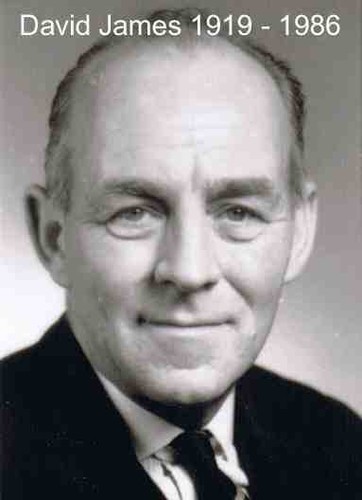
David James (1919 - 1986)
Personal Information
Description
David Pelham James was the son of Bridget Guthrie and Sir Archibald James. He attended Summer Fields School in Oxford and then Eton College, after which he signed on as an apprentice on the four masted barque Viking to sail to Australia and back. He then went to witness the Spanish Civil War with his father, before taking his place at Balliol College, Oxford, to read Geography. His studies were interrupted by the Second World War, and he became an officer in the Royal Naval Volunteer Reserve in charge of a Motor Gun Boat on coastal patrol in the English Channel. On February 27th, 1943 they engaged with a group German armed trawlers and David's boat was set on fire and sank. He was taken prisoner and confined to the Marlag und Milag Nord camp, near Bremen, until he escaped in December under the guise of being a Bulgarian Naval Officer named I. Bagerov. Although he reached and boarded a Swedish vessel in Lubeck, he was arrested when he went back ashore to wait for the ship's departure. A second escape succeeded and he reached Stockholm on February 22nd, 1944. This episode is the subject of James's first book, which was initially published by Blackwoods as 'A Prisoner's Progress' and later revised as 'Escaper's Progress'.
Books
Outward Bound
A classic play about a group of passengers on a ship in a fog-bound sea. Movies were made of it.
Lord Roberts
This book was written in response to an advertisement in the Times by which Lord Roberts' daughter sought the help of an up-and-coming writer to write his biography. David James responded and, with support from (later, Sir) Arthur Bryant, was selected. Details of the work involved over two years may be found in "One Man in his Time", by John Robson.
A Prisoner's Progress
This book, which was originally published by Blackwoods Magazine, in two parts, describes how the author became a war-time officer in the Royal Naval Volunteer Reserve in charge of a Motor Gun Boat on coastal patrol in the English Channel. On February 27th, 1943, they engaged with a group German armed trawlers and David's boat was set on fire and sunk. He was taken prisoner and confined to the Marlag und Milag Nord camp, near Bremen, until he escaped in December under the guise of being a Bulgarian Naval Officer named I. Bagerov. Although he reached and boarded a Swedish vessel in Lubeck, he was arrested when he went back ashore to wait for the ship's departure. A second escape succeeded and he reached Stockholm on February 22nd, 1944. The first edition was published as a book in 1947 by Blackwoods. A second edition, with the same text but also an Introduction by Eric Williams and an updated Preface was published in 1954 by Hollis and Carter. An American version comprising the same text with the title 'Escaper's Progress' followed in 1955 by W.W.Norton.
Scott of the Antarctic
Towards the end of 1944, David James went to Graham Land, in what is now British Antarctic Territory, as a member of Operation Tabarin, and spent the southern winter at Hope Bay, exploring with dog teams and sledges. He returned home in July, 1946, and soon after became an advisor to Sir Michael Balcon, who was about to start making the film 'Scott of the Antarctic', with John Mills in the title role. This book describes how the film was produced, in the Antarctic, in Switzerland, in Norway and at Ealing Studios.
That Frozen Land
This is an account of the time David James spent as a member of Operation Tabarin at Hope Bay on the Antarctic Peninsula. He left England by sea in November, 1944, and immediately took care of the twenty-five huskies that had been bought in Labrador for the expedition. He and his twelve colleagues reached their destination on February 12th, 1945, and started to build the base from which they later explored the peninsula to the south. James was a surveyor, and with his companions Andrew Taylor, the base leader, Ivan McKenzie Lamb, a botanist, and Vic Russell, a fellow surveyor, he made an epic sledge journey of 271 miles over the sea-ice, in which they circumnavigated James Ross Island and visited the hut on Snow Hill Island which Otto Nordenskjold had used. James left Hope Bay in January, 1946, but returned in 1947 to help in the making of the film Scott of the Antarctic, about which he also wrote.