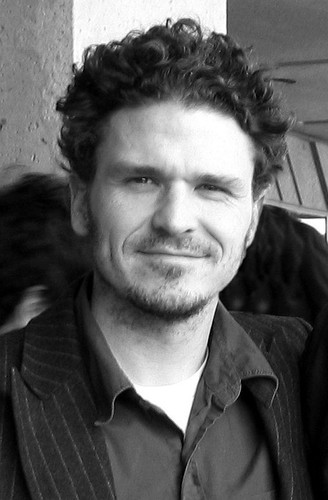
Dave Eggers
Personal Information
Description
Dave Eggers is the author of six previous books, including his most recent, Zeitoun, a nonfiction account of a Syrian-American immigrant and his extraordinary experience during Hurricane Katrina and What Is the What, a finalist for the 2006 National Book Critics Circle Award. That book, about Valentino Achak Deng, a survivor of the civil war in southern Sudan, gave birth to the Valentino Achak Deng Foundation, run by Mr. Deng and dedicated to building secondary schools in southern Sudan. Eggers is the founder and editor of McSweeney’s, an independent publishing house based in San Francisco that produces a quarterly journal, a monthly magazine (The Believer), and Wholphin, a quarterly DVD of short films and documentaries. In 2002, with Nínive Calegari he co-founded 826 Valencia, a nonprofit writing and tutoring center for youth in the Mission District of San Francisco. Local communities have since opened sister 826 centers in Chicago, Los Angeles, Brooklyn, Ann Arbor, Seattle, and Boston. In 2004, Eggers taught at the University of California-Berkeley Graduate School of Journalism, and there, with Dr. Lola Vollen, he co-founded Voice of Witness, a series of books using oral history to illuminate human rights crises around the world. A native of Chicago, Eggers graduated from the University of Illinois with a degree in journalism. He now lives in the San Francisco Bay Area with his wife and two children. [Source]
Books
The Best American Travel Writing 2000
Short Stories: Author Boat Camp: William Booth Lions and Tigers and Bears: Bill Buford This Teeming Ark: Tim Cahill The Toughest Trucker In The World: Tom Clynes Hitchhiker's Cuba: Dave Eggers Nantucket On My Mind: David Halberstam The Nile At Mile One: Mark Hertsgaard Spies In The House Of Faith: Isabel Hilton The First Drink Of The Day: Clive Irving Lard Is Good For You: Alden Jones The Truck: Ryszard Kapuscinski Confessions Of A Cheese Smuggler: David Lansing Inside The Hidden Kingdom: Jessica Maxwell Weird Karm: P.J.O'Rourke Zoned On Zanzibar: Tony Perrottet Storming The Beach: Rolf Potts The Last Safari: Mark Ross Winter Rules: Stee Rushin From The Wonderful People Who Brought You The Killing Fields: Patrick Symmes China's Wild West: Jeffrey Taylor Exiled Beyond Kilometer 101: Jeffrey Tayler The Two Faces of Tourism: Jonathan Tourtellot The Very Short History of Nunavut: William T. Vollmann One Man and His Donkey: David Wallis Marseille's Moment: Amy Willentz
A heartbreaking work of staggering genius
One of the most mesmerizing memoirs of the literary season: a wrenching, hilarious, and stylistically groundbreaking story of a college senior who, in the space of five weeks, loses both of his parents to cancer and inherits his eight-year-old brother. "Well, this was when Bill was sighing a lot. He had decided that after our parents died he just didn't want any more fighting between what was left of us. He was twenty-four, Beth was twenty-three, I was twenty-one, Toph was eight, and all of us were so tired already, from that winter. So when something would come up, any little thing, some bill to pay or decision to make, he would just sigh, his eyes tired, his mouth in a sorry kind of smile. But Beth and I...Jesus, we were fighting with everyone, anyone, each other, with strangers at bars, anywhere --^ we were angry people wanting to exact revenge. We came to California and we wanted everything, would take what was ours, anything within reach. And I decided that little Toph and I, he with his backward hat and long hair, living together in our little house in Berkeley, would be world-destroyers. We inherited each other and, we felt, a responsibility to reinvent everything, to scoff and re-create and drive fast while singing loudly and pounding the windows. It was a hopeless sort of exhilaration, a kind of arrogance born of fatalism, I guess, of the feeling that if you could lose a couple of parents in a month, then basically anything could happen, at any time --^ all bullets bear your name, all cars are there to crush you, any balcony could give way; more disaster seemed only logical. And then, as in Dorothy's dream, all these people I grew up with were there, too, some of them orphans also, most but not all of us believing that what we had been given was extraordinary, that it was time to tear or break down, ruin, remake, take and devour. This was San Francisco, you know, and everyone had some dumb idea -- I mean, wicca? --^ and no one there would tell you yours was doomed. Thus the public nudity, and this ridiculous magazine, and the Real World tryout, all this need, most of it disguised by sneering, but all driven by a hyper-awareness of this window, I guess, a few years when your muscles are taut, coiled up and vibrating. But what to do with the energy? I mean, when we drive, Toph and I, and we drive past people, standing on top of all these hills, part of me wants to stop the car and turn up the radio and have us all dance in formation, and part of me wants to run them all over."--Excerpt from chapter 5.
The Lifters
What if nothing was as it seemed? What if the ground beneath your feet was not made of solid earth and stone but had been hollowed into hundreds of tunnels and passageways? What if there were mysterious forces in these tunnels, mere inches below you as you sit in class or eat a banana? What if it were up to just two kids to stop these forces? What would it feel like to know the fate of an entire town rested on your shoulders?
The Wild Things
In a stunning act of imagination, Dave Eggers has adapted Maurice Sendak's children's classic, Where the Wild Things Are, into this richly drawn full-length novel, the story of a lonely boy navigating the emotional journey away from boyhood. Max is a rambunctious eight-year-old, living with his mother and his sister, terrorizing the neighborhood on his bicycle. But Max's world is changing around him: His father is absent and his mother is increasingly distracted. Max's teenage sister is outgrowing him, leaving him alone in favor of her friends. Sad and angry, Max dons his wolf suit and makes terrible, ruinous mischief. Setting off into the night, Max finds a boat and sails away to an island. Here he meets strange and giant creatures. Creatures that rage and break things. Creatures that trample and scream. These monsters do everything Max feels inside! And so, Max appoints himself their king. Here, on a magnificent adventure with the creatures, Max can be the wildest thing of all.In this visionary new novel, Eggers brings an imaginary world vividly to life, filling it with monsters, chaos, and one very real little boy. By turns beautiful and joyful, sorrowful and strange, The Wild Things is an astonishing literary triumph.
Zeitoun
From Goodreads: The true story of one family, caught between America’s two biggest policy disasters: the war on terror and the response to Hurricane Katrina. Abdulrahman and Kathy Zeitoun run a house-painting business in New Orleans. In August of 2005, as Hurricane Katrina approaches, Kathy evacuates with their four young children, leaving Zeitoun to watch over the business. In the days following the storm he travels the city by canoe, feeding abandoned animals and helping elderly neighbors. Then, on September 6th, police officers armed with M-16s arrest Zeitoun in his home. Told with eloquence and compassion, Zeitoun is a riveting account of one family’s unthinkable struggle with forces beyond wind and water.
Created in Darkness by Troubled Americans
Now more than ever, Americans are troubled by questions. As sweaty modernity thrusts itself upon us, the veil of ignorance that cloaked our nation hangs in tatters, tattered tatters. Our "funny bones" are neither fun nor bony. Glum is the new giddy, and the old giddy wasn't too giddy to begin with.What can be done to stop this relentless march of drabbery? Not much. Nothing we can think of. It's pretty much too late. The light of August turns to the overcast skies of autumn, and the taunting sting of winter cannot be far ahead on the highway of the road on the horizon. Who can sing a song without words? Maybe Bobby McFerrin, but is there anyone else? Where do we go when the party is over? Perhaps the afterparty. But what comes after the afterparty?Questions, there are so many questions, and then some queries, arriving via fax. To these we respond in the only way possible: Talk to the hand, because the face ain't listening. Nevertheless, we present the pages within as an offering of peace, as a message of hope, and as a perfumed hankie of love--a hankie drizzled with the intoxicating aroma that has only one name: ha-ha-oopsie.From the Hardcover edition.
The best American nonrequired reading 2013
Presents literature from mainstream and alternative American periodicals, including fiction, nonfiction, and poetry.
The Best American Nonrequired Reading 2007
Presents selections of mainstream and alternative American literature, including both fiction and nonfiction, that discuss a broad spectrum of subjects.
The Best of McSweeney's
"A comprehensive collection of some of the magazine's most remarkable work."--Back of jacket.
The Best American Nonrequired Reading 2008
Presents selections of mainstream and alternative American literatue including both fiction and nonfiction, that discuss a broad spectrum of subjects.
The voice of witness reader
For ten years, Voice of Witness has illuminated contemporary human rights crises through its remarkable oral history book series. Founded by Dave Eggers, Lola Vollen and Mimi Lok, Voice of Witness has amplified the stories of hundreds of people impacted by some of the most crucial human rights crises of our time, including men and women living under oppressive regimes in Burma, Colombia, Sudan, and Zimbabwe; public housing residents and undocumented workers in the United States; and exploited workers around the globe. This selection of narratives from these remarkable men and women is many things: an astonishing record of human rights issues in the twenty-first century; a testament to the resilience and courage of the most marginalized among us; and an opportunity to better understand the world we live in through human connection and participatory vision of history.
Ungrateful Mammals
Before he embarked on his writing career, Dave Eggers was classically trained as a draftsman and painter. He then spent many years as a professional illustrator and graphic designer before turning to writing full-time. More recently, in order to raise money for ScholarMatch, his college-access nonprofit, he returned to visual art, and the results have been exhibited in galleries and museums around the country. Usually involving the pairing of an animal with humorous or Biblical text, the results are wry, oddly anthropomorphic tableaus that create a very entertaining and eccentric body of work from one of today's leading culture makers.
Tomorrow Most Likely
1 volume (unpaged) : color illustrations ; 26 cmAD420L Lexile
