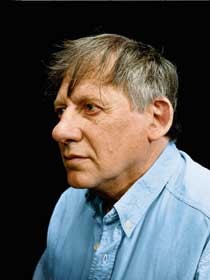
Christopher Alexander
Personal Information
Description
British-born architect, planning researcher, educator at UC-Berkeley and Univ. of Oregon. (Source: Union List of Artist Names - Getty Research Institute)
Books
Tunisia
An introduction to the geography, people, history, government, resources, culture, and major cities of Tunisia.
The battle for the life and beauty of the earth
The purpose of all architecture, writes Christopher Alexander, is to encourage and support life-giving activity, dreams, and playfulness. But in recent decades, while our buildings are technically better--more sturdy, more waterproof, more energy efficient-- they have also became progressively more sterile, rarely providing the kind of environment in which people are emotionally nourished, genuinely happy, and deeply contented. Using the example of his building of the Eishin Campus in Japan, Christopher Alexander and his collaborators reveal an ongoing dispute between two fundamentally different ways of shaping our world. One system places emphasis on subtleties, on finesse, on the structure of adaptation that makes each tiny part fit into the larger context. The other system is concerned with efficiency, with money, power and control, stressing the more gross aspects of size, speed, and profit. This second, "business-as-usual" system, Alexander argues, is incapable of creating the kind of environment that is able to genuinely support the emotional, whole-making side of human life. To confront this sterile system, the book presents a new architecture that we--both as a world-wide civilization, and as individual people and cultures--can create, using new processes that allow us to build places of human energy and beauty. The book outlines nine ways of working, each one fully dedicated to wholeness, and able to support day-to-day activities that will make planning, design and construction possible in an entirely new way, and in more humane ways. An innovative thinker about building techniques and planning, Christopher Alexander has attracted a devoted following. Here he introduces a way of building that includes the best current practices, enriched by a range of new processes that support the houses, communities, and health of all who inhabit the Earth.
A pattern language
Alexander and his co-authors present us with over two hundred (roughly 250) "patterns" that they believe must be present in order for an environment to be pleasing, comfortable, or in their words, "alive." The patterns start at the most general level -- the first pattern, "Independent Regions," describes the ideal political entity, while another of my favorite patterns, "Mosaic of Subcultures," described the proper distribution of different groups within a city. The patterns gradually become more specific -- you'll read arguments about how universities should relate to the community, the proper placement of parks, the role of cafes in a city's life. If you wonder about the best design for a home, the authors will describe everything from how roofs and walls should be built, down to how light should fall within the home, where your windows should be placed, and even the most pleasant variety of chairs in the home. An underlying theme of all the patterns is that architecture, at its best, can be used to foster meaningful human interaction, and the authors urge us to be aware of how the houses we build can help us balance needs for intimacy and privacy.
The Linz Cafe (Center for Environmental Structure Series)
The Linz Cafe is the fourth in the seminal series of books on architecture. The Linz Cafe describes the application of the theory to a single building commissioned by the organizers of the 1980 summer exposition "Forum Design" in Linz, Austria. From the Introduction: "The Linz Cafe is one of the first buildings in which I have succeeded in carrying out almost all the intentions expressed in the earlier volumes of this series. It is a small three storey building, built on the banks of the Danube in Linz." –Christopher Alexander. This book tells an intimate story of the conception and realization of the building.
The nature of order
"Here is acclaimed architect Christopher Alexander's four-volume masterwork; the result of 27 years of research and a lifetime of profoundly original thinking. Consider three vital perspectives on our world: a scientific perspective; a perspective based on beauty and grace; a commonsense perspective based on our intuitions about everyday life. Neither scientists, nor mystics, nor architects, nor politicians have so far found a single view of the world in which the three are united. This groundbreaking work allows us to form on picture of the world in which all three perspectives are interlaces. It opens the door to 21st-century science and cosmology."--From dust jacket.
The Production of Houses
Describes how the design and construction of a cluster of five homes were carried out under the guidance of Alexander’s architectural principles.
The Timeless Way of Building
The theory of architecture implicit in our world today, Christopher Alexander believes, is bankrupt. More and more people are aware that something is deeply wrong. Yet the power of present-day ideas is so great that many feel uncomfortable, even afraid, to say openly that they dislike what is happening, because they are afraid to seem foolish, afraid perhaps that they will be laughed at. Now, at last, there is a coherent theory which describes in modern terms an architecture as ancient as human society itself. The Timeless Way of Building is the introductory volume in the Center for Environmental Structure series, Christopher Alexander presents in it a new theory of architecture, building, and planning which has at its core that age-old process by which the people of a society have always pulled the order of their world from their own being. Alexander writes, "There is one timeless way of building. It is thousands of years old, and the same today as it has always been. The great traditional buildings of the past, the villages and tents and temples in which man feels at home, have always been made by people who were very close to the center of this way. And as you will see, this way will lead anyone who looks for it to buildings which are themselves as ancient in their form as the trees and hills, and as our faces are."—Publisher