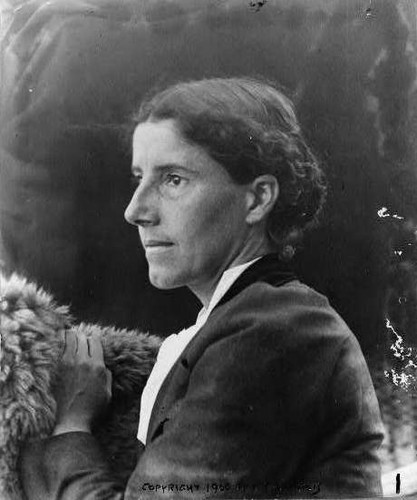
Charlotte Perkins Gilman
Personal Information
Description
Charlotte Perkins Gilman, also known as Charlotte Perkins Stetson, was a prominent American sociologist, novelist, writer of short stories, poetry, and nonfiction, and a lecturer for social reform. She was a utopian feminist during a time when her accomplishments were exceptional for women, and she served as a role model for future generations of feminists because of her unorthodox concepts and lifestyle. Her best remembered work today is her semi-autobiographical short story, The Yellow Wallpaper, which she wrote after a severe bout of post-partum depression. She was the daughter of Frederic B. Perkins.
Books
The Yellow Wall-paper and Other Stories
Charlotte Perkins Gilman was America's leading feminist intellectual of the early twentieth century. 'The Yellow Wall-Paper' and Other Stories makes available the fullest selection of her short fiction ever printed. In addition to her pioneering masterpiece, 'The Yellow Wall-Paper' (1890), which draws on her own experience of depression and insanity, this edition features her Impress 'story studies', works in the manner of writers such as James, Twain, and Kipling. These stories, together with other fiction from her neglected California period (1890-5), throw new light on Gilman as a practitioner of the art of fiction. In her Forerunner stories she repeatedly explores the situation of the 'woman of fifty' and inspires reform by imagining workable solutions to a range of personal and social problems. The introduction to this edition places Gilman in the cultural and historical context of the American divided self, her Beecher heritage, and her contribution to the female Gothic.
The selected letters of Charlotte Perkins Gilman
"The Selected Letters of Charlotte Perkins Gilman makes accessible the many intricate narratives created by Gilman's correspondences. The editors have grouped the letters according to the significant events in Gilman's life and the important people to whom she wrote, including her friends and family members."--Inside jacket.
Our Androcentric Culture, or the Man-Made World
Gilman argues that men's superior position in society is not natural but rather the product of their political, economic, and social advantages.
Herland
On the eve of WWI, three American male explorers stumble onto an all-female society somewhere in the distant reaches of the earth. Unable to believe their eyes, they promptly set out to find some men, convinced that since this is a civilized country--there must be men. So begins this sparkling utopian novel, a romp through a whole world "masculine" and "feminine", as on target today as when it was written 65 years ago.
Charlotte Perkins Gilman's utopian novels
Charlotte Perkins Gilman's Utopian Novels brings together for the first time in one volume Gilman's three major utopian novels: Moving the Mountain (1911), Herland (1915), and With Her in Ourland (1916). These novels portray ideal societies that give visionary shape and imaginative form to Gilman's ideas of equality, economic justice, and social reorganization. Set in imaginary realms of future time or uncharted space, the novels dramatize the reformist ideas she discusses in her nonfiction books and essays. The reader can readily trace the development of Gilman's thought from her first optimistic vision of a utopian society thirty years hence, once the women of America "wake up," to the more developed feminist ideas of Herland, in which the implications of renovated female consciousness are more fully explored but are located in imaginary geographic space, to the final satirical view of contemporary society with all its illogical incongruities in which utopian renovation is indefinitely postponed.
Unpunished
Charlotte Perkins Gilman's first and only detective novel begins with a murder to confound any mystery fan: a local attorney, Wade Vaughn, is found dead in his study with a bullet in his temple, a knife in his back, a gaping wound in his skull, a cord around his neck, and a poisoned whiskey glass by his side. As the plot unfolds, it reveals motives for murder as numerous as the means: Vaughn is an evil man who has abused and blackmailed clients, servants, and family members, driven his wife to suicide, and devised a sinister plan for forcing marriage upon his young stepdaughter. The task of untangling this multitudinous mystery falls to a husband-and-wife detective team. The good-natured and resourceful Jim Hunt is sometimes outshone by his clever and intrepid wife Bess, a former journalist, who goes undercover as a servant in the dead man's home. When Bess and Jim finally discover the solution - through secret diaries, hidden surveillance, and last-minute confession - it surprises even them. Unpunished is a mystery with a message; Gilman weaves her case for women's freedom and empowerment into a story rich in twists and turns, colorful characters, red herrings, and wry humor.
With her in Ourland
Sequel to Herland. Published serially in the author's monthly magazine, Forerunner, volume 7 (1916). Herland described an all-women utopia in a secluded high valley, where 3 adventurous young men visit by airplane. Eventually, 2 of the 3 are expelled, along with a young Herland woman who has married one of the men. With Her in Ourland continues as the husband and wife tour the world outside of Herland, interviewing people, taking notes and photographs, and discussing history, religions, war, child-rearing, the role of women, treatment of immigrants, women's suffrage, and more. The two novels together convey the author's social criticisms of our world at her time and her prescriptions to improve the human condition in the United States.
Yellow Wallpaper (Bedford Cultural Editions)
"This edition of The Yellow Wallpaper includes a generous selection of cultural and historical documents that illuminate how Gilman's classic feminist tale can be read as a springboard for her subsequent career as a cultural critic." "The documents accompanying this edition have been selected to help readers situate The Yellow Wallpaper in relation to Gilman's time period and wide range of interests. Included are excerpts from nineteenth-century advice manuals for young women and mothers; medical texts discussing the nature of women's sexuality; social reform literature concerning women's rights, the working classes, and immigration; and excerpts from periodicals, diaries, and writers' notebooks that give readers a sense of the changing literary scene that Gilman entered. Both Gilman's story and her subsequent career as a social critic are illuminated when readers see her as a writer about and a citizen of her time."--BOOK JACKET.
The Dark Descent
pt. 1. The color of evil. The reach / Stephen King -- Evening primrose / John Collier -- The ash-tree / M.R. James -- The new mother / Lucy Clifford -- There's a long, long trail a-winding / Russell Kirk -- The call of Cthulhu / H.P. Lovecraft -- The summer people / Shirley Jackson -- The whimper of whipped dogs / Harlan Ellison -- [Young Goodman Brown]( / Nathaniel Hawthorne -- Mr. Justice Harbottle -- J. Sheridan Le Fanu -- The crowd / Ray Bradbury -- The autopsy / Michael Shea -- John Charrington's wedding / E. Nesbit -- Sticks / Karl Edward Wagner -- Larger than oneself / Robert Aickman -- Belsen Express / Fritz Leiber -- Yours truly, Jack the Ripper / Robert Bloch -- If Damon comes / Charles L. Grant -- Vandy, Vandy / Manly Wade Wellman -- pt. 2. The Medusa in the shield. The swords / Robert Aickman -- The roaches / Thomas M. Disch -- Bright segment / Theodore Sturgeon -- Dread / Clive Barker -- The fall of the house of Usher / Edgar Allan Poe -- The monkey / Stephen King -- Within the walls of Tyre / Michael Bishop -- The rats in the walls / H.P. Lovecraft -- Schalken the painter / J. Sheridan Le Fanu -- The yellow wallpaper / Charlotte Perkins Gilman -- A rose for Emily / William Faulkner -- How love came to Professor Guildea / Robert Hichens -- Born of man and woman / Richard Matheson -- My dear Emily / Joanna Russ -- You can go now / Dennis Etchison -- The rocking-horse winner / D.H. Lawrence -- Three days / Tanith Lee -- Good country people / Flannery O'Connor -- Mackintosh Willy / Ramsey Campbell -- The jolly corner / Henry James -- pt. 3. A fabulous formless darkness. Smoke ghost / Fritz Leiber -- Seven American nights / Gene Wolfe -- The signal-man / Charles Dickens -- [Crouch End]( / Stephen King -- Night-side / Joyce Carol Oates -- Seaton's aunt / Walter de la Mare -- Clara Militch / Ivan Turgenev -- The repairer of reputations / Robert W. Chambers -- The beckoning fair one / Oliver Onions -- What was it? / Fitz-James O'Brien -- The beautiful stranger / Shirley Jackson -- [The damned thing]( / Ambrose Bierce -- Afterward / Edith Wharton -- The willows / Algernon Blackwood -- The Asian shore / Thomas M. Disch -- The hospice / Robert Aickman -- A little something for us tempunauts / Philip K. Dick.
The Charlotte Perkins Gilman reader
The Charlotte Perkins Gilman Reader is an anthology of fiction by one of America's most important feminist writers. Probably best known as the author of "The Yellow Wallpaper," in which a woman is driven mad by chauvinist psychiatry, Gilman wrote numerous other short stories and novels reflecting her radical socialist and feminist view of turn-of-the-century America. Collected here by the noted Gilman scholar Ann J. Lane are eighteen stories and fragments, including a selection from Herland, Gilman's novel of a feminist utopia. The resulting anthology provides a provocative blueprint to Gilman's intellectual and creative production.