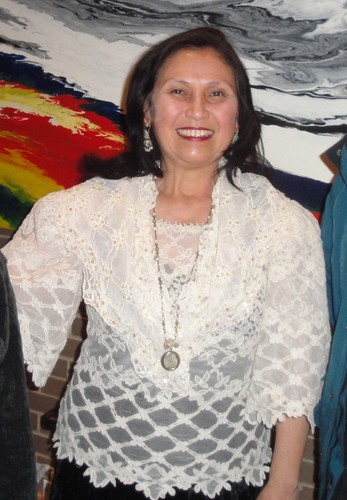
Cecilia Manguerra Brainard
Personal Information
Description
Cecilia Manguerra Brainard (born 1947) is an author and editor of 22 books. She co-founded PAWWA or Philippine American Women Writers and Artists; and also founded PALH or Philippine American Literary House. Brainard's works include the World War II novel, When the Rainbow Goddess Wept; The Newspaper Widow; Magdalena; and Selected Short Stories by Cecilia Manguerra Brainard, which won the 40th Philippine National Book Award and Cirilo Bautista Prize. She ranks among the Top Translated Filipino Authors of the Philippine Works and Translation Data Base. She edited several anthologies including How I Became a Writer: Essays by Filipino and Filipino American Writers, Fiction by Filipinos in America, Contemporary Fiction by Filipinos in America, and three volumes of Growing Up Filipino, young adult books used by educators.
Books
A La Carte
A La Carte: Food and Fiction is a collection of 25 short stories by Filipino and Philippine American writers that are related to food. Each story is preceded by a Filipino recipe. A La Carte is the winner of the prestigious Gourmand Award 2008 as the Best Food Literature Book from the Philippines. Noted Philippine critic says: "Here is a book guaranteed to satisfy even the most discriminating taste, but also to make readers hungry for more stories, characters, insights, and recipes. Fact, fiction, fantasy, and food mix in a feast for the mind, the heart, the palate, and the soul. There are many well-known writers in the anthology, but it is not so much who writes as what is written that makes this book a must-read, just as it is not so much the chef or the cook that makes a recipe to die for, but the dish itself. Enjoy the 25-course banquet!"
When the rainbow goddess wept
Set against the backdrop of the Japanese invasion of the Philippines in 1941, When the Rainbow Goddess Wept tells the story of nine-year-old Yvonne, forced to flee her home and childhood when her family joins the resistance effort. Witnessing death and destruction on an unimaginable scale, Yvonne finds comfort in the stories her people have passed down over generations: the legends of Bongkatolan, the Woman Warrior, and the merciful rainbow goddess. Her tale combines Filipino myth and legend with an important chapter in Filipino history to create a compelling story of courage and determination.
Woman with horns and other stories
Woman With Horns and Other Stories is the first short story collection by Cecilia Manguerra Brainard. Called "a welcome addition to Filipiniana" by the Manila Times, the stories draw from historical and contemporary sources. Many of these stories set in mythical Ubec, Philippines, explore the clash of Philippine culture with foreign influences that reached the archipelago during different historical periods.
Out of Cebu
Out of Cebu: Essays and Personal Prose collects 28 essays by the award-winning author, Cecilia Manguerra Brainard. A number of essays are about the author's Cebuano roots, including colorful accounts about her mother’s family, the Cuencos, a prominent political family in Cebu. The book also includes writings about the author’s life and travels outside of Cebu.
Magnificat
Collected and Edited by Cecilia Manguerra Brainard, this book collects 24 Marian devotees' accounts of their experiences in Marian pilgrim sites. The sites are found in Bosnia-Herzegovina, Eritrea, Ethiopia, France, India, Mexico, Poland, Portugal, Spain, Turkey, the United States, and there are eight Pilgrim sites in the Philippines. The book includes short writeups of other international pilgrim sites and some Catholic Prayers. Archbishop Tagle of Manila has issued an Imprimatur for the book, Magnificat: Mama Mary's Pilgrim Sites.
The newspaper widow
"Ines Maceda, the "newspaper widow," aims to clear her son's name. He has been accused of murdering a priest. In addition, Ines grieves for her deceased husband and combats the lingering trauma of earlier miscarriages. Her development is one of the shining elements of the novel-she feels tangible, rooted in the story and the setting. The Newspaper Widow offers a nuanced glance into Filipino society circa 1908. It is a world rich with history, myth, and ritual; descriptions pulse with life, providing crucial insights into aspects of Filipino culture and world colonial history, such as encounters with the "Island of the Living Dead," sectioned off to contain those inflicted with leprosy, and once the world's largest leper colony. " - from review by Mya Alexice
Vigan and other stories
In this, her third collection of short stories, the award-winning author Cecilia Manguerra Brainard shows an uncanny talent for speaking in varied voices that bridge time and place: she is at home in Vigan, the mythical Ubec (Cebu), Sagada, Manila, Cusco, Peru, Calcutta, Chartres, California, bringing each location alive with loving detail. She speaks as a school girl, an older woman, a love-struck boy, a stolen child, an underground revolutionary. She writes of her own family and childhood with love and sadness and a deep sense of humanity. Most charming? “Meeting Che Guevara”, which starts out “I was nineteen when I met Che Guevara
Growing Up Filipino II
This is the hardbound edition of Growing Up Filipino II: More Stories for Young Adults.
MAGDALENA
Expertly written by Cecilia Manguerra Brainard (USC Adjunct Professor and teacher at the UCLA-Extension's Writers Program), Magdalena is set in the chaotic backdrop of twentieth century East Asia. A romantic, powerful tale of three generations of Filipino women, written with a close eye on the terrors of war and the Japanese invasion of the Philippines during World War II, Magdalena is an intense, involving, highly recommended saga that documents author Cecilia Manguerra Brainard as a gifted author with a mastery of story telling that will keep the reader's total attention and engagement from first page to last! ~ Midwest Book Review
Behind the Walls
This is a collection of personal essays by convent-bred Filipinas. Krip Yuson writes: "This collection of essays has long been overdue, and should fit very nicely into that special niche of Filipiniana that uncovers the mystique behind a Filipina. What influence and reach these “colegialas” or “convent-bred” ladies have had, and continue to exercise, on the Philippine societal landscape! Our two lady presidents thus far have been products of that special, privileged education that took place “behind the walls.” And it is likely that the next will also come from an exclusive Catholic girls’ school. Beyond the elitist tradition of education under foreign nuns and their successors is that continuum of poise and grace, good manners and right conduct, knowledge and moral strength that has come to characterize our women of substance. May the tradition live on!"
