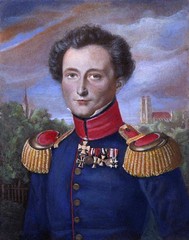
Carl von Clausewitz
Personal Information
Description
Carl Philipp Gottfried (or Gottlieb) von Clausewitz (1 June 1780 – 16 November 1831) was a Prussian general and military theorist who stressed the "moral" (meaning, in modern terms, psychological) and political aspects of war. His most notable work, Vom Kriege (On War), was unfinished at his death. Clausewitz was a realist in many different senses and, while in some respects a romantic, also drew heavily on the rationalist ideas of the European Enlightenment. Source: [Carl von Clausewitz]( on Wikipedia.
Books
Vom Kriege
Vom Kriege is the basic work on the Western way of war. For Clauswitz, war is "politics by other means". It concentrates on defeating the enemy by massing overwhelming force at the enemy's weak point. In his rationalistic model, the prince (or other governing elite) begins with a set of objectives and chooses the most cost-effective way of accomplishing them. If force is seen as that way, then the prince chooses war. When the objectives have been achieved, then the war has been won regardless of conditions and dispositions on the field. Clausewitz is read by every officer cadet in every decent military academy in the world. Written in the 18th century, Vom Kriege is as relevant today as the day it was published.
On Wellington
Clausewitz's original book, Der Feldzug von 1815 in Frankreich, is vol.8 of his collected works. Although the Duke of Wellington wrote a famous reply to it in 1842, it had never been published in English. In 2010, two translations appeared. The first was Carl von Clausewitz and Arthur Wellesley, first Duke of Wellington, On Waterloo: Clausewitz, Wellington, and the Campaign of 1815, ed./trans. Christopher Bassford, Daniel Moran, and Gregory W. Pedlow (Clausewitz.com, 2010). This book is built around a full, modern translation of Clausewitz's campaign study and includes Wellington's reply, additional materials from Clausewitz and Wellington's circle, and essays by the editors (all recognized scholars in the field). The second was Carl von Clausewitz, On Wellington: A Critique of Waterloo, ed. Peter Hofschröer, ed. (Norman, OK: University of Oklahoma Press), which contains only Clausewitz's campaign study and Hofschröer's own introduction.
Napoleon Absent, Coalition Ascendant
"The writings of Carl von Clausewitz (1780-1831) are among the most important works on war ever written. Much of the focus has understandably been on his great theoretical work On War, published in 1832. That work, however, formed only the first three of the ten volumes of his published writings. For Napoleon Absent, Coalition Ascendant, Murray and Pringle have chosen the original version of the text published in 1833 which is the first of the two volumes originally published as Der Feldzug von 1799 in Italien und der Schweiz. In these two volumes, Clausewitz describes and analyses the campaigns of 1799 in Italy and Switzerland, providing a superb history of this episode of the French Revolutionary wars. He covers the campaigns in detail and provides excellent analysis of their events, along with what he identifies as the changes in warfare that rocked Europe from 1792-1815. These campaigns were an important part of the wars of the French Revolution and Napoleonic period, but they have never been covered adequately from a historical standpoint."--
On Waterloo
Carl von Clausewitz and Arthur Wellesley, 1st Duke of Wellington. On Waterloo: Clausewitz, Wellington, and the Campaign of 1815. Ed./trans. Christopher Bassford, Daniel Moran, and Gregory W. Pedlow. Published 2010 by Clausewitz.com through CreateSpace.com. ISBN-10: 1453701508. ISBN-13: 9781453701508. 318pp. List price: $18.00. This book is built around a new and complete translation of Clausewitz's study of the Waterloo campaign (Berlin: 1835), which is a strategic analysis of the entire campaign (not just the Battle of Waterloo), and the Duke of Wellington's detailed 1842 response to it. It contains Wellington's initial battle report; two of Clausewitz's post-battle letters to his wife Marie; correspondence within Wellington's circle concerning Clausewitz's work; Clausewitz's campaign study; Wellington's memorandum in response; and enlightening essays by the editors.