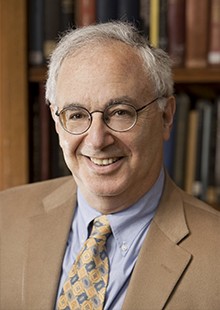
Bruce A. Ackerman
Personal Information
Description
Bruce Arnold Ackerman (born August 19, 1943) is an American constitutional law scholar. He is a Sterling Professor at Yale Law School. In 2010, he was named by Foreign Policy magazine to its list of top global thinkers. Source: Bruce Arnold Ackerman on Wikipedia (Wikipecia contributors, CC BY-SA 2.0)
Books
The failure of the founding fathers
Describes previously unknown aspects of the electoral college crisis of 1800, presenting a revised understanding ofthe early days of two great institutions that continue to have a major impact on American history: the plebiscitarian presidency and a Supreme Court that struggles to put the presidency's claims of a popular mandate into constitutional perspective. Through close studies of two Supreme Court cases, Ackerman shows how the court integrated Federalist and Republican themes into the living Constitution of the early republic. The ink was barely dry on the Constitution when it was almost destroyed by the rise of political parties in the United States. As Bruce Ackerman shows, the Framers had not anticipated the two-party system, and when Republicans battled Federalists for the presidency in1800, the rules laid down by the Constitution exacerbated the crisis. [Publisher web site].
Vixi
"Sixteen-year-old Richard Pipes escaped from Nazi-occupied Warsaw with his family in October 1939. Their flight took them to the United States by way of Italy, and Pipes went on to earn a college degree, join the U.S. Air Corps, serve as professor of Russian history at Harvard for nearly forty years, and become advisor to President Reagan on Soviet and Eastern European affairs. In this book, the eminent historian remembers the events of his own remarkable life as well as the unfolding of some of the twentieth century's most extraordinary political events." "Pipes shows us the inner workings of Harvard University during its Golden Age, discusses the nature of Soviet Communism during the Cold War years, and describes from an insider's perspective the conflicts within the Reagan administration over American policies toward the USSR. He offers portraits of such cultural and political figures as Isaiah Berlin, Ronald Reagan, and Alexander Haig, as well as unique observations on his Polish homeland, Jewish heritage, and the process of assimilation into American culture. Perhaps most interesting of all, Pipes depicts his evolution as a historian and his understanding of how history is witnessed and how it is recorded."--Jacket.
El Futuro de La Revolucion Liberal
"Since 1989, the Cold War has ended, new nations have emerged in Eastern Europe, and revolutionary struggles to establish liberal ideals have been waged against repressive governments throughout the world. Will the promise of liberalism be realized? What can liberals do to make the most of their opportunities and construct enduring forms of political order? In this important and timely book, a leading political theorist discusses the possibility of liberal democracy in Western and Eastern Europe and offers practical suggestions for its realization. Bruce Ackerman begins by sketching the challenges faced a Western Europe free for the first time in half a century to determine its own fate without the constant intervention of the United States and the Soviet Union. Unless decisive steps are taken, this moment of promise can degenerate into a new cycle of nationalist power struggle. Revolutionary action is now required to build the foundations of a democratic federal Europe - a union strong enough to keep the peace and to combat the threat of local tyrannies."--Publisher description.
Voting with dollars
"In this book, two leading law professors challenge the existing campaign reform agenda and present a new initiative that avoids the mistakes of the past.". "Bruce Ackerman and Ian Ayres build on the example of the secret ballot and propose a system of "secret donation booths" for campaign contributions. They unveil a plan in which the government provides each voter with a special credit card account containing fifty "Patriot dollars" for presidential elections. To use this money, citizens go to their local automated teller machine and anonymously send their Patriot dollars to their favorite candidates or political organizations. Americans are free to make additional contributions, but they must also give these gifts anonymously. Because candidates cannot identify who provided the funds, big contributors will find it much harder to buy political influence. And the need for politicians to compete for the Patriot dollars will give much more power to the people."--BOOK JACKET.
Bush V. Gore
The Supreme Court's intervention in the 2000 election will shape American law and democracy long after George W. Bush has left the White House. This book brings together a broad range of preeminent legal scholars who address the larger questions raised by the Supreme Court's actions. Did the Court's decision violate the rule of law? Did it inaugurate an era of super-politicized jurisprudence? How should Bush v. Gore change the terms of debate over the next round of Supreme Court appointments? The contributors -- Bruce Ackerman, Jack Balkin, Guido Calabresi, Steven Calabresi, Owen Fiss, Charles Fried, Robert Post, Margaret Jane Radin, Jeffrey Rosen, Jed Rubenreid, Cass Sunstein, Laurence Tribe, and Mark Tushnet -- represent a broad political spectrum. Their reactions to the case are varied and surprising, filled with sparkling argument and spirited debate.
The stakeholder society
"What would happen, ask Bruce Ackerman and Anne Alstott, if America were to make good on its promise of equal opportunity by granting every qualifying young adult a citizen's stake of eighty thousand dollars? Ackerman and Alstott argue that every U.S. citizen has the right to share in the wealth accumulated by preceding generations. The distribution of wealth is currently so skewed that the stakeholding fund could be financed by an annual tax of 2 percent on the property owned by the richest 40 percent of Americans." "Ackerman and Alstott analyze their initiative from moral, political, economic, legal, and human perspectives. By summoning the political will to initiate stakeholding, they argue, we can achieve a society that is more democratic, productive, and free."--BOOK JACKET.
Clean coal/dirty air
On t.p.: Or how the Clean Air Act became a multibillion-dollar bail-out for high-sulfur coal producers and what should be done about it.
We, the people
What Brown v. Board of Education should have said
"Brown v. Board of Education, the Supreme Court's landmark 1954 decision ordering the desegregation of America's public schools, is perhaps the most famous case in American constitutional law. Criticized and even openly defied when first handed down, in half a century Brown has become a venerated symbol of quality and civil rights.". "Its meaning, however, remains as contested as the case is celebrated. In the decades since the original decision, constitutional interpreters of all stripes have found within it different meanings. Both supporters and opponents of affirmative action have claimed the mantle of Brown, criticizing the other side for betraying its spirit. Meanwhile, the opinion itself has often been criticized as bland and uninspiring, carefully written to avoid controversy and maintain unanimity among the Justices.". "In this volume, nine of America's top constitutional and civil rights experts have been challenged to rewrite the Brown decision as they would like it to have been written, incorporating what they now know about the subsequent history of the United States but making use of only those sources available at the time of the original decision. In addition, Jack Balkin gives a detailed introduction to the case, chronicling the history of the litigation in Brown and explaining the current debates over its legacy."--BOOK JACKET.