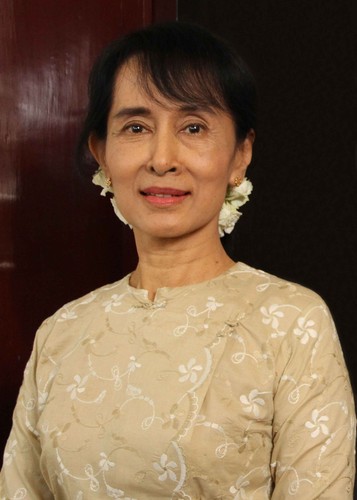
Aung San Suu Kyi
Personal Information
Description
There is no description yet, we will add it soon.
Books
Freedom from fear
"Aung San Suu Kyi, human-rights activist and leader of Burma's National League for Democracy, was detained in 1989 by SLORC, the ruling military junta. Today, she is newly liberated from six years' house arrest in Rangoon, where she was held as a prisoner of conscience, despite an overwhelming victory by her party in May 1990." "This collection of writings, now revised with substantial new material, including the text of the Nobel Peace Prize speech delivered by her son, reflects Aung San Suu Kyi's greatest hopes and fears for her people and her concern about the need for international cooperation, and gives poignant and humorous reminiscences as well as independent assessments of her role in politics. Containing speeches, letters and interviews, some of which are newly added, these writings give a voice to Burma's 'woman of destiny', who was awarded both the Sakharov Prize for Freedom of Thought and the 1991 Nobel Peace Prize."--Jacket.
Voix du défi
In Burma, while thousands of political prisoners are detained and tortured, and thousands more flee the country to escape poverty and forced labor, a woman of delicate appearance and fierce determination leads her nation's struggle for freedom. They chant her name, "Aung San Suu Kyi! Democracy!". Bringing this story to the world is Alan Clements, an American who spent five years in Rangoon as a Buddhist monk. Over a period of months Clements met with Aung San Suu Kyi at her home, shortly after her release from house arrest in July 1995. Their conversations became The Voice of Hope, Aung San Suu Kyi's first published work since her release. The Voice of Hope is a journey to the heart of her struggle. In response to perceptive and probing questions by Clements, she describes how she has managed to sustain her hope and optimism even when her husband and two sons are kept from her, and while so many of her followers and associates have been hurt or killed. What are the foundations of her strength? What is her understanding of the motivations of her enemy, the State Law and Order Restoration Council (SLORC)? How effective can nonviolence be in the modern world? In what ways does her Buddhism inspire her actions? How does she overcome feelings of resentment and vindictiveness? Why is the truth she speaks so threatening to her enemies? Does she envision her own death? Is there conflict between her Buddhist pursuits and her political ones? What are the limits of free speech? Is the struggle for freedom worth any sacrifice? In every case Aung San Suu Kyi's answers are honest, direct, unexpected, and rich. The Voice of Hope offers us a rare insight to an extraordinary life - along with the empathy and vision to serve also as a moral compass in our own lives.
Doʻ ʼOṅʻ Chanʻʺ Cu Kraññʻ (suiʹ ma hutʻ) ʼa me lā rā lamʻʺ mha ṅrimʻʺ khyamʻʺ reʺ panʻʺ tve ve khaiʹ tayʻ
Interview with Aung San Su Kyi and other famous politicians on political situation in Myanmar.
Let's visit Bhutan
An introduction to a tiny, beautiful Himalayan kingdom which has been little influenced by the modern world.
The voice of hope
Fully updated edition of the best collection of wide-ranging interviews with Aung Suu Kyi, the Nobel Peace Prize winner under house arrest in BurmaAung San Suu Kyi is known for her courageous stand for democracy and human rights inside Burma (now Myanmar). Forced to endure many years of house arrest by the military junta, she continues to act as a focus for change inside a country that is ruled by one of the most hard-line dictatorships in the world. Such is her determined action for the best interests of Burma that she was awarded the Nobel Peace Prize in 1991.In September 07, the Burmese monks led a powerful protest against their government, which was brutally put down. Yet, in the midst of their struggle, they still were encouraged by the sight of Aung San Suu Kyi, who is still imprisoned.One of the very few people she has trusted enough to take her message to the wider world is Alan Clements. The Voice of Hope is the result of the secret and dangerous meetings they had over several years, and offers unquestionably the most wide-ranging collection of her views on the political situation inside Burma, her non-violent approach to democracy and human rights, her Buddhist beliefs, her family, and how she keeps a sense of meaning and purpose under the most appalling conditions.Brand new material includes an inspiring discussion with U-Gambira, the leader of the All-Burma Monks Alliance, conducted after the 2007 uprising (he has since 'disappeared'). There is also an updated Chronology of Events of recent Burmese history, a new Introduction and a new list of Burma-related websites.
Praññʻ sū khyacʻ so Doʻ ʼOṅʻ Chanʻʺ Cu Kraññʻ
Collected speeches and writings of Aung San Suu Kyi, a famous opposition politician of Myanmar.
Letters from Burma
For the last fiftenn years of Burma's traumatic history, Aung San Suu Kyi has been the inspirational leader of attempts to restore democracy to her country. In these fifty-two pieces she paints a vivid, poignant yet fundamentally optimistic picture of her native land. She evokes the country's seasons and scenery, customs and festivities, and describes an inspirational pilgrimage to the Buddhist abbot of Thamanya. She celebrates the courageous army officers, academics and actors who have supported the National League for Democracy, often at great personal risk, and she sets out a comprehensive programme for economic reform. A passionate advocate of better health care and education, and the need for ethical foreign investment in Burma's future, Aung San Suu Kyi reveals an acute insight into the impact of political decisions on ordinary people's lives. She examines the terrible traumas inflicted on children of imprisoned dissidents - children allowed to see their parents for fifteen minutes every fortnight - the effect of inflation on the national diet and of state repression on traditions of hospitality. One woman's vision, humanity and commitment to political and ethnic harmony won her party an overwhelming victory in the elections of May 1990; every facet of her personality is powerfully displayed here.
Let's visitNepal
Describes the geography, history, people, and customs of Nepal.
Experiments with Truth
Introduces and explores the resonance of Mohandas Gandhi's (1869-1948) ethics of nonviolence in the visual arts. Taking the form of a reader, the texts range across influences on Gandhian philosophy and outgrowths from it. The accompanying images include Gandhi's own iconography, photojournalism of related social movements and nonviolent struggles, artworks speaking to violence or issuing from an inner space of peace, and portraits of the Mahatma's forebears and followers. Experiments with Truth counterpoints art and ideas: religious art of the past, paintings and sculpture from the mid-20th century on, contemporary installations, newly written historical summaries and thematic explorations, reprints of texts by famous peacemakers, and passages in religious texts that inspired Gandhi.
Let's visit Burma
Describes the geography, history, people, and customs of Burma.
Doʻ ʼOṅʻ Chanʻʺ Cu Kraññʻ e* krāʺ phratʻ rveʺ kokʻ pvai samuiṅʻʺ vaṅʻ kha rīʺ cañʻ myāʺ
Interview with Aung San Suu Kyi on her political campaign in Myanmar.