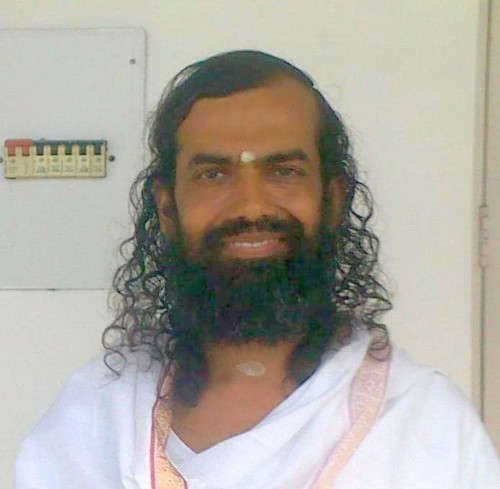
Ashwini Kumar Aggarwal
Personal Information
Description
Ashwini is with the Sri Sri Ravi Shankar Ashram, based in Punjab. He loves to practise Yoga and perform Homa. And enjoys cheery homeliness.
Books
Bhagavad Gita Dhyana Yoga
Sanskrit is the mother lode of Scriptures. It is the storehouse of all that is benign and worthwhile. Most of us are however not in a position to unlock the power and efficacy of our ancient heritage, being out of touch with this Divine Language. The Srimad Bhagavad Gita is a scripture of enduring and all-encompassing munificence. Anyone, in this entire planet has and can benefit from just a few verses from the Bhagavad Gita. This book is an attempt to unlock the Sanskrit in the Gita, using lucid commentary in English and grammatical analysis of verses in Devanagari. The 6th chapter is unique. It is the Yoga of Self-Control. It portrays the Yoga of Meditation i.e. Dhyana. A free-flowing Hindi and English essential meaning of verses makes the book useful for all. Well formatted Dhatu, Word and Pada Indexes make this edition a useful work for scholars and academicians worldwide.
Bhagavad Gītā
Rudra Puja - Simple Complete Profound
Rudra Puja has been practised in India since the beginning of time. Shiva means Auspicious. Rudra is a synonym for Shiva that means ‘Destroyer of Evil'. Puja means that which is born of fullness. The Vedic scriptures hail the Rudram chants as a method to remove sufferings, attain desires and bestow all round prosperity in one’s village. This book presents the complete Rudra Puja abhisheka procedure in Sanskrit using clear Devanagari font. Headings are given in English for the reader to follow the text properly. The Rudram for SOUTH INDIAN Krishna Yajur Veda and Rudrashtadhyayi for NORTH INDIAN Shukla Yajur Veda are both given in separate sections with correct Vedic Accents. Additionally, the Devanagari Latin Transliteration is given for the South Indian version for English readers all across the globe. A copious Appendix gives the Devanagari Alphabet, Pronunciation Key, and some famous Shiva Shlokas. The book is a useful guide to the Shodopacara Puja method followed in Indian Temples. It is a handy companion for devotees seeking to delve into the Sanskrit Chants. Will surely serve as a Reference Manual even for established Pandits and Scholars.
Bhagavad Gita for Chanting
A definitive guide to help a reader recite the Bhagavad Gita. Designed with this sole purpose, correct chanting of the Verses. Each verse of the Bhagavad Gita is written in 4 padas (four quarters), with pauses in the correct places. Grammatically sound and using the rules of Sandhi, Conjuncts, Samasas. Chanting correctly is the first and foremost step to enter the profound world of wisdom. Appeals to readers of all generations and backgrounds, because the introduction is in English. The verses are in Sanskrit, using beautiful, clearset Devanagari font.
Bhagavad Gita Reader
For ease in reading the Sanskrit Verses of the Bhagavad Gita. Each verse of the Anushtup Chhanda is given in 4 padas (four quarters) A Gita edition written for reading aloud that has been not been available so far ! Fulfills this lack.
Ishavasya Upanishad
Upanishads are verses from the Vedas that have been compiled as independent and complete sets. Those verses in the Vedas that amplify the greatness of man, his soul’s journey, and his ultimate purpose are termed as Upanishads. Traditionally the verses in each Veda have been classified as Mantra portion or Brahmana portion. Mantra verses are action oriented. Brahmana verses are thinking oriented. Within the Brahmana portion, a further sub-classification of verses has been done, namely Brahmana-Aranyaka-Upanishad. Technically Brahmana means planning, discussion and analysis. Aranyaka means research and philosophy. Upanishad means essential thought or teaching or guiding principle. Upanishad verses are those that are found at the end. Thus aptly named Vedanta. Literal meaning ending-portion of the Veda. Spiritual connotation core-design-crux-essence. Ishavasya Upanishad constitutes the final chapter (4oth adhyāya) of the Shukla Yajurveda from verse 1959 onwards, and survives in two recensions, named Kanva and Madhyandina. This book contains a lucid essence of these precious verses for the modern reader. It has a Sanskrit Grammar section where padachheda and anvaya with case-vibhakti of each word is clearly given.
Narada Bhakti Sutra
Bhakti is a very special attitude. It is a rare kind of lifestyle. It requires tremendous guts, large-heartedness and purity of vision. Narada was an adventurer from long ago, who exemplified the qualities of a Bhakta. We have heard the famous quote – Beauty lies in the eyes of the Beholder. This is what Narada lived. To him each and every one was divine, so he extended his hand to the cruelest sinner and to the most benevolent king. He went out of his way to have a dialogue with serpents and goblins - braving harsh mountains and rough weathers - demons and despots, commoners, officers, soldiers, saints and children. Narada exuded such warmth and caring, he brought such innocence and spontaneity in his wake, that he not only infused his surroundings with vitality, but also imparted a measure of grace. This is the story of the values he lived, that an ancient sage penned down. It has come down to us as priceless nuggets evoking awe and inspiration. It has the charm of taking us on a journey to freedom. For the students of Sanskrit grammar, copious notes giving the case of each word have been clearly listed.
Srimad Bhagavad Gita Recitation
A handy Pocket Book Gita for personal use and travel. Lists all the 700 verses of the Bhagavad Gita in Sanskrit using clearset Devanagari font. Highlights of this edition are: Pocket size 118 pages, 4.2 x 6.8 inch. Each verse is in 4 padas (four quarters) for ease in Recital. The pauses are correctly marked using Sanskrit Grammar rules of Panini. The spellings are accurate with correct split at Sandhi & Conjunct, and no-split at Samasa. Font size and readability is excellent for this size of a book.