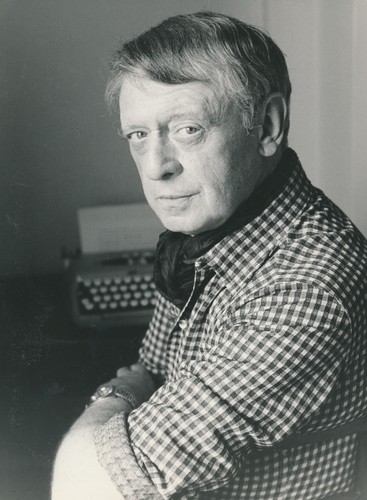
Anthony Burgess
Description
John Anthony Burgess Wilson, who published under the name Anthony Burgess, was an English writer and composer. Although Burgess was primarily a comic writer, his dystopian satire A Clockwork Orange remains his best-known novel. In 1971, it was adapted into a controversial film by Stanley Kubrick, which Burgess said was chiefly responsible for the popularity of the book. Burgess produced numerous other novels, including the Enderby quartet, and Earthly Powers. He wrote librettos and screenplays, including the 1977 television mini-series Jesus of Nazareth. He worked as a literary critic for several publications, including The Observer and The Guardian, and wrote studies of classic writers, notably James Joyce. A versatile linguist, Burgess lectured in phonetics, and translated Cyrano de Bergerac, Oedipus Rex, and the opera Carmen, among others. Burgess also composed over 250 musical works; he considered himself as much a composer as an author, although he achieved considerably more success in writing.
Books
Earthly Powers
Anthony Burgess has long been regarded as one of the most original and daring writers of our time. In Earthly Powers, Burgess has writtena book rich with astonishing powers and surprising events.
Black prince
"The Black Prince is a brutal historical tale of chivalry, religious belief, obsession, siege and bloody warfare. From disorientating depictions of medieval battles to court intrigues and betrayals, the campaigns of Edward III, the Black Prince, are brought to vivid life. This rambunctious novel, based on a completed screenplay and the notes for an unfinished novel by Anthony Burgess and approved by the Burgess estate, showcases Adam Roberts in complete control of the novel as a way of making us look at history with fresh eyes, all while staying true to the linguistic pyrotechnics and narrative verve of Burgess's best work."--Dust jacket flap
Revolutionary Sonnets and Other Poems
Revolutionary Sonnets explores themes of violence and love, pretensions and emotion, sex and war and is both sobering and funny.
One Man's Chorus
A genuine master of the mot and the anecdote, Burgess rarely fails to amuse in this generous selection of essays on topics as various as oranges (not only of the clockwork variety), Marilyn Monroe, God, and Yiddish humor (his favorite one-liner, the Jewish matron's response to her son's psychiatrist: "Oedipus Schmoedipus - what's it matter so long as he loves his mother?"). In other of these candid and sometimes cantankerous pieces written over the past two decades Burgess revisits his youth in Manchester, reconsiders his experiences among British colonials in Malaysia, and reevaluates his literary exile in Monaco. He examines his craft, he carps at critics, he reflects upon literature and litterateurs, from such twentieth-century giants as James Joyce, T. S. Eliot, and Virginia Woolf to the eccentric Sitwells to fellow novelists Evelyn Waugh and Graham Greene
Honey for the Bears
On a trip to Leningrad, English antique dealer Paul Hussey finds it more difficult than he expected to sell twenty dozen dresses on the black market. Meanwhile his wife Belinda, who is coming to terms with her latent lesbianism, has disappeared into a Soviet hospital.
Byrne
When Anthony Burgess died in 1993 he left the complete "Byrne," a novel in epic verse. This is the first American publication. Byrne tells the astonishing story of an Irish artist who, in the early years of this century, goes rapidly to the bad, bedding and abandoning women everywhere, debasing his talents as a composer and painter, and finally ending up within Hitler's Third Reich, at which point he vanishes. After his disappearance, the story passes to his twin sons, one a doubting priest, the other suffering from a debilitating disease, who move across the troubled face of contemporary Europe before encountering their father in one final apocalyptic confrontation.
A Dead Man in Deptford
The whole of Elizabethan England--from the court and its intrigue to the theatre and its genius to London and its slums--is brilliantly recreated in this joyous celebration of the life of Christopher Marlowe, killed in highly suspicious circumstances in a tavern brawl in Deptford hundreds of years ago.
A Mouthful of Air
Yeats once wrote of a poem, saying he had made it out of a mouthful of air. Burgess advances this point by presenting a fascinating survey of language--how it operates, and how it will develop in the future--that ranges from Shakespearean pronunciation to the place of English in the world family of languages.
On Mozart
The author uses an imaginary conversation to pay tribute to Mozart on the bicentennial of his death, describing his contributions to the Enlightenment, discussing the phenomenon of a prodigy, and speculating as to future works Mozart might have written
You've Had Your Time
The second volume of the two-volume autobiography. The narrative begins in 1959, with the author’s return from Brunei and the start of a professional writing career and ends in 1982 with the centenary celebrations of James Joyce’s birth, which prompt the author to certain conclusions about the relationship between literature and life. Rarely, if ever, has a writer exposed his inner life so completely and with such vigour, humour and linguistic verve.
The devil's mode
In this collection of short stories, the reader encounters Shakespeare, on tour in Spain in discussion with Cervantes; Attila the Hun preparing to devastate Rome; Debussy visiting the Rosetti's and meeting Mallarme; Sherlock Holmes solving a symphonic crime and much more.
The Pianoplayers
This novel is one of Anthony Burgess's most accessible and entertaining works. By turns bawdy, raucous, tender and bittersweet, and full of music and songs, this is a warm and affectionate portrait of the working-class Lancashire of the 1920s and 1930s that he knew from his own early life. The Pianoplayers is a funny, moving, autobiographical novel that brings to life the world of silent cinemas and music-halls of 1920s Manchester and Blackpool. Fully annotated and with a new introduction, this is an authoritative text for a new generation of readers. Part of the forthcoming Irwell Edition of the Works of Anthony Burgess, this book offers an opportunity to reappraise an unjustly neglected novel important to our understanding of Burgess's wider oeuvre. The 2017 Burgess centenary makes this a key moment for reflection on the life and work of a major figure in twentieth century letters.
Little Wilson and Big God
Bound in the publisher's original quarter cloth and paper covered boards with the spine stamped in gilt.
Flame Into Being
Traces the life of the English author, D.H. Lawrence, and examines the development of his fiction and poetry