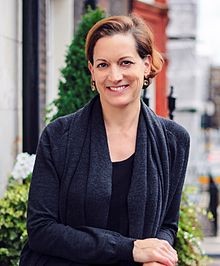
Anne Applebaum
Personal Information
Description
Anne Elizabeth Applebaum (born July 25, 1964) is an American and naturalized-Polish journalist and historian. She has written extensively about the history of Communism and the development of civil society in Central and Eastern Europe.
Books
Between East and West
An extraordinary journey into the past and present of the lands east of Poland and west of Russia - an area defined throughout its history by colliding empires, and only now emerging from the clamp of Soviet rule. Traveling from the former Soviet naval center of Kaliningrad on the Baltic to the Black Sea port of Odessa, Anne Applebaum encounters a rich range of competing cultures, religions, and national aspirations as inhabitants of the borderlands attempt to build a future grounded in their ancestral legacies. In reasserting their heritage, neighbors often unearth old conflicts: in Vilnius, a Lithuanian professor charts a historical conspiracy against his language by the Poles, while his Polish neighbors rail against the Lithuanian determination to deny their ancient claims to the city. In Minsk, a young "post-modernist" couple, seeking a rallying point for Belarusian nationalism, piece together cultures and legends to create tradition where none is remembered, while another resident of the city devotes himself to recovering the Jewish culture that once predominated. Rich in surprising encounters and vivid characters, Between East and West brilliantly illuminates the soul of the borderlands and the shaping power of the past.
Iron Curtain
In the follow-up to her previous book "Gulag," the author, a journalist delivers a history of how Communism took over Eastern Europe after World War II and transformed in frightening fashion the individuals who came under its sway. At the end of World War II, the Soviet Union, to its surprise and delight, found itself in control of a huge swath of territory in Eastern Europe. Josef Stalin and his secret police set out to convert a dozen radically different countries to Communism, a completely new political and moral system. In this book, the author describes how the Communist regimes of Eastern Europe were created and what daily life was like once they were complete. She draws on newly opened East European archives, interviews, and personal accounts translated for the first time to portray in detail the dilemmas faced by millions of individuals trying to adjust to a way of life that challenged their every belief and took away everything they had accumulated. Today the Soviet Bloc is a lost civilization, one whose cruelty, paranoia, bizarre morality, and strange aesthetics is captured in the pages of this book.
Twilight of Democracy
The Pulitzer Prize–winning historian explains, with electrifying clarity, why elites in democracies around the world are turning toward nationalism and authoritarianism. From the United States and Britain to continental Europe and beyond, liberal democracy is under siege, while authoritarianism is on the rise. In Twilight of Democracy, Anne Applebaum, an award-winning historian of Soviet atrocities who was one of the first American journalists to raise an alarm about antidemocratic trends in the West, explains the lure of nationalism and autocracy. In this captivating essay, she contends that political systems with radically simple beliefs are inherently appealing, especially when they benefit the loyal to the exclusion of everyone else. Elegantly written and urgently argued, Twilight of Democracy is a brilliant dissection of a world-shaking shift and a stirring glimpse of the road back to democratic values.
From A Polish Country House Kitchen 90 Recipes For The Ultimate Comfort Food
With more than 150 splendid photographs, headnotes that illuminate Poland's vibrant food culture, and more than 90 recipes for classic and contemporary Polish food, this unique and fascinating cookbook brings an ignored cuisine to light. Pulitzer Prize-winner Anne Applebaum has lived in Poland since before the fall of communism, and this cookbook--nourished by her engagement with the culture and food of her adopted country--offers a tantalizing look into the turbulent history of this beautiful region. In a Polish Country House Kitchen celebrates long-distance friendships with a love of food at the core, bringing the good, sustaining foods of Anne's Polish country home into kitchens the world over.
Gulag Voices
Collects the writings of a diverse group of people who survived imprisonment in the Gulag, recounting their experiences and relationships, and offering insight into the psychological aspects of life in the camps.
World Monuments
A stunning tour of 50 of the world s most extraordinary destinations selected from the World Monuments Fund s most important sites of global heritage.
Red Famine
In 1929 Stalin launched his policy of agricultural collectivization—in effect a second Russian revolution—which forced millions of peasants off their land and onto collective farms. The result was a catastrophic famine, the most lethal in European history. At least five million people died between 1931 and 1933 in the USSR. But instead of sending relief the Soviet state made use of the catastrophe to rid itself of a political problem. In Red Famine, Anne Applebaum argues that more than three million of those dead were Ukrainians who perished not because they were accidental victims of a bad policy but because the state deliberately set out to kill them. Applebaum proves what has long been suspected: after a series of rebellions unsettled the province, Stalin set out to destroy the Ukrainian peasantry. The state sealed the republic’s borders and seized all available food. Starvation set in rapidly, and people ate anything: grass, tree bark, dogs, corpses. In some cases, they killed one another for food. Devastating and definitive, Red Famine captures the horror of ordinary people struggling to survive extraordinary evil. Today, Russia, the successor to the Soviet Union, has placed Ukrainian independence in its sights once more. Applebaum’s compulsively readable narrative recalls one of the worst crimes of the twentieth century, and shows how it may foreshadow a new threat to the political order in the twenty-first.