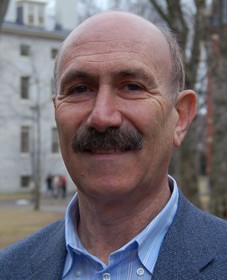
Amir D. Aczel
Personal Information
Description
Amir Dan Aczel was an Israeli-born American lecturer and author of popular books on mathematics and science.
Books
Descartes' secret notebook
A portrait of the great 17th century philosopher and mathematician looks at the contributions of Rene Descartes. His interest in mysticism and probable membership in the occult brotherhood of Rosicrucians, and his secret notebook, which he kept in code, attempting to redecipher the contents of the long lost volume. Rene Descartes (1596-1650) is one of the towering and central figures in Western philosophy and mathematics. His apothegm "Cogito, ergo sum" marked the birth of the mind body problem, while his creation of so-called Cartesian coordinates has made our intellectual conquest of physical space possible. But Descartes had a mysterious and mystical side, as well. After Descartes' death, Gottfried Leibniz, inventor of calculus and one of the greatest mathematicians of all time, moved to Paris in search of this notebook and eventually found it in the possession of Claude Clerselier, a friend of Descartes'. Liebniz called on Clerselier and was allowed to copy only a couple of pages, which, though written in code, he amazingly deciphered there on the spot. Liebniz's hastily scribbled notes are all we have today of Descartes' notebook. Why did Descartes keep a secret notebook, and what were its contents? The answers to these questions will lead the reader on an exciting, swashbuckling journey, and offer a fascinating look at one of the great figures of Western culture.
Descartes's Secret Notebook
Rene Descartes (1596--1650) is one of the towering and central figures in Western philosophy and mathematics. His apothegm "Cogito, ergo sum" marked the birth of the mind-body problem, while his creation of so-called Cartesian coordinates has made our intellectual conquest of physical space possible.But Descartes had a mysterious and mystical side, as well. Almost certainly a member of the occult brotherhood of the Rosicrucians, he kept a secret notebook, now lost, most of which was written in code. After Descartes's death, Gottfried Leibniz, inventor of calculus and one of the greatest mathematicians of all time, moved to Paris in search of this notebook--and eventually found it in the possession of Claude Clerselier, a friend of Descartes's. Liebniz called on Clerselier and was allowed to copy only a couple of pages--which, though written in code, he amazingly deciphered there on the spot. Liebniz's hastily scribbled notes are all we have today of Descartes's notebook.Why did Descartes keep a secret notebook, and what were its contents? The answers to these questions will lead the reader on an exciting, swashbuckling journey, and offer a fascinating look at one of the great figures of Western culture.From the Hardcover edition.
Entanglement
"Serious scientists, working off of theories, first developed by Einstein and his colleagues seventy years ago, have been investigating the phenomenon known as "entanglement," one of the strangest aspects of the strange universe of quantum mechanics.". "According to Einstein, quantum theory required entanglement - the idea that subatomic particles could become inextricably linked, and that a change to one such particle would instantly be reflected in its counterpart even if a universe separated them. Einstein felt that if the quantum theory could produce such incredibly bizarre effects then it had to be invalid. But new experiments in both the United States and Europe show not only that it does happen, but that it may lead to unbreakable codes and even teleportation."--BOOK JACKET.
The Riddle of the Compass
A fascinating account that takes us from ancient China to renaissance Italy to everywhere today, by the bestselling author of Fermat's Last Theorem. Annotation. Bestselling science writer Amir Aczel uncovers the fascinating story of the invention of the compass and its impact on the world. Amir D. Aczel, the distinguished science writer, turns detective as he uncovers the fascinating story of the invention of the compass. It's a fabulous tale of Chinese lodestones directing the building of palaces and ancient mariners following the flights of birds to reach their destinations. The arrival of the compass in Europe and an understanding of its potential revolutionized trade in the Mediterranean and ushered in the great Age of Exploration. Tracking down the roots of the compass and telling the story of navigation through the ages, Aczel instructs and charms as never before. Amir Aczel is known for his ability to write delightful books about hard topics in math and science. And this is the book he was born to write. Raised on ocean liners by his ship's captain father, the young Aczel stood at the helm and steered ships through the Mediterranean. His experience adds depth and resonance to the telling of this terrific story.
Probability 1
Is there intelligent life in the universe? Could the people who have believed in it for centuries be right? People who put their faith in science are puzzled. And now they have a definitive answer. Probability 1 answers this question with a resounding Yes, there must be intelligent life in the universe. Amir Aczel, mathematician and author of the beloved Fermat's Last Theorem, proves the point with a combination of science and math. Aczel shows how the history of space discovery and probability theory come together to prove that we are not alone in the universe. Interplanetary travel for the armchair scientist, Probability 1 offers a rational take on the issue for the skeptic and the true believer alike.
Fermat's Last Theorem
xn + yn = zn, where n represents 3, 4, 5, ...no solution "I have discovered a truly marvelous demonstration of this proposition which this margin is too narrow to contain." With these words, the seventeenth-century French mathematician Pierre de Fermat threw down the gauntlet to future generations. What came to be known as Fermat's Last Theorem looked simple; proving it, however, became the Holy Grail of mathematics, baffling its finest minds for more than 350 years. In Fermat's Enigma--based on the author's award-winning documentary film, which aired on PBS's "Nova"--Simon Singh tells the astonishingly entertaining story of the pursuit of that grail, and the lives that were devoted to, sacrificed for, and saved by it. Here is a mesmerizing tale of heartbreak and mastery that will forever change your feelings about mathematics.
A strange wilderness
"Bestselling popular science author Amir Aczel selects the most fascinating individuals and stories in the history of mathematics, presenting a colorful narrative that explores the quirky personalities behind some of the most profound, enduring theorems. Through such mathematical geniuses as Archimedes, Leonardo of Pisa (a.k.a. Fibonacci), Tartaglia ("the stutterer"), Descartes, Gottfried Liebniz, Carl Gauss, Joseph Fourier (Napoleon's mathematician), Evariste Galois, Georg Cantor, Ramanujan, and "Nicholas Bourbaki," we gather little known details about the alliances and rivalries that profoundly impacted the development of what the scheming doctor-turned-mathematician Geronimo Cardano called "The Great Art." This story of mathematics is not your dry "college textbook" account; tales of duels, battlefield heroism, flamboyant arrogance, pranks, secret societies, imprisonment, feuds, theft, and even some fatal errors of judgment fill these pages (clearly, genius doesn't guarantee street smarts). Ultimately, readers will come away from this book entertained, with a newfound appreciation of the tenacity, complexity, eccentricity, and brilliance of the mathematical genius"--
Present at the Creation
"As autobiography (this book) is enthralling, as history indispensable, as a manual on government and diplomacy invaluable". -- Wallace Carroll, New York Times Book Review.
The Jesuit and the Skull
From the New York Times bestselling author of Fermat's Last Theorem, "an extraordinary story"( Philadelphia Inquirer) of discovery, evolution, science, and faith.In 1929, French Jesuit priest Pierre Teilhard de Chardin was a part of a group of scientists that uncovered a skull that became known as Peking Man, a key evolutionary link that left Teilhard torn between science and his ancient faith, and would leave him ostracized by his beloved Catholic Church. His struggle is at the heart of The Jesuit and the Skull, which takes readers across continents and cultures in a fascinating exploration of one of the twentieth century's most important discoveries, and one of the world's most provocative pieces of evidence in the roiling debate between creationism and evolution.