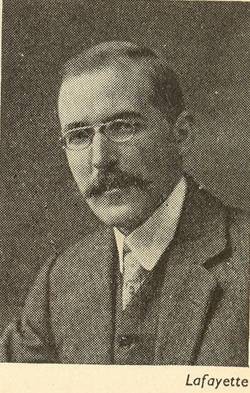
Alfred Walter Stewart
Personal Information
Description
Alfred Walter Stewart (5 September 1880 – 1 July 1947) was a Scottish chemist, academic, and part-time novelist who wrote seventeen detective novels and a pioneering science fiction work between 1923 and 1947 under the pseudonym of J. J. Connington. He created several fictional detectives, including Superintendent Ross and Chief Constable Sir Clinton Driffield. [Wikipedia] He was born in Glasgow and educated at the universities of Glasgow, Marburg, and London. He was Professor of Chemistry from 1919 to 1944 at Queen's University, Belfast, and author of a number of respected treatises on chemistry. As J. J. Connington, he wrote over twenty detective stories, beginning with Death at Swaythling Court (1926), in which the investigation is usually carried out either by Superintendent Ross (The Eye in the Museum, 1929; The Two Tickets Puzzle, 1930) or, more often, by Chief Constable Sir Clinton Driffield (Murder in the Maze, 1927; The Sweepstake Murders, 1931). As Connington he also published an unusual science fiction novel, Nordenholt's Millions (1923). - from
Books
The Two Tickets Puzzle
Superintendent Ross Mystery series #2 When Oswald F. Preston is shot dead on the 10.35 local train from Horston, two obvious suspects are immediately in the frame: his wife's lover and an employer with a grudge. With red herrings a-plenty, and a number of other contenders for murderer, including a young heiress, Superintendant Ross has his work cut out for him. This is a classic "fair play" mystery that will be enjoyed by every reader who wants to pit their wits against the detective. - from fictiondb.com
The Twenty-One Clues
The constable was content to call it a suicide pact. All the evidence was there. The bodies of John Barratt and Mrs Callis were discovered in a lovers' nook among some bracken. Beside them was a pistol with Barratt's fingerprints on it, and torn up letters in the handwriting of Barratt and Mrs Callis were scattered around. Arrangements for the elopement had apparently been complete. Why had their plans fallen through? Why had they turned their backs on the railway station with tickets to London in their pockets? Sir Clinton Driffield is not so sure that the obvious solution is the right one....
A Minor Operation
Sir Clinton Driffield Mystery series #11 There was blood on the drawing-room floor and Hazel Deerhurst had disappeared wearing slippers over walking shoes, two pairs of stockings and a bright silk kimono. First investigations shed interesting light on Hazel. A mysterious machine is found at her home, some paintings and a cryptic telegram. She was also secretary to a man whose secrets involved the future of the empire. Is she victim or villainess?
The Castleford Conundrum
Sir Clinton Driffield Mystery series #8 Philip Castleford was more than worried. Were all those years he had spent attending to Winifred's whims, enduring her habits, to count for nothing? He hadn't minded it too much for he thought that his daughter Hilary would have security - but now he found her shabbily treated and his own position undermined by his wife's grasping brothers.
Mystery at Lynden Sands
Sir Clinton Driffield Mystery series #4 In the fourth Sir Clinton Driffield mystery, the detective finds himself up against a missing heir, an accidental bigamist, a series of secret marriages and impersonations and an ingenious scientific murder. Aided by his wit and powers of reasoning, as well as Wendover, his very own Watson, Sir Clinton once again succeeds in piecing together a solution as the novel reaches its thrilling climax. - from fantasticfiction.com
The Dangerfield Talisman
In the first place there was the Dangerfield Talisman, an ancient golden armlet set with diamonds and valued at $50,000 - an unguarded treasure, which, although stolen more than once, always came back. Second was the Dangerfield Secret. The last thief of the talisman has been found on the lawn of Old Rollo Dangerfield's home, dead of a heart attack. And in unearthing the mystery a whole series of bewildering complications unfolds ...
Truth Comes Limping
Sir Clinton Driffield Mystery series #13 Clinton Driffield, hardened solver of many a knotty problem, was playing chess with his old friend, Wendover, when their game was interrupted by the news that a dead man had been found in a lane near by. It turned out to be the body of a hack journalist with a reputation for always being hard-up and for writing a particularly revealing type of biography. When a hundred pounds in notes was found near the body, blackmail was naturally suggested, and the tracing of the money back to an unpopular local land-owner, whose family had many a skeleton in the cupboard, pointed strongly to murder. Until death struck again....
In Whose Dim Shadow
Sir Clinton Driffield Mystery series #10 Also published as The Tau Cross Mystery In this, the tenth Clinton Driffield mystery, the action moves away from a country setting to the English suburbs, inhabited by a cast of unusual diversity: an ambitious young policeman, a naive journalist, an elderly clerk with dreams of foreign travel and an unhappily married Frenchwoman. This meticulously clued mystery shows Connington at his compelling best and ends with a satisfying flourish.
The Boat-House Riddle
Sir Clinton Driffield Mystery series #6 When Chief Constable Sir Clinton Driffield goes to stay with his friend Wendover, mysterious goings-on in the boathouse he owns soon attract the duo's attention. Lights go on and off, strangers come in and out, and a game warden is found murdered nearby. And as they work to solve the crime, a second body is dredged up from the lake.
Nemesis at Raynham Parva
Sir Clinton Driffield Mystery series #5 Nemesis at Raynham Parva published in the U.S. as Grim Vengeance From the dustjacket of the first edition: "Two murders at night, both the victims foreigners; and when Sir Clinton Driffield, visiting his sister, is forced to suspect the South American whom his niece has just married, he finds himself faced with a problem in morals and psychology. Finally, a third murder takes place, this one in the house of Sir Clinton's sister, and in broad daylight. Suspicion naturally falls on a young man who is found standing beside the body with a pistol in his hand; but Sir Clinton clears him, only to find that his own niece is the next suspect. In the course of the narrative, all the evidence known to the police (and even a little more) is supplied to the reader as it comes to light; but it is safe to say that the final development of the plot will be wholly unexpected."
Tom Tiddler's Island
Published in the U.S. as Gold Brick Island A young couple, the Trents, arrive on the lonely islet of Ruffa - where a large house has been lent to them for part of their honeymoon - and stumble upon mystery. Gold is being exported from Ruffa in quantity. Where does it come from? From the Armada wreck in the bay? Or from some old Norseman's hoard like the Traprain Law treasure? Or has the other tenant discovered the secret of making gold? The Trents are set on a surprising course to find out ...
Nordenholt's Million
Famine sweeps across the world when a lab accident unleashes a virulent strain of bacteria that transforms healthy fields into barren wastelands. With the fate of the human race at stake, wealthy financier Stanley Nordenholt establishes a stronghold in central Scotland and assumes dictatorial powers to save what remains of the planet's starving population. This gripping tale of survival explores some of the moral dilemmas that arise in the wake of catastrophic events as well as their social, cultural, and political consequences. A precursor to the latter-day tales from the golden age of science fiction, this compelling novel was published by a noted British chemist in 1923. Acclaimed by the Encyclopedia of Science Fiction as "realistic, reasoned, sociologically observed, and credible," it offers an ever-relevant warning against the exploitation of disaster as a pretext for the suspension of freedom, democracy, and justice.
Alias J. J. Connington
When he wrote this book, the late Professor A. W. Stewart had already retired from academic life after a long career during which he held various University posts in London, Glasgow, and elsewhere. His chemical research work included, among many other matters, the discovery of the Tesla-luminescence spectra which opened up a new field in spectroscopy, and the recognition of the class of isobaric atoms to which uranium-239, neptunium, and plutonium belong. In addition to a series of books on advanced chemistry, he wrote--under the pseudonym J. J. Connington--a scientific thriller, Nordenholt's Million, a financial novel, and numerous detective stories. The present volume of essays shows yet another aspect of his work. From the author: "This is an 'escape' book, intended to divert the reader for a short time from the troubles which daily engross us. It deals with a number of topics: a murder mystery in real life; the germs of the plots of some well-known novels; the curious problem of the Dumbuck crannog; the psychological illusions produced by certain drugs; various methods of getting "easy money"; the value of an honest witness's evidence; the adventurous careers of the translators of the Arabian Nights; the discovery of the black swan; the rather gruesome history of a millionaire mystic; the Loch Arkaig treasure; the strange affair of the Long Man on Ben Macdhui; my own casual encounter with that curious phenomenon which goes by the name of the Loch Ness Monster; and other subjects as well. Part of the material comes from my experiences as a writer, a professor, a technical adviser, and a scientific researcher; but the reader may rely on the assurance that there is no likelihood of him finding himself out of his depth, even if he has no acquaintance with science. Other portions of the volume are the results of a life-long predilection for browsing off the beaten track in my reading. These parts, I hope, may act as finger-posts to direct my readers deeper into some fascinating fields which I have here treated cursorily for lack of elbow-room. My aim has been to provide a wide variety of topics, so that there may be 'something for everybody'; and I may fittingly conclude, in the words of an older writer: 'Choose that which pleaseth thee best. Not to detain thee longer, farewell; and when thou hast considered thy purchase, may'st thou say, that the price of it was but a charity to thyself, not ill spent.'"
Death at Swaythling Court
Hubbard made his money in blackmail, most detestable blackmail at that. A wealthy, lisping butterfly collector, there were no special regrets when he was found dead at his desk in his own home. Yet Colonel Sanderstead felt it his duty to probe the affair, since his nephew's best friends had very good reason to wish Hubbard dead. His investigation, as it turns out, would never have solved the case, but it leads to an amazing confession.
The Counsellor
Every Sunday on Radio Ardennes, the Counsellor had his hour. His voice clear, expressive, and sympathetic as it answered a selection of the queries that crowded his post-bag. 'Just ask a question' was his motto. But even he did not expect Wallace Whatgift to ask for his help in solving the mysterious disappearance of a young woman.
The Sweepstake Murders
Sir Clinton Driffield Mystery series #7 Nine men formed a sweepstake syndicate. One man died. To forestall legal argument they agreed that only living members should share any winnings. They won £241,920. And then the deadly arithmetic began. Nine less one left eight shares worth £30,240. Eight less one left seven shares worth £34,560. Seven less one left six shares worth £40,320. Six less one left five shares worth £48,384. Who was killing for profit? And who would be left to collect?