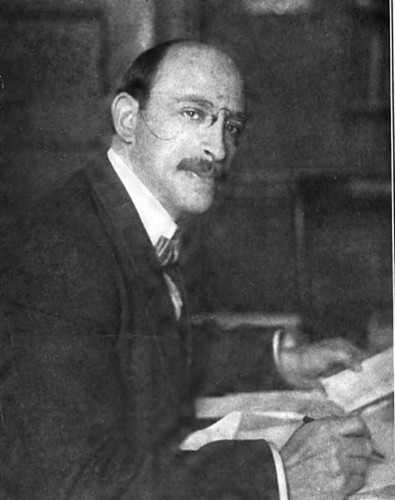
Alexander Berkman
Personal Information
Description
Russian-American anarchist and writer
Books
Now and After
Now and After: The ABC of Communist Anarchism is an introduction to the principles of anarchism and anarchist communism written by Alexander Berkman. First published in 1929 by Vanguard Press, Now and After has been reprinted many times, often in partial or abbreviated versions, under the titles What Is Communist Anarchism?, What Is Anarchism? or The ABC of Anarchism. (Source: [Wikipedia](
Trial and Speeches of Alexander Berkman and Emma Goldman in the United States District Court, in the City of New York, July, 1917
Prison Memoirs of an Anarchist
Prison Memoirs of an Anarchist is Alexander Berkman's account of his experience in prison in Western Penitentiary of Pennsylvania, in Pittsburgh, from 1892 to 1906. First published in 1912 by Emma Goldman's Mother Earth press, it has become a classic in autobiographical literature. ([Wikipedia](
The Bolshevik Myth
After being imprisoned in the Atlanta Federal Penitentiary for his role in opposing mandatory conscription following the U.S. entry into World War I, Alexander Berkman became one of 246 left-wing radicals (including his fellow anarchist and lover Emma Goldman) deported to Russia in December 1919 aboard the U.S.S. Buford. While initially an enthusiastic supporter of the revolutionary Bolshevik regime, Berkman’s travels throughout Russia and Ukraine led to increasing discomfort with the authoritarianism and corruption characteristic of Bolshevik rule. Eventually, the violent suppression of the Kronstadt rebellion completely broke his support for the Bolshevik regime, leading to his emigration from Russia. Berkman recorded his experiences in the years from 1920 to 1922 in a diary, which he reworked into The Bolshevik Myth. (While the book is presented as the original diary, archival research has shown that much of the original material from Berkman’s diary was rewritten.) Readers of The Bolshevik Myth may note considerable structural and topical similarities with Goldman’s more famous memoir on the Russian Revolution, My Disillusionment in Russia. Since Goldman and Berkman were deported from the U.S. together and traveled throughout Russia and Ukraine as part of the same committees and delegations, the two memoirs represent two different perspectives on effectively the same journey. This Standard Ebooks edition includes the final chapter of Berkman’s original manuscript, which was rejected by the publisher Boni & Liveright as a literary “anti-climax.” Berkman later published the final chapter, which provides a theoretical analysis on the Bolshevik regime from an anarchist perspective, separately under the title of “The Anti-Climax.”
What Is Anarchism?
"Writing in everyday language, using examples from everyday life, this book examines political events to create an interlocking and comprehensive assessment of what Anarchism is and how we might get there. It's a mixture of moral and practical argument that, despite its pedantic style at times, and some archaic language, has not been surpassed. It was the first attempt of an Anarchist to present his ideas in a thorough and cohesive way, ideas distilled from nearly forty years of activism. Berkman examines how change comes about - and, just as importantly for him, why it doesn't. Perhaps in a book filled with thoughtful and contentious points, the most salient discussion is why people continue to accept capitalism and all its institutions that oppress and repress individual freedom. For Berkman, human evolution was instinctively predicated on mutual aid and justice was a kind of instinctive sympathy that can only be hindered or corrupted by government. We start from there."--Jacket.
The tragic procession
Reprinted here for the first time, this collection of bulletins—edited through the years by Alexander Berkman, Mark Mratchny, Milly Witcop-Rocker, Rudolf Rocker, et al.—chronicle the gradual slaughter of a whole generation of Russian anarchists and revolutionists. They also illustrate the astonishing effort of small groups of radicals who, living often in appalling conditions themselves, attempted to both highlight the vicious reality of the Bolshevik government and alert a wider public to the awful situation its prisoners found themselves in. Imprisoned, tortured, driven mad, and exiled to places so remote no contact with the outside world was possible, the prisoners disappeared into a totalitarian darkness. Each recorded name or initial printed here signifes a life that often had been spent in revolutionary commitment, a life systematically and carefully destroyed by erstwhile “comrades.” To remember them is the least we can do.